










Snus vs nicotine pouches: key differences and safety
Many adult nicotine users assume snus and nicotine pouches are essentially the same product in different packaging. They are not. While both sit under your upper lip and deliver nicotine through the gum tissue, snus and nicotine pouches differ in content, health risks, and legality in ways that genuinely matter. If you are switching from smoking, moving away from vaping, or simply curious about your options, understanding these distinctions is the difference between making an informed choice and guessing. This guide breaks down everything you need to know.
Table of Contents
- What are snus and nicotine pouches?
- How are they made? Ingredients and production processes explained
- Nicotine delivery and strength: what users should know
- Safety and health: TSNA levels, gum health, and cancer risk
- Legal status and availability in the UK and EU
- Making your choice: which is right for you?
- Find your perfect nicotine pouch with HitSnus
- Frequently asked questions
Key Takeaways
| Point | Details |
|---|---|
| Snus vs pouches defined | Snus contains tobacco, while nicotine pouches are completely tobacco-free but provide similar nicotine effects. |
| Safety and health | Both reduce risk compared to smoking; pouches are TSNA-free and less likely to cause oral issues. |
| Nicotine delivery | Nicotine pouches in higher strengths can match or surpass snus for experienced users. |
| Legal differences | Snus remains banned in the UK and EU (outside Sweden); pouches are legal and widely available. |
| Choosing the right product | Your decision should weigh health, legality, and personal preferences. |
What are snus and nicotine pouches?
Before comparing them, it helps to know exactly what each product is. Snus is a moist oral tobacco product originating from Sweden. It is made from ground, pasteurised tobacco and placed under the upper lip, where nicotine absorbs through the gum. It has been used in Scandinavia for centuries and remains deeply embedded in Swedish culture.
Nicotine pouches are a more recent innovation. They contain no tobacco whatsoever. Instead, nicotine pouches use plant fibres as a base, infused with purified or synthetic nicotine, flavourings, and pH adjusters. The delivery mechanism is similar, but the contents are fundamentally different. If you want to get familiar with the language around these products, our guide to nicotine pouch terminology is a solid starting point.
| Feature | Snus | Nicotine pouches |
|---|---|---|
| Contains tobacco | Yes | No |
| Base material | Ground tobacco | Plant fibre |
| Nicotine source | Natural (tobacco) | Purified or synthetic |
| Flavourings | Limited | Wide variety |
| Legal in UK | No | Yes |
| TSNAs present | Yes | Undetectable |
The table above makes the core contrast clear. Pouches can replicate the nicotine delivery of snus without the tobacco content, which has significant implications for both health and legality.
How are they made? Ingredients and production processes explained
Understanding the production process reveals why these two products behave so differently in terms of safety. Snus manufacturing involves steam pasteurisation of ground tobacco, water, and salt. This process takes weeks and is designed to reduce harmful compounds. Nicotine pouches, by contrast, mix purified nicotine with plant fibres and other ingredients, with no tobacco processing involved at all.
The key safety concern in snus is tobacco-specific nitrosamines, known as TSNAs. These are carcinogenic compounds that form naturally in tobacco. Pasteurisation lasts 4 to 6 weeks and reduces TSNA levels, but does not eliminate them. Snus still contains TSNAs at around 2.8 micrograms per gram. In nicotine pouches, TSNAs are completely undetectable.
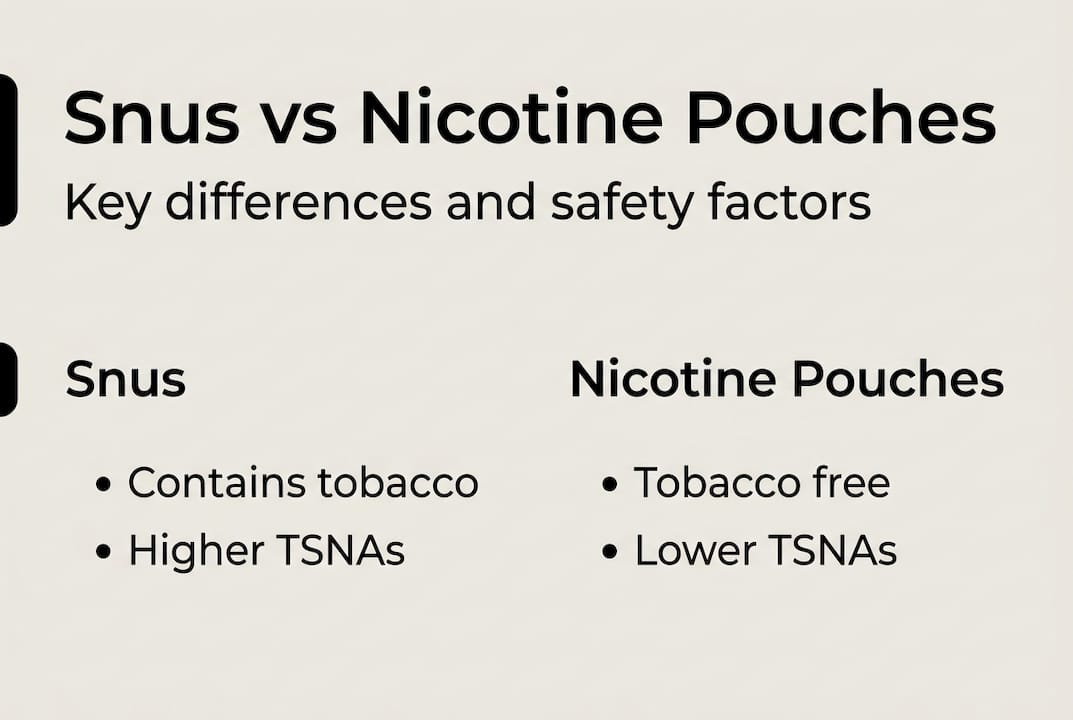
Here is what goes into each product:
Snus ingredients:
- Ground tobacco
- Water
- Salt
- Humectants (to retain moisture)
- Flavourings (limited range)
Nicotine pouch ingredients:
- Plant-based fibre (often eucalyptus or pine)
- Purified or synthetic nicotine
- pH adjusters (to aid absorption)
- Flavourings (extensive range)
- Fillers and stabilisers
Pro Tip: If you are sensitive to tobacco compounds or want to avoid TSNAs entirely, nicotine pouches are the cleaner option from a manufacturing standpoint. Our article on how nicotine pouches are made goes deeper into the production process if you want the full picture.
Nicotine delivery and strength: what users should know
Both snus and nicotine pouches deliver nicotine through the oral mucosa, the tissue lining the inside of your mouth. This route offers a steadier, more sustained release than smoking, without the spikes and crashes associated with cigarettes.

Pharmacokinetic data shows pouches can match or even exceed snus for nicotine delivery, particularly at higher strengths. This surprises many users who assume tobacco products are inherently more potent. The reality is that modern high-strength pouches are engineered for efficient absorption.
Here is how nicotine strength typically breaks down:
- Light (under 6mg): Suitable for occasional users or those stepping down from higher doses.
- Regular (6 to 12mg): The most common range, comparable to standard snus portions.
- Strong (12 to 20mg): Matches or exceeds most traditional snus products.
- Extra strong (over 20mg): Designed for heavy users; can surpass snus in total nicotine delivery.
Pro Tip: If you are moving from snus to pouches, start at a comparable strength rather than going straight to the highest available. Our guide to strongest nicotine pouch options can help you find the right match.
Nicotine dependence is tied to nicotine content, not to whether the product contains tobacco. High-strength pouches carry the same addiction potential as strong snus.
For users comparing pouches to other alternatives, our breakdown of nicotine pouches vs vaping and our nicotine pouch comparison guide offer useful context.
Safety and health: TSNA levels, gum health, and cancer risk
This is where the differences between snus and nicotine pouches become most significant for long-term users. TSNA levels in snus sit at 2.8μg/g but are undetectable in pouches. Both options substantially reduce risks compared to smoking, but they are not equivalent to each other.
Key health comparisons:
- Cancer risk: Snus offers a 90% lower cancer risk compared to traditional smokers. Nicotine pouches, being TSNA-free, are expected to reduce this risk further, though long-term data is still emerging.
- Gum recession: Studies show more gum recession with snus, particularly loose snus placed repeatedly in the same spot. Pouches, with their consistent shape and softer materials, cause less localised irritation.
- Oral cancer: The presence of TSNAs in snus creates a measurable, if reduced, risk. Pouches eliminate this specific pathway entirely.
- Cardiovascular effects: Both products raise heart rate and blood pressure due to nicotine. This is not unique to either format.
Both snus and nicotine pouches are dramatically safer than smoking. But if oral health and cancer risk are your primary concerns, pouches have the edge.
For a broader look at how these products fit into harm reduction, the harm reduction evidence from clinical research is worth reviewing. You can also explore our guides on nicotine delivery methods and smokeless nicotine systems for a wider perspective.
Legal status and availability in the UK and EU
This is perhaps the most practically important difference for UK and European users. Snus is a banned product across the EU and in the UK, with one notable exception: Sweden, which negotiated a permanent exemption when it joined the EU. If you are in the UK, buying or selling snus is illegal.
Nicotine pouches, being tobacco-free, fall under a different regulatory category. They are legal and widely available throughout the UK and most of Europe, regulated as consumer products rather than tobacco products.
Here is a quick summary of the legal landscape:
- Snus in Sweden: Legal, widely used, culturally established.
- Snus in the UK: Banned as a tobacco product.
- Snus in the EU (excluding Sweden): Banned.
- Nicotine pouches in the UK: Legal, no tobacco content, widely available online and in shops.
- Nicotine pouches in the EU: Legal in most countries, though regulations vary by nation.
For UK users, this makes the choice straightforward from a legal standpoint. Our dedicated article on snus vs nicotine pouches covers the regulatory angle in more detail.
Making your choice: which is right for you?
With all the data laid out, the practical question is which product suits your situation. Harm reduction advocates see both as superior to smoking, but pouches offer further reductions in oral health risk. Here is how to think about it:
- You are in Sweden or another legal snus market: Snus remains a legitimate, lower-risk alternative to smoking with decades of real-world safety data.
- You are in the UK or EU: Nicotine pouches are your legal option, and they are genuinely competitive with snus on nicotine delivery.
- You want to avoid tobacco entirely: Pouches are the clear choice, with no TSNAs and no tobacco processing involved.
- You are a heavy user: High-strength pouches can match snus for nicotine delivery, so you do not need to compromise on effect.
- You care about flavour variety: Pouches win decisively, with options ranging from mint and citrus to coffee and berry.
All nicotine products carry addiction potential. That applies equally to snus and pouches. Our nicotine pouch usage tips can help you use them responsibly and get the most from each session.
Find your perfect nicotine pouch with HitSnus
If you have decided that nicotine pouches are the right fit, the next step is finding the right product for your preferences. At HitSnus, we stock a wide range of tobacco-free nicotine pouches from leading brands including ZYN, Velo, and FUMI, all available for fast delivery across the UK.
Whether you are after a mild everyday pouch or something with serious strength, our nicotine pouches UK shop makes it easy to filter by brand, flavour, and nicotine level. We also publish detailed guides to help you compare products before you buy, so you can make a confident, informed decision rather than guessing. Browse our full range today and find the pouch that works for you.
Frequently asked questions
Are nicotine pouches safer than snus?
Nicotine pouches contain no tobacco and no detectable TSNAs, making them potentially safer than snus for oral health and cancer risk. TSNAs are undetectable in pouches but remain present in snus even after pasteurisation.
Which delivers more nicotine: snus or nicotine pouches?
High-strength nicotine pouches can provide as much or more nicotine than traditional snus, especially for experienced users. Empirical PK data shows pouches can match or exceed snus in nicotine delivery at comparable strengths.
Are nicotine pouches legal in the UK?
Tobacco-free nicotine pouches are legal in the UK and most European countries. Snus is banned in the EU and UK except in Sweden, where it holds a permanent exemption.
Does using snus or pouches cause gum disease?
Snus, especially loose snus placed repeatedly in the same spot, can increase gum recession over time. Studies show more gum recession with snus compared to pouches, which carry a lower overall oral health risk.