












Nicotine satisfaction curve explained for users
TL;DR:
- The nicotine satisfaction curve depends on how quickly and intensely nicotine reaches the brain, shaping the user’s experience. Faster delivery methods like nicotine salts produce sharper peaks and require fewer doses, reducing overall intake, while slower methods like pouches provide longer-lasting but milder satisfaction. Understanding these curves helps users choose products aligned with their tolerance, cravings, and consumption goals for more satisfying and efficient nicotine use.
The nicotine satisfaction curve is defined as the relationship between how quickly and intensely nicotine reaches the brain and the subjective satisfaction a user experiences as a result. This curve differs dramatically across products: cigarettes, nicotine pouches, and nicotine salt vapes each produce a distinct absorption profile that shapes how satisfied you feel, how soon cravings return, and how your usage patterns develop over time. Understanding this pharmacokinetic relationship, the formal term for how a substance moves through the body, gives you a genuine advantage when choosing products and managing your experience.
How do different nicotine delivery methods affect the satisfaction curve?

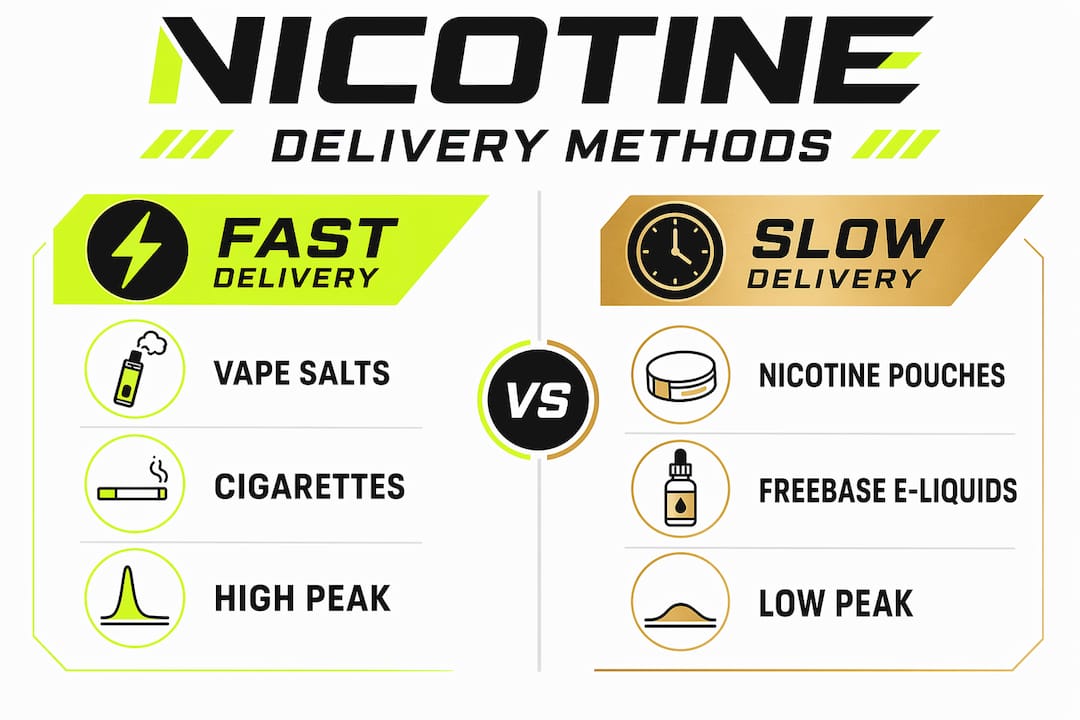
The delivery method you choose determines the shape of your satisfaction curve more than the nicotine strength on the label. Nicotine delivery speeds vary significantly: cigarettes peak plasma nicotine levels in 5 to 8 minutes, nicotine pouches peak between 20 and 65 minutes, and nicotine salt vapes reach peak levels in as little as 1.2 to 1.5 minutes. That gap between 1.5 minutes and 65 minutes is not a minor detail. It determines whether your brain receives a sharp dopamine spike or a slow, sustained release.
| Delivery method | Peak time | Curve shape | Satisfaction profile |
|---|---|---|---|
| Cigarette | 5 to 8 minutes | Sharp rise, moderate fall | Strong, fast, fades within 30 to 45 minutes |
| Nicotine salt vape | 1.2 to 1.5 minutes | Very sharp rise, rapid fall | Intense, immediate, shorter duration |
| Freebase vape | 7 to 9 minutes | Gradual rise, slow fall | Moderate, sustained, less intense peak |
| Nicotine pouch (ZYN, Velo, FUMI) | 20 to 65 minutes | Flat, slow rise, long plateau | Mild, steady, long-lasting |
Nicotine salts achieve up to 90% of cigarette blood nicotine concentration faster than freebase e-liquids, with a Tmax of roughly 2 to 3 minutes compared to 7 to 9 minutes for freebase. This makes nic salts the closest pharmacokinetic match to cigarettes currently available without combustion. For smokers switching products, that similarity matters enormously because the brain has been conditioned to expect a specific curve shape.
Nicotine pouches from brands like ZYN, Velo, and FUMI sit at the opposite end of the spectrum. Their slower, flatter curve produces less of an immediate rush but delivers a longer plateau of nicotine presence. This suits users who want sustained background satisfaction rather than a sharp peak. The trade-off is that the delayed onset can feel unsatisfying at first, particularly for users accustomed to faster delivery.
Pro Tip: If you find yourself using a nicotine pouch more frequently than expected, the issue is likely the slow onset rather than insufficient strength. Try holding the pouch in place for at least 20 minutes before replacing it, and allow the full absorption window to complete.
Nicotine salt chemistry also plays a role in the physical experience. Lower pH of nic salts (around 5 to 6, compared to freebase at pH 8 to 10) produces a smoother throat hit at high strengths, which allows users to inhale more comfortably and absorb nicotine more efficiently through alveolar membranes.
What role does tolerance play in shaping your satisfaction curve?
Tolerance does not simply reduce the effect of nicotine. It actively reshapes the satisfaction curve by altering the number and sensitivity of nicotine receptors in the brain. Acute receptor desensitisation occurs within a single session: receptors become temporarily unresponsive after repeated stimulation, which is why the second cigarette of the day rarely feels as satisfying as the first. This is not a placebo effect. It is a measurable neurochemical shift.
Chronic use introduces a second mechanism: receptor upregulation. The brain responds to persistent nicotine exposure by growing more receptors, which sounds counterintuitive. More receptors should mean more sensitivity, but these additional receptors are largely desensitised during active use. The result is that chronic receptor upregulation leads to physical dependence and withdrawal symptoms when nicotine is absent, because the neurochemical balance now depends on nicotine being present to maintain baseline function.
Here is how tolerance progression typically unfolds for a regular nicotine user:
- Initial use: Receptors are fully sensitive. Even low doses produce a noticeable dopamine response and clear satisfaction.
- Within a session: Acute desensitisation reduces receptor responsiveness. Subsequent doses feel weaker even at the same strength.
- After weeks of daily use: Receptor upregulation occurs. The curve flattens further, and higher doses or more frequent use become necessary to reach the same peak.
- Overnight recovery: Sleep allows receptors to partially reset their sensitivity. This is why the first use of the day consistently produces the strongest effect.
- Long-term dependence: PET imaging studies show receptor density normalises only over weeks to months after cessation, which explains the persistence of cravings during that period.
Behavioural conditioning compounds the chemical picture. Rapid brain nicotine delivery in roughly 10 seconds from a cigarette creates strong learned associations between environmental cues (a coffee, a break, a specific location) and the expectation of reward. These associations maintain cravings even after pharmacological dependence has faded, which is why switching products without addressing the behavioural layer often produces incomplete satisfaction.
Pro Tip: If you are switching from cigarettes to pouches or vaping, expect a two to three week adjustment period. Your receptors are calibrated to a specific curve shape. Patience during this window is not weakness. It is neurobiology.
Why does delivery speed matter for behaviour and consumption?
Speed of delivery is the single most influential variable in how much nicotine you consume overall. Faster nicotine delivery correlates directly with fewer doses needed to satisfy cravings. Nic salt users take approximately 40% fewer daily puffs compared to freebase users, which represents a meaningful reduction in total nicotine intake for equivalent satisfaction. The brain receives its reward signal quickly, recognises satiation, and stops seeking more.
Slower delivery creates the opposite dynamic. When the satisfaction signal is delayed, users often continue dosing before the first dose has fully absorbed. This is a common pattern with freebase vaping and nicotine pouches, and it leads to higher overall consumption than the user intends. Understanding this mechanism reframes the conversation about nicotine intake effects and product choice entirely.
“The speed of nicotine delivery shapes not just how satisfied you feel, but how much you consume to get there. A faster curve, used correctly, can mean less total nicotine for the same subjective reward.”
Several practical implications follow from this:
- Users switching from cigarettes to freebase vaping often vape more frequently than they smoked, not because freebase is weaker, but because the slower curve delays the satiation signal.
- Nicotine salt vapes are a more pharmacokinetically accurate substitute for cigarettes, which is why smokers transitioning to vaping report higher satisfaction rates with nic salts than with freebase.
- Nicotine pouches suit users who want a background level of nicotine presence rather than a discrete satisfaction event. They are not inferior products. They serve a different curve preference.
- Choosing a product based on strength alone, without considering delivery speed, frequently leads to either under-satisfaction or overconsumption.
What causes the morning nicotine rush and how can you manage it?
The first nicotine use of the day produces the strongest effect because overnight sleep allows partial receptor sensitivity recovery. This is the satisfaction curve at its steepest. However, for many users, particularly those using high-strength nic salts or smoking on an empty stomach, this peak comes with unwanted side effects including dizziness, lightheadedness, and nausea.
The physiological cause is a combination of factors. Vasoconstriction and blood pressure spikes from sudden nicotine exposure, combined with low blood sugar after overnight fasting, create conditions where the cardiovascular response to nicotine is amplified. An empty stomach removes the buffering effect that food provides on absorption rate, making the curve even steeper than usual.
Managing this effectively involves a straightforward sequence:
- Eat or drink something with glucose before your first nicotine use. Even a small amount of food stabilises blood sugar and reduces the intensity of the vascular response.
- Use a primer approach. Take a smaller initial dose than usual, whether that means a shorter puff, a lower-strength pouch, or a brief initial use. This gradually introduces nicotine to the system and reduces the shock of sudden vasoconstriction.
- Sit down for the first use of the day. Standing increases the cardiovascular demand and can worsen dizziness when blood pressure is already spiking.
- Wait for the curve to settle. The dizziness typically passes within two to three minutes as the body adjusts. Continuing to dose during this window worsens the effect.
Pro Tip: Morning dizziness from nicotine is almost always a dose and speed problem, not a sensitivity problem. Switching to a nicotine pouch for your first use of the day introduces nicotine slowly enough to avoid the spike entirely, while still satisfying the morning craving.
How can you use the satisfaction curve to choose better products?
Applying the satisfaction curve to product selection transforms nicotine use from habit into informed choice. The core principle is matching the curve shape of your chosen product to your craving profile and tolerance level. You can explore nicotine pouches vs vaping comparisons to see how the two categories differ in practical terms before committing to a product.
Consider these practical frameworks when selecting or adjusting your nicotine products:
- For smokers switching: Nicotine salt vapes most closely replicate the cigarette satisfaction curve. Start with a strength that matches your smoking volume rather than defaulting to the highest available.
- For reducing overall consumption: Faster delivery products used deliberately produce satisfaction with fewer doses. Switching from freebase to nic salts, or from frequent pouch replacement to a single long-duration pouch, can reduce total daily nicotine intake.
- For all-day background satisfaction: Nicotine pouches from ZYN, Velo, or FUMI provide a sustained plateau that suits working environments or situations where discrete, smoke-free use is preferred.
- For managing tolerance: Step-down strategies work best when you reduce strength gradually over several weeks rather than abruptly. Abrupt reductions trigger withdrawal because receptor density does not adjust quickly.
- For new users: Begin with lower-strength products regardless of delivery method. The satisfaction curve is steeper when receptor sensitivity is high, so lower doses produce proportionally stronger effects early on.
Understanding nicotine alternatives in 2026 means recognising that no single product is universally superior. The right product is the one whose curve shape matches your physiology, your tolerance level, and your usage context.
Key takeaways
The nicotine satisfaction curve is determined by delivery speed, receptor sensitivity, and behavioural conditioning, and matching your product to your curve profile is the most effective way to manage satisfaction and consumption.
| Point | Details |
|---|---|
| Delivery speed shapes satisfaction | Nic salt vapes peak in under 2 minutes; pouches take up to 65 minutes. Speed determines reward intensity. |
| Tolerance reshapes the curve | Receptor desensitisation and upregulation flatten satisfaction over time, requiring deliberate product adjustment. |
| Morning effects are physiological | Overnight receptor recovery creates the day’s steepest curve. Managing it requires a primer approach and food intake. |
| Faster delivery means less consumption | Nic salts reduce daily puffs by 40% compared to freebase, producing equivalent satisfaction with lower total intake. |
| Product choice should match craving profile | Selecting by strength alone ignores delivery speed, which is the more influential variable for satisfaction. |
What I have learned from watching users misread the curve
I have spent years watching adult nicotine users make the same mistake: they treat nicotine strength as the primary variable and ignore delivery speed entirely. Someone switches from cigarettes to a nicotine pouch, finds it unsatisfying, and concludes they need a stronger product. They do not. They need a different curve shape. The pouch is delivering nicotine at a fraction of the speed their brain expects, and no increase in strength will fully compensate for that delay.
The other pattern I see constantly is impatience during product transitions. The brain’s receptor calibration does not reset in a day. Users who switch from cigarettes to vaping and declare it unsatisfying after 48 hours are not wrong about their experience. They are just too early in the adjustment window. Two to three weeks is the realistic minimum for the curve to feel natural with a new delivery method.
What genuinely surprises people is that nicotine satisfaction is both chemical and behavioural. The ritual of a cigarette break, the physical act of holding something, the environmental cues tied to use: these are not trivial additions to the pharmacological effect. They are part of the satisfaction architecture. Switching products without acknowledging this leaves users chasing a chemical fix for what is partly a conditioned response.
The nicotine product market in 2026 is more sophisticated than it has ever been. The science of delivery curves is now embedded in product design at brands like ZYN and Velo. Users who understand this science make better choices, experience fewer frustrations during transitions, and consume more deliberately. That is the real value of understanding the curve.
— Fabio
Explore nicotine pouches that match your satisfaction curve
Hitsnus stocks a carefully selected range of nicotine pouches designed for adult users who want tobacco-free satisfaction without compromising on experience. Whether you prefer the slow, sustained plateau of a lower-strength ZYN or the firmer presence of a higher-strength FUMI, the nicotine pouches at Hitsnus are available in multiple strengths and flavours to match your curve profile. Fast UK delivery, no tobacco, and no combustion. If you have read this far, you understand your options better than most. Hitsnus makes it straightforward to act on that knowledge and find the product that genuinely fits how your body responds to nicotine.
FAQ
What is the nicotine satisfaction curve?
The nicotine satisfaction curve describes how quickly and intensely nicotine reaches the brain after use, and the corresponding satisfaction a user experiences. The shape of this curve varies by delivery method and is influenced by tolerance and behavioural conditioning.
Which nicotine product delivers the fastest satisfaction?
Nicotine salt vapes reach peak blood nicotine levels in 1.2 to 1.5 minutes, making them the fastest delivery method currently available. Cigarettes peak in 5 to 8 minutes, while nicotine pouches take between 20 and 65 minutes.
Why does the first nicotine use of the day feel strongest?
Overnight sleep allows nicotine receptors to partially recover their sensitivity, producing a steeper satisfaction curve from the first dose. This receptor reset is the physiological basis for the pronounced morning effect experienced by regular users.
Why do nicotine pouches sometimes feel unsatisfying?
Nicotine pouches have the slowest absorption profile of all common delivery methods, peaking between 20 and 65 minutes. Users accustomed to faster delivery often replace pouches too early, before full absorption has occurred, which creates the impression of insufficient strength.
Can understanding the satisfaction curve help reduce nicotine consumption?
Yes. Choosing faster-delivery products like nicotine salt vapes produces satiation more quickly, which means fewer doses are needed overall. Studies show nic salt users take approximately 40% fewer daily puffs than freebase users for equivalent satisfaction.