











How to transition to smokeless alternatives
TL;DR:
- Switching from cigarettes to smokeless alternatives requires understanding product options, behavioral triggers, and comprehensive planning. Success depends on addressing habits, choosing the right product, and having support strategies in place; individual challenges like sensory dissatisfaction can be managed by exploring different flavors and strengths. Long-term benefits include reduced exposure to harmful chemicals, improved lifestyle convenience, and personal progress toward quitting nicotine entirely if desired.
Making the switch away from cigarettes is one thing. Knowing how to transition to smokeless alternatives in a way that actually sticks is another. Most smokers who attempt the change hit the same wall: the product changes but the habit, the triggers, and the cravings do not. This guide cuts through the noise and gives you a clear, practical plan covering product choice, behavioural prep, craving management, and what to realistically expect on the other side. Whether you are considering nicotine pouches, heated tobacco, or vaping, the right approach makes a significant difference.
Table of Contents
- Key takeaways
- Understanding smokeless nicotine alternatives
- Preparing for your transition
- Step-by-step transition guide
- Common challenges and how to handle them
- What to expect after switching
- My honest take on making the switch
- Start your transition with Hitsnus
- FAQ
Key takeaways
| Point | Details |
|---|---|
| Know your product options | E-cigarettes, nicotine pouches, heated tobacco, and snus each carry different risk profiles and suit different users. |
| Preparation reduces relapse | Identifying your smoking triggers and planning replacements before you switch dramatically improves your chances of success. |
| Behavioural change matters as much as product choice | Switching products without addressing habits and emotional cues leaves you vulnerable to returning to cigarettes. |
| Sensory matching speeds up satisfaction | Choosing a flavour and nicotine strength that closely mirrors your smoking experience reduces dissatisfaction early on. |
| Combine strategies for best results | Pairing your product switch with habit planning and, where appropriate, professional support improves outcomes significantly. |
Understanding smokeless nicotine alternatives
Before you commit to any product, it pays to understand what you are actually switching to. The category is broader than most people realise, and the differences between products matter for both your experience and your safety.
The main product types
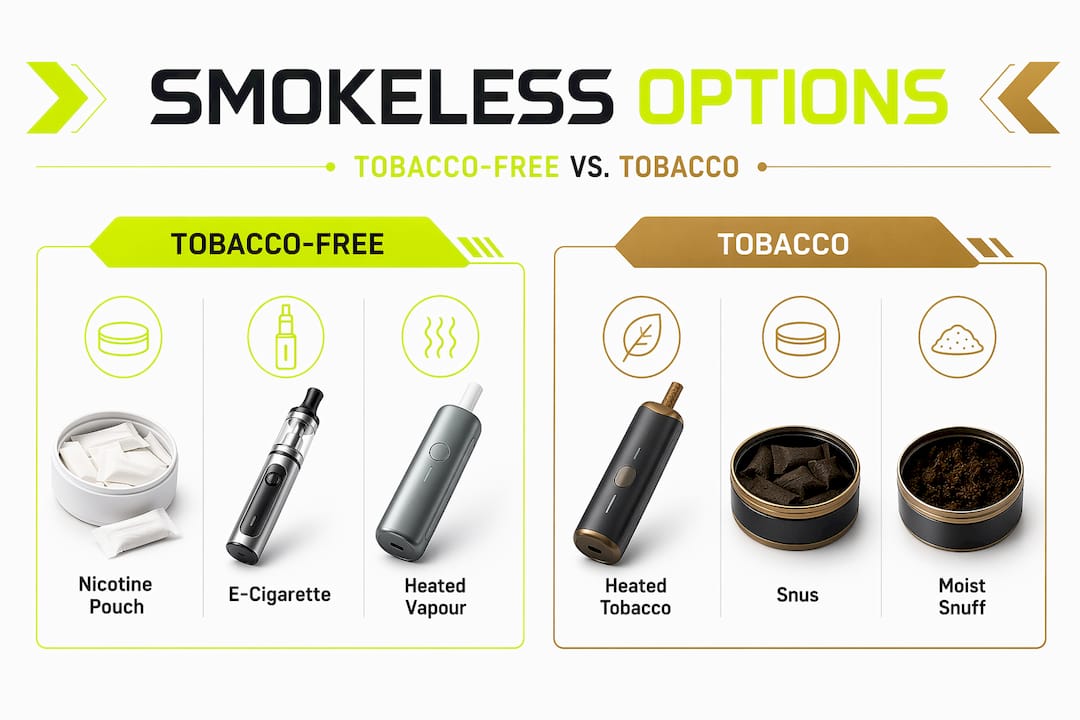
Nicotine pouches are small, tobacco-leaf-free sachets placed under the upper lip. They deliver nicotine without smoke, vapour, or spitting. Brands like ZYN, Velo, and FUMI come in a range of flavours and strengths, making them one of the most discreet smokeless tobacco alternatives currently available.
E-cigarettes and vapes heat a liquid containing nicotine to produce an aerosol. They closely mimic the hand-to-mouth ritual of smoking, which helps some users transition more comfortably. However, e-cigarette aerosol contains nicotine, heavy metals, and ultrafine particles, so choosing reputable regulated brands is not optional. It is the baseline.
Heated tobacco products (HTPs) heat real tobacco without burning it, producing a nicotine-containing vapour at lower temperatures than combustion. They retain some tobacco taste, which suits users who find pure vapour unsatisfying.
Snus and moist snuff are oral tobacco products placed against the gum. A 2025 umbrella review found that switching to oral smokeless tobacco is associated with lower risks of lung cancer, COPD, and heart disease compared to continued smoking, though quitting all tobacco remains the gold standard.

Comparing the options
| Product | Tobacco-free | Discreet | Smoke/vapour | Typical nicotine delivery |
|---|---|---|---|---|
| Nicotine pouches | Yes | Very high | None | Moderate to high |
| E-cigarettes | Yes | Medium | Vapour | Adjustable |
| Heated tobacco | No | Medium | Light vapour | Moderate |
| Snus | No | High | None | Moderate to high |
One fact worth holding on to: combustible tobacco smoke contains over 7,000 chemicals, including around 70 carcinogens. Any complete switch away from combustible cigarettes reduces your exposure to that chemical load substantially.
Safe adult use also means strict storage. Young people who vape are 3 to 4 times more likely to start smoking than those who do not, so keeping all nicotine products out of reach of minors is a non-negotiable responsibility.
Preparing for your transition
The single biggest reason smokeless product transitions fail is that people treat it purely as a product swap. The cigarette goes, the pouch arrives, problem solved. It rarely works that way. Smoking is as much a behavioural pattern as a chemical dependency, and your preparation needs to reflect that.
Know your triggers before you switch
Start by mapping out when and why you smoke. Common triggers include:
- Stress or anxiety. A cigarette becomes a socially acceptable pause. You need to plan a replacement pause, whether that is a walk, a breathing exercise, or a flavoured pouch.
- Routine moments. Morning coffee, after meals, and work breaks are the most common. These are predictable, which means they are plannable.
- Social situations. If your friendship group smokes, the social cue can override your intention every time.
- Emotional states. Boredom, loneliness, and low mood each have their own smoking patterns.
Once you have identified your top three to five triggers, you can plan a specific response for each one. That specificity is what separates people who succeed from those who rely on willpower alone.
Setting a realistic goal also matters. A gradual reduction strategy works well for some people. An immediate switch works better for others. Neither is superior in every case. What matters is that your goal is written down, specific, and has a start date.
Pro Tip: Tell someone you trust about your transition plan. Having a support person who checks in with you adds accountability without requiring professional intervention, and it costs nothing.
The evidence supports combining approaches. Nicotine replacement therapy nearly doubles quit chances when paired with behaviour change and support. You do not have to go it alone, and you should not feel as though asking for help is a sign of weakness.
Step-by-step transition guide
With your preparation done, you are ready to move into the practical execution. Here is how to structure the transition sensibly, without overwhelming yourself from day one.
-
Choose your product based on your smoking style. If the hand-to-mouth ritual matters to you, a vape device may ease the transition. If discretion is your priority, nicotine pouches are hard to beat. Check out this step-by-step guide to pouches if you are leaning in that direction. Match the nicotine strength to your current intake. Starting too low will leave you dissatisfied and reaching for a cigarette within hours.
-
Set a switch date. Whether you go cold turkey on cigarettes or reduce gradually over two weeks, having a firm date creates commitment. Mark it. Tell someone.
-
Use the five-minute wait rule for cravings. Distraction, waiting, and substitution are your core tools. When a craving hits, wait five minutes before acting on it. Most cravings peak and pass within that window. Fill the time with a brief walk, a glass of water, or your chosen smokeless alternative.
-
Replace smoking rituals deliberately. If you smoke with your morning coffee, use that moment for a nicotine pouch instead. The ritual stays. The combustion goes. This small reframing matters more than it sounds.
-
Make your environment smoke-free. Removing cigarettes from your home and car removes environmental cues that trigger smoking urges. It also protects anyone living with you from secondhand smoke exposure.
-
Consider adding clinical support. E-cigarettes are not approved quit aids by the FDA, so if you want the most supported approach, combining your product switch with a quitline, counsellor, or approved medication is the smartest path.
Pro Tip: Keep your chosen smokeless product on you at all times for the first two weeks. Running out during a craving is one of the most common reasons people relapse to cigarettes in the early stages.
Common challenges and how to handle them
Even with strong preparation, obstacles will appear. Here is where most transitions hit friction, and what to do when they do.
Sensory dissatisfaction is the most common early problem. If your chosen product does not feel satisfying, the instinct is to go back to what you know. This is where flavour and product matching plays a critical role. Studies show that offering menthol and non-menthol options improved switching success from combustibles to heated tobacco products. Do not assume your first choice is your only choice. Explore your options across flavours and strengths before concluding that smokeless products are not for you.
Emotional relapse triggers are often underestimated. A stressful week at work or a difficult personal situation can unravel weeks of progress. Having a pre-planned coping strategy, not just a replacement product, is your defence here.
“Treating the product as the whole solution is the most common mistake I see. The product is necessary. It is not sufficient.”
- If your current product is consistently unsatisfying, switch brands or formats rather than reverting to cigarettes.
- Seek support from NHS Stop Smoking services, which are free and evidence-based, if you find yourself cycling between smoking and alternatives without making progress.
- Avoid unregulated or illicit products. They carry unpredictable risk profiles and undermine the safety rationale for switching in the first place. Find out more about smokeless nicotine alternatives explained to understand what regulated products actually contain.
What to expect after switching
Understanding what happens to your body and lifestyle after a successful transition keeps you motivated when the novelty wears off.
| Timeframe | What typically changes |
|---|---|
| First 1 to 3 days | Cravings peak, irritability increases, sense of smell begins to improve |
| Week 1 to 2 | Breathing often feels easier, energy levels begin to stabilise |
| Month 1 | Cough may reduce, circulation improves, financial savings become noticeable |
| Month 3 to 6 | Lung function improvement measurable, social freedom increases |
| Year 1 and beyond | Cardiovascular risk reduction ongoing, no secondhand smoke affecting others |
The lifestyle gains are real and visible. Non-smoking policies cover an increasing range of public spaces in the UK, and smokeless alternatives can be used discreetly in contexts where cigarettes would be banned. Your clothes, home, and car no longer carry the smell. These are not trivial changes.
Long-term, the goal for many people shifts from “switching from cigarettes” to deciding whether to continue reducing nicotine use or eventually quit entirely. That decision is personal. What matters is that you are no longer exposing yourself and others to combustible smoke, and your options remain open.
My honest take on making the switch
I have followed the smokeless nicotine space for years, and the pattern I see most consistently is this: people spend 90% of their energy choosing the right product and about 10% addressing everything else. The product matters. However, the product is not doing the heavy lifting on its own.
What actually determines success, in my experience, is whether someone has mapped their behavioural triggers before the switch date arrives. The person who knows they smoke when stressed and has a plan for that moment will outperform the person who bought the best-rated product on the market but gave no thought to their 11am work break habit.
I am also cautious about the way smokeless alternatives are sometimes framed as a guaranteed path to quitting. They are not. E-cigarettes are part of a broader strategy, not a standalone solution. The most successful transitions I have seen involve product choice combined with honest self-assessment, at least one support person, and a willingness to adjust the plan when the first approach does not work.
Setbacks are normal. They are not evidence that you cannot do this. They are data. Use them to refine your approach and keep going.
— Fabio
Start your transition with Hitsnus
If you are ready to take the first practical step, Hitsnus has you covered. The range of tobacco-free nicotine pouches available includes trusted brands like ZYN, Velo, and FUMI, in a wide selection of flavours and nicotine strengths to suit where you are in your transition. Fast UK delivery means your supply arrives before your motivation does, and the product pages include usage guidance to help you get started confidently.
Whether you are brand new to nicotine pouches or refining your approach after a previous attempt, the Hitsnus blog also offers a complete guide to smokeless nicotine with practical advice written for adult users like you. Browse the range, find your strength and flavour match, and make your switch with a product you can rely on.
FAQ
What is the easiest smokeless product to switch to from cigarettes?
Nicotine pouches are widely considered the most accessible starting point because they require no device, produce no vapour, and are available in multiple strengths. Choosing a strength that matches your current nicotine intake reduces early dissatisfaction.
How do I manage cravings when transitioning to a smokeless alternative?
Use the five-minute wait rule: when a craving hits, delay acting for five minutes using distraction or a replacement activity. Most cravings pass within this window, particularly when your smokeless product is already on hand.
Are smokeless alternatives safer than cigarettes?
Switching completely from cigarettes reduces exposure to thousands of harmful chemicals found in combustible smoke. Smokeless products carry their own risk profiles, so choosing reputable, regulated brands and using them as directed is important.
Should I combine my product switch with professional support?
Yes, where possible. Combining behaviour change with clinical support and nicotine replacement therapy produces better outcomes than product switching alone. NHS Stop Smoking services are free and available across the UK.
What should I do if my first smokeless product does not feel satisfying?
Try a different flavour or a higher nicotine strength before concluding the category does not work for you. Research shows that sensory preferences like flavour significantly affect switching success, so adjusting your product choice is a legitimate strategy, not a failure.