











Nicotine absorption explained: pouches vs vaping facts
Many users assume all nicotine products deliver the same experience, but absorption speed and method dramatically alter how nicotine enters your bloodstream and affects you. Pouches rely on gradual oral absorption, whilst vaping delivers rapid pulmonary uptake. This guide clarifies the science behind systemic nicotine exposure, comparing bioavailability, peak levels, and practical factors that shape your experience with each method.
Table of Contents
- How nicotine enters your system: fundamentals of absorption
- Nicotine pouches: absorption process and key variables
- Vaping: how inhaled nicotine is absorbed and distributed
- Comparing nicotine absorption: pouches vs vaping vs cigarettes
- User factors: what affects nicotine absorption for you?
- Explore tailored nicotine options with HitSnus
- Frequently asked questions
Key Takeaways
| Point | Details |
|---|---|
| Route determines speed | Vaping delivers nicotine faster to the bloodstream than oral pouches due to pulmonary absorption. |
| Pouches deliver gradually | Nicotine pouches provide a slower, more sustained effect than cigarettes or vaping. |
| Only partial dose absorbed | You absorb just 25-30% of the nicotine listed on a pouch, with user technique influencing actual delivery. |
| Peak levels vary widely | High-dose pouches can sometimes surpass the nicotine peaks of regular cigarettes. |
| User actions matter | Placement, duration, and style all affect how much nicotine enters your system, whether using pouches or vaping. |
How nicotine enters your system: fundamentals of absorption
To understand why pouches and vaping feel so different, you need to grasp how nicotine reaches your bloodstream. Pouches use buccal absorption, where nicotine dissolves in saliva and crosses the oral mucosa into capillaries. Vaping employs pulmonary absorption, delivering nicotine through lung tissue directly into arterial blood. The route determines both speed and intensity of effects.
Three key factors govern absorption efficiency:
- Freebase nicotine ratio: Only un-ionised (freebase) nicotine crosses membranes easily; pH levels control this ratio
- Bioavailability: The percentage of nicotine that reaches systemic circulation intact
- User behaviour: Saliva production, placement, puff style, and duration all influence uptake
Nicotine delivery systems vary widely in these parameters. Pouches typically maintain high pH environments to maximise freebase content, whilst vaping devices control nicotine salt formulations and aerosol particle size to optimise lung absorption.
Pro Tip: Understanding your product’s pH and nicotine form helps you predict how quickly effects will onset and how long they’ll last.
Nicotine pouches: absorption process and key variables
With the basics established, let’s examine how pouches deliver nicotine through the oral route. When you place a pouch between your gum and lip, nicotine begins dissolving in saliva. The dissolved nicotine then penetrates the oral mucosa, entering small blood vessels beneath the surface. This process takes time, creating a gradual rise in blood nicotine levels rather than a sharp spike.
Pouch manufacturers engineer products with median pH 8.8, yielding up to 86% freebase nicotine. However, only 25-30% of labelled nicotine content actually enters systemic circulation. A 4mg pouch typically delivers 1-1.2mg to your bloodstream, with the remainder either remaining in the pouch or being swallowed and metabolised by the liver before reaching circulation.
Several variables affect this absorption:
- Duration of use: Longer contact time increases total absorption, though most nicotine transfers within the first 30 minutes
- Placement and movement: Upper lip placement and occasional repositioning enhance saliva contact and mucosal exposure
- Saliva production: More saliva accelerates dissolution but can also lead to swallowing, which reduces bioavailability
- Swallowing behaviour: Nicotine that’s swallowed undergoes first-pass metabolism, drastically reducing systemic availability
Compared to patches and gum, pouches offer faster onset whilst maintaining sustained delivery. The pH-dependent absorption mechanism means product formulation significantly impacts your experience, making pouch strength comparison essential for finding your ideal match.
“The alkaline environment in modern nicotine pouches maximises freebase nicotine availability, but systemic bioavailability remains limited by mucosal transfer rates and first-pass metabolism of swallowed nicotine.”
Vaping: how inhaled nicotine is absorbed and distributed
Now let’s explore how vaping differs fundamentally by using the lungs as the absorption site. When you inhale vapour, tiny aerosol droplets carry nicotine deep into your lungs, where it crosses the thin alveolar membrane directly into pulmonary capillaries. This route provides almost immediate access to arterial blood, which travels straight to the brain within seconds.

Vaping delivers nicotine with remarkable speed, producing blood concentration peaks (Cmax) of 4.7-11.2 ng/mL during standard sessions. The rapid arterial delivery creates the characteristic ‘throat hit’ and quick satisfaction that many users seek. Unlike pouches, vaping bioavailability can approach cigarette levels when technique and device settings align optimally.
Three factors dramatically influence vaping absorption:
| Factor | Impact on absorption |
|---|---|
| Puff duration | Longer draws increase nicotine delivery per puff |
| Device power | Higher wattage produces more aerosol and nicotine |
| Inhalation depth | Deeper lung inhalation maximises alveolar contact |
| Nicotine concentration | Higher e-liquid strength delivers more per puff |
Experienced vapers can match or exceed cigarette nicotine delivery rates by adjusting these variables. However, this flexibility also means absorption varies widely between users and sessions. Understanding vaping vs pouches helps you recognise why the same device might feel different depending on how you use it.
Pro Tip: If you’re transitioning from cigarettes, start with higher nicotine concentrations and shorter, more frequent puffs to mimic familiar absorption patterns whilst you develop your technique.
The key differences between vaping and pouches extend beyond speed. Vaping offers immediate feedback and dose control through puff frequency, whilst pouches provide hands-free, discreet delivery with predictable duration.
Comparing nicotine absorption: pouches vs vaping vs cigarettes
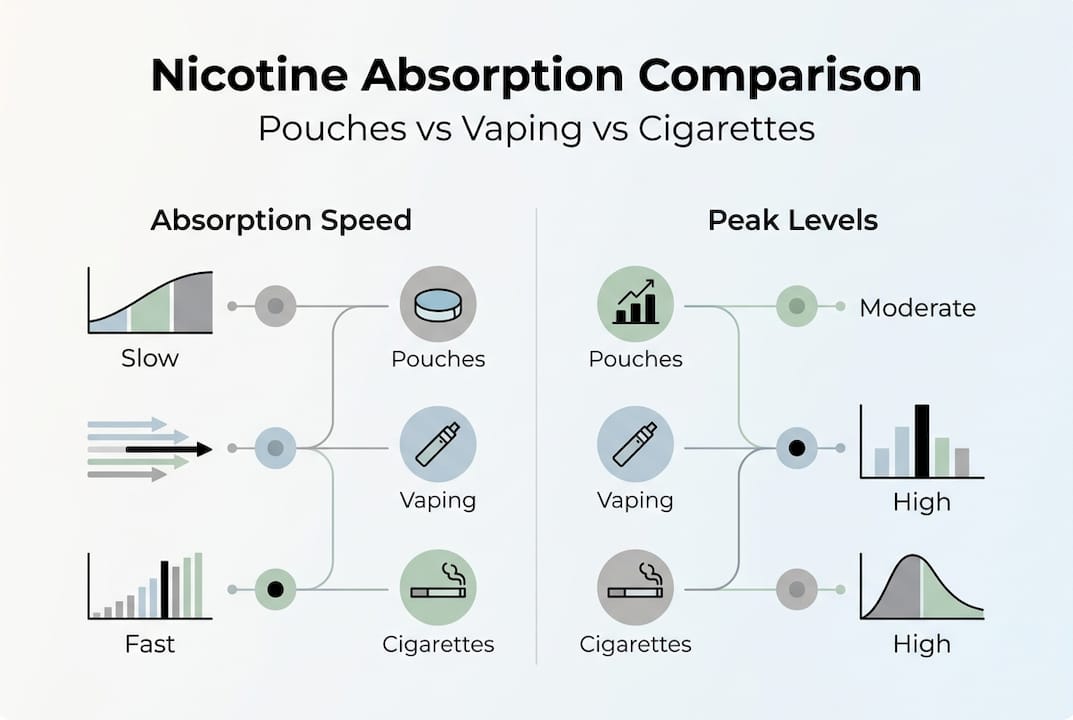
Having examined each method separately, let’s place their absorption profiles side by side. The differences in peak concentration, time to peak, and total exposure explain why each product feels distinct despite delivering the same molecule.
| Method | Bioavailability | Time to Cmax | Typical Cmax | Total exposure (AUC) |
|---|---|---|---|---|
| Cigarette | ~100% | 5-10 min | 15-20 ng/mL | Reference (100%) |
| Vaping | 50-80% | 5-15 min | 5-15 ng/mL | 60-100% of cigarette |
| 4mg pouch | 25-30% | 30-45 min | 8-12 ng/mL | 92% of cigarette |
These numbers reveal surprising insights. Standard 4mg pouches deliver 92% of total cigarette nicotine exposure, but with slower, lower peaks. This creates sustained effects without the intense initial rush. Meta-analysis confirms 4mg pouch total exposure reaches 91.73% of cigarette levels, challenging assumptions about relative strength.
Vaping sits between cigarettes and pouches for speed, offering:
- Faster onset than pouches (minutes vs 30-45 minutes)
- More controllable dosing through puff frequency
- Variable peaks depending on device and technique
- Potential to match cigarette delivery with optimised settings
High-dose pouches (8-12mg) can actually exceed cigarette Cmax values, delivering stronger peak effects than smoking. This explains why some users find strong pouches more satisfying than expected based solely on labelled nicotine content.
The practical difference you feel comes down to absorption kinetics. Cigarettes and vaping provide rapid arterial spikes that satisfy cravings quickly. Pouches offer gentler, sustained delivery that maintains steady blood levels for longer periods. Neither approach is inherently superior; they serve different user preferences and situations.
Exploring nicotine pouch benefits and smokeless alternatives helps you match product characteristics to your lifestyle and satisfaction requirements.
User factors: what affects nicotine absorption for you?
Of course, published averages only tell part of the story. Your technique and choices create substantial variation in actual absorption. Understanding these controllable factors lets you optimise your experience safely.
For pouches, user behaviour significantly impacts absorption:
- Placement precision: Upper lip placement typically provides better mucosal contact than lower lip
- Movement frequency: Occasional repositioning refreshes saliva contact without excessive disturbance
- Saliva management: Allowing saliva to pool briefly before swallowing maximises absorption time
- Duration discipline: Most nicotine transfers in 30-40 minutes; extended use adds minimal benefit
For vaping, technique variables include:
- Inhalation style: Mouth-to-lung (MTL) mimics cigarettes; direct-lung (DL) increases volume
- Puff duration: 3-5 second draws optimise nicotine delivery without harshness
- Power settings: Higher wattage increases aerosol production but may reduce efficiency
- Frequency patterns: Shorter intervals between puffs maintain steady blood levels
Pro Tip: Don’t chase maximum absorption. Finding your comfortable baseline prevents tolerance build-up and maintains satisfaction over time.
Common myths about maximising absorption often backfire. Keeping pouches in longer than 45 minutes rarely increases uptake significantly. Taking massive vape hits can cause nicotine overdose symptoms like nausea and dizziness without improving satisfaction. The goal is consistent, comfortable delivery matched to your needs.
Choosing appropriate pouch strength and understanding alternatives helps you make informed decisions. The pH and formulation factors manufacturers control matter more than extreme user behaviours.
Start with moderate strengths and standard techniques. Adjust gradually based on your response rather than chasing theoretical maximum absorption. This approach maintains effectiveness whilst minimising side effects and tolerance development.
Explore tailored nicotine options with HitSnus
If you’re ready to apply this knowledge, HitSnus offers the UK’s most comprehensive selection of nicotine pouches tailored to your absorption preferences. Whether you want sustained delivery from standard-strength pouches or quicker satisfaction from premium formulations, you’ll find products matched to your needs.
Our nicotine pouches UK collection includes brands engineered for optimal pH balance and freebase ratios, ensuring efficient absorption. Browse strength options from 4mg to 12mg, each formulated for specific user profiles. New to pouches? Our guides help you select the right starting point based on your current nicotine consumption.
Explore our nicotine pouch clearance section for premium products at exceptional value. Every product includes detailed strength information and usage guidance, so you can make informed choices about absorption profiles and expected effects. With fast UK delivery and expert support, HitSnus makes finding your ideal nicotine solution straightforward.
Frequently asked questions
How much nicotine from a pouch actually enters my bloodstream?
About 25-30% of labelled nicotine is systemically absorbed; a standard 4mg pouch typically delivers 1-1.2mg to your bloodstream.
Does vaping get nicotine into the blood faster than pouches?
Yes, vaping delivers nicotine rapidly via pulmonary absorption within minutes, whilst pouches provide slower sustained absorption over 30-45 minutes.
Can high-dose pouches deliver stronger effects than cigarettes?
High-dose pouches can exceed cigarette Cmax levels, producing stronger peak blood concentrations than regular cigarettes despite slower onset.
Does saliva or where I place the pouch matter for absorption?
Yes, saliva production and placement significantly affect absorption; optimal positioning and saliva management increase bioavailability whilst excessive swallowing reduces it.
Does the type of vaping device I use affect nicotine absorption?
Absolutely; device power, airflow, and user technique dramatically influence both the amount and speed of nicotine absorbed from vaping.