












Smoking alternatives checklist: your complete guide
TL;DR:
- A comprehensive smoking alternatives checklist combines nicotine replacement therapies, behavioral strategies, and lifestyle adjustments to enhance quit success. Combining NRT formats like patches and gum with behavioral support significantly improves the chances of long-term abstinence. Tailoring tools to individual triggers and reviewing the plan regularly is essential for overcoming challenges and sustaining the quit attempt.
A smoking alternatives checklist is a practical framework that maps proven nicotine replacement therapies (NRT) and behavioural supports onto your personal quit plan, giving you the best possible chance of success. The industry term for this process is smoking cessation planning, and the evidence is clear: combined medication and support is far more likely to succeed than willpower alone. This guide covers every category of quit smoking option, from patches and nicotine pouches to motivational interviewing and prescription medicines, so you can build a checklist that fits your triggers, budget, and lifestyle.
1. What belongs on your smoking alternatives checklist?
The most effective smoking alternatives checklist combines at least one form of nicotine replacement with at least one behavioural strategy. Neither works as well in isolation. NRT addresses the physical withdrawal, while behavioural support tackles the habits and routines that keep you reaching for a cigarette. Named tools that belong on every starter checklist include nicotine patches, nicotine gum, varenicline (brand name Champix), and a structured quit plan with a fixed quit date.
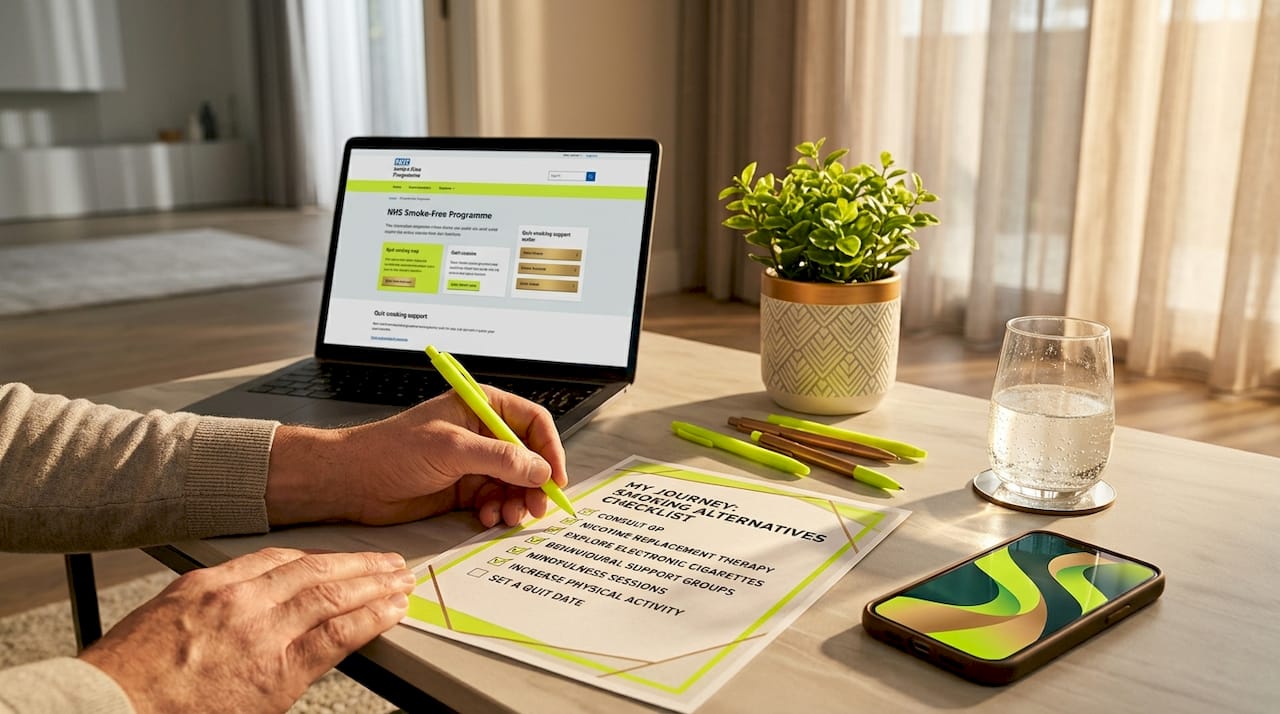
Think of the checklist in three columns: pharmacotherapy (patches, gum, lozenges, sprays, inhalators, prescription medicines), behavioural support (motivational interviewing, quit plans, support groups), and lifestyle adjustments (trigger management, routine changes, tracking tools). Filling all three columns before your quit date is the single most reliable predictor of success. Leaving any column blank is where most attempts fall short.
2. Which NRT products should you include?
Nicotine replacement therapy is the first category to populate on any smoking cessation checklist. NRT is available free at UK community pharmacies and is recommended for a defined course of 8 to 12 weeks. That timeframe matters because shorter courses leave withdrawal symptoms unmanaged, while open-ended use without a plan tends to drift.
The five main NRT formats each serve a different purpose:
- Patches deliver a steady, background level of nicotine across 16 or 24 hours, preventing baseline withdrawal before it starts.
- Gum and lozenges act within minutes, making them ideal for sudden cravings triggered by stress or social situations.
- Nasal and mouth sprays are the fastest-acting options, reaching the bloodstream in roughly two minutes.
- Inhalators mimic the hand-to-mouth action of smoking, which helps smokers who miss the physical ritual.
- Combination NRT pairs a patch with a fast-acting format. Combining two NRT forms is more effective than using one alone, a recommendation endorsed by the Australian Government Department of Health.
| NRT format | Speed of action | Best used for |
|---|---|---|
| Patch (24hr) | Slow, steady | Baseline withdrawal prevention |
| Gum / lozenge | 10–15 minutes | Moderate cravings |
| Mouth / nasal spray | 1–2 minutes | Sudden, intense cravings |
| Inhalator | 5–10 minutes | Habitual hand-to-mouth urge |
| Combination (patch + gum) | Dual-speed | Most craving profiles |
Pro Tip: Start your NRT on your quit date or during a planned cut-down phase, not after a failed attempt. Timing the start correctly is one of the most overlooked factors in NRT success.
Varenicline (Champix) is worth a separate mention. It is a prescription medicine that blocks nicotine receptors and reduces both cravings and the reward of smoking. Reintroduced with safety approval in 2024, it is typically prescribed for 12 weeks and is considered the most clinically effective single medicine for quitting.
3. How behavioural support strengthens your quit attempt
Pharmacotherapy handles the chemistry of addiction. Behavioural support handles everything else, and that “everything else” is substantial. Changing routines and replacing triggers reduces relapse risk and complements NRT directly, because many cravings are conditioned responses to situations rather than pure nicotine withdrawal.
The most striking recent evidence comes from digital delivery. Motivational interviewing via instant messaging triples validated quit rates at 12 months compared to no support, with 4.1% abstinence versus 1.4% in the control group. That gap is significant because it shows that even brief, low-friction contact sustains motivation over the long term, particularly for smokers who were not initially planning to quit.
Your behavioural checklist should include:
- Set a firm quit date at least two weeks ahead and tell someone about it.
- Identify your three strongest smoking triggers (stress, boredom, social settings, alcohol, morning routine).
- Book at least one appointment with a stop-smoking adviser, GP, or pharmacist before your quit date.
- Download a quit-tracking app such as Smoke Free or NHS Quit Smoking to monitor progress daily.
- Replace the smoking routine with a substitute behaviour at each trigger point (a short walk, a glass of water, chewing gum).
- Plan for high-risk moments in the first two weeks, specifically the post-meal cigarette, the work break, and the first drink of the evening.
“Stop-smoking medication combined with intensive behavioural support is much more likely to succeed than medication alone.” — NHS inform
Pro Tip: If face-to-face support feels like too much commitment, start with a messaging-based programme. The evidence shows it works, and the barrier to entry is far lower than a clinic appointment.
4. How to match your checklist to your personal triggers
The right combination of alternatives depends entirely on your trigger profile. Matching pharmacotherapy to individual triggers is the key variable that separates a generic quit plan from one that actually holds. A stress smoker needs fast-acting NRT on standby. A habitual morning smoker needs a patch applied before waking. A social smoker needs a discreet, portable option for situations where lighting up would feel automatic.
| Trigger type | Recommended NRT | Behavioural strategy |
|---|---|---|
| Stress / anxiety | Mouth spray or gum | Breathing exercises, short walks |
| Morning routine | 24-hour patch | Change wake-up routine, swap coffee location |
| Social / alcohol | Lozenge or nicotine pouch | Inform friends, hold a drink in your usual smoking hand |
| Boredom | Inhalator | Schedule activities, use a fidget tool |
| Post-meal | Gum or lozenge | Leave the table immediately, brush teeth |
If you are using a cut-down-to-quit approach rather than stopping abruptly, monitor your puffing behaviour carefully. Gradual reduction carries a risk of compensatory deeper inhalation, which can offset the benefit of smoking fewer cigarettes. Tracking the number of cigarettes alongside how intensely you are smoking each one is the only way to know whether the reduction is genuine. Pairing gradual reduction with NRT from the start closes this gap. You can find practical guidance on nicotine habit reduction that covers timing and usage in detail.
5. Alternative nicotine products beyond standard NRT
Not every smoker responds to patches and gum. The broader category of alternative nicotine products includes e-cigarettes, nicotine pouches, smokeless tobacco alternatives, and prescription medicines beyond varenicline. Each carries a different evidence base and risk profile.
E-cigarettes are widely used as a quit tool in the UK, but safety evidence remains limited and they are not yet classified as a first-line treatment. The NHS acknowledges they are less harmful than smoking but recommends consulting a doctor before using them as a primary cessation method.
Nicotine pouches are tobacco-free, placed under the lip, and deliver nicotine without smoke or vapour. They are discreet, require no device, and are available across the UK market. For smokers who want a portable, socially invisible option, pouches sit alongside gum and lozenges as a fast-acting alternative. Understanding the differences between smokeless options helps you choose the format that suits your lifestyle.
Bupropion is a prescription antidepressant that also reduces nicotine cravings. It is less commonly prescribed than varenicline but is an option for smokers who cannot tolerate NRT or varenicline.
Hypnotherapy and acupuncture are frequently mentioned as quit smoking options, but neither has sufficient clinical evidence to recommend as a standalone method. They are not included in NHS stop-smoking guidelines.
| Product | Evidence strength | Prescription needed | Tobacco-free |
|---|---|---|---|
| NRT (patch, gum, spray) | Strong | No | Yes |
| Varenicline (Champix) | Very strong | Yes | Yes |
| Bupropion | Moderate | Yes | Yes |
| E-cigarettes | Emerging | No | Yes |
| Nicotine pouches | Emerging | No | Yes |
| Hypnotherapy | Weak | No | Yes |
Key takeaways
A smoking alternatives checklist works best when it combines steady-release NRT, a fast-acting backup option, and at least one structured behavioural support, all timed around a fixed quit date.
| Point | Details |
|---|---|
| Combine NRT formats | Patch plus gum or spray outperforms either product used alone. |
| Set a quit date | Timing NRT to start on or before your quit date maximises its effectiveness. |
| Add behavioural support | Motivational interviewing and routine changes reduce relapse risk significantly. |
| Match tools to triggers | Stress, social, and habitual triggers each require a different product and strategy. |
| Review and adjust | Revisit your checklist at two weeks and four weeks to adapt to what is and is not working. |
Why I think most quit plans fail before they start
Most smokers I speak to have tried to quit at least twice before they find something that sticks. The pattern is almost always the same: they pick one method, usually patches or willpower, and treat it as the whole plan. When it does not work, they conclude that quitting is not possible for them rather than that the plan was incomplete.
The checklist approach changes that framing. When you treat quitting as a system with multiple components rather than a single act of resolve, a relapse becomes a signal to adjust the system, not evidence of personal failure. I have seen smokers who failed with patches alone succeed within weeks once they added a fast-acting spray for post-meal cravings and booked a single session with a stop-smoking adviser. The components were not new. The combination was.
The other mistake I see constantly is skipping the trigger audit. People know they smoke when stressed, but they have not mapped out which stressful moments are highest risk or what they will do instead. That five-minute planning exercise, done honestly before the quit date, is worth more than any single product on the market.
My honest advice: build your checklist in writing, share it with one other person, and schedule a review at the two-week mark. Flexibility is not weakness. Adjusting your approach based on what is actually happening is exactly what the evidence supports.
— Fabio
Try tobacco-free nicotine pouches from Hitsnus
If you are building your personal quit plan and want a discreet, tobacco-free option to add to your checklist, nicotine pouches are worth serious consideration. Nicotine pouches are placed under the lip, require no device or flame, and deliver nicotine quickly without smoke or vapour. Hitsnus stocks a wide range of pouches from brands including ZYN, Velo, and FUMI, in multiple strengths and flavours, with fast UK delivery.
Whether you are using pouches alongside a patch as part of combination therapy or looking for a standalone smokeless option for social situations, Hitsnus makes it straightforward to find the right product. Visit Hitsnus to browse the full range and find the strength that matches where you are in your quit journey.
FAQ
What is a smoking alternatives checklist?
A smoking alternatives checklist is a structured list of nicotine replacement therapies, prescription medicines, and behavioural supports that a smoker selects and combines to maximise their chance of quitting. It functions as a personalised quit plan rather than a single-product approach.
How long should I use NRT?
NRT is recommended for 8 to 12 weeks, starting on your quit date or during a planned cut-down phase. Shorter courses leave withdrawal symptoms unaddressed and increase relapse risk.
Is combining two NRT products safe?
Combining a patch with a fast-acting format such as gum or spray is both safe and more effective than using one product alone. This dual approach is recommended by the Australian Government Department of Health for smokers with varied craving patterns.
Are nicotine pouches a recognised quit smoking option?
Nicotine pouches are tobacco-free and available in the UK as an alternative nicotine product. They are not yet classified as a licensed NRT product, but they are widely used as a discreet, smokeless option alongside or instead of traditional NRT formats.
What if I have tried NRT and it did not work?
A single failed attempt with NRT usually indicates an incomplete plan rather than NRT failure. Adding a second NRT format, booking behavioural support, or asking a GP about varenicline are the recommended next steps. You can also explore smokeless alternatives compared to find a format that better suits your habits.