










Why nicotine pouches are rising in popularity: benefits and trends
TL;DR:
- Nicotine pouches have experienced rapid growth, now dominating the oral nicotine market due to their discretion and flavor appeal. They effectively reduce cigarette consumption, offering fewer harmful chemicals while providing steady nicotine absorption. However, dual use and regulation challenges highlight the importance of deliberate switching strategies for harm reduction.
Nicotine pouches have moved from niche curiosity to mainstream nicotine product at a pace that’s difficult to overstate. Kilograms of nicotine sold through oral pouches rocketed from just 3.8 kg in 2017 to 3,407 kg in 2024, a near 900-fold increase in seven years. This article breaks down what’s driving that explosive growth, why flavours matter so much, how pouches compare to cigarettes and snus for harm reduction, and what you should know before making the switch yourself.
Table of Contents
- Understanding the market boom: sales, consumption and shifting habits
- Top drivers: flavour, smokeless discretion, and harm reduction
- How pouches support quitting: evidence from Sweden and beyond
- Mechanics of nicotine pouches: absorption, strengths and regulatory shifts
- A fresh take: why nicotine pouch popularity is more nuanced than you think
- Explore smokeless alternatives with HitSnus
- Frequently asked questions
Key Takeaways
| Point | Details |
|---|---|
| Explosive sales growth | Nicotine pouches have rapidly become a leading smokeless alternative with huge sales increases in recent years. |
| Flavour drives adoption | Flavoured options motivate adults to switch, shaping the pouch market and quitting strategies. |
| Harm reduction appeal | Pouches are popular for their low toxicant levels and steady nicotine delivery compared to cigarettes. |
| Women benefit strongly | Evidence shows pouches are especially effective as quit aids for women, particularly in Sweden. |
| Regulation shifts options | Bans and restrictions on flavours increase demand for unflavoured and higher-strength pouches. |
Understanding the market boom: sales, consumption and shifting habits
Numbers rarely tell the whole story, but in this case they come close. Nicotine pouch sales in the US increased 250.8% from January 2023 ($145.5 million) to August 2025 ($510.5 million), with mint flavour alone accounting for 60.5% of that revenue and other flavours adding another 23.6%. That leaves fewer than 16% of sales in the unflavoured category, which tells you something very direct: flavour is not a secondary feature, it is the product.
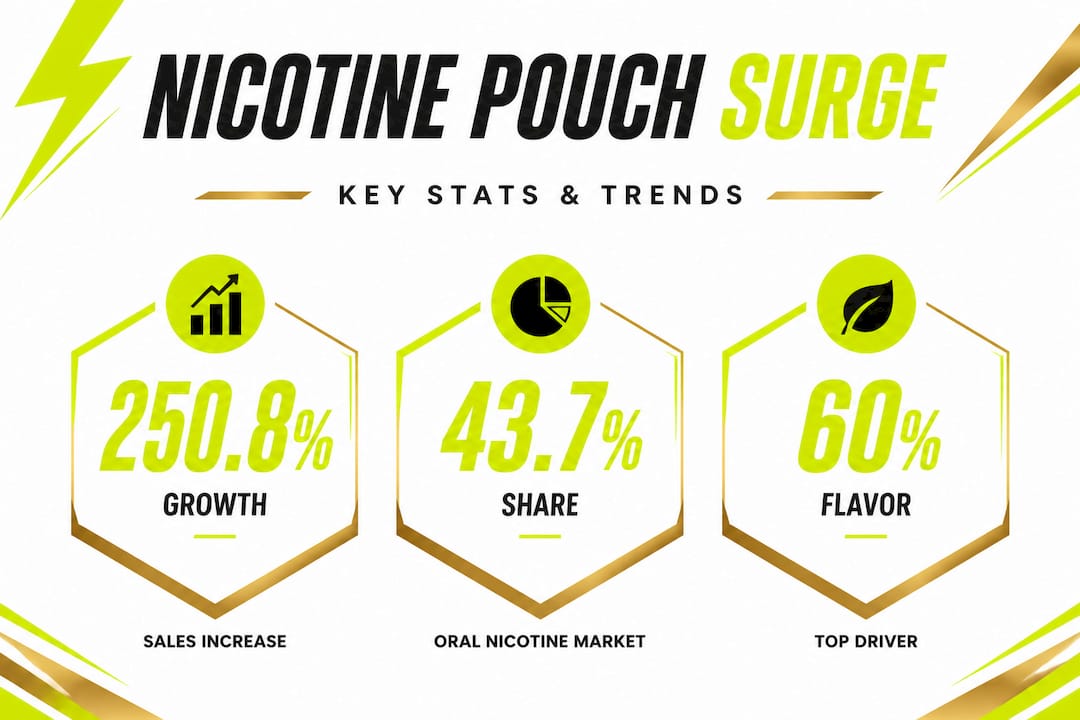
The broader tobacco and nicotine market has also shifted structurally. Pouches now hold 43.7% of the oral tobacco and nicotine market as of 2024, with an average annual percentage change (AAPC) of 113.3% since their introduction. That growth has come directly at the expense of moist snuff and traditional snus, both of which have declined in market share year over year.
Market growth at a glance
| Year | Estimated pouch sales | Market share (oral nicotine) | Top flavour category |
|---|---|---|---|
| 2017 | Negligible | Under 1% | N/A |
| 2020 | Growing rapidly | ~8% | Mint |
| 2023 | $145.5M (Jan) | ~28% | Mint (58%) |
| 2024 | Strong growth | 43.7% | Mint (60%+) |
| 2025 | $510.5M (Aug) | Majority of oral nicotine | Mint + alternatives |
Who’s buying? The data suggests adult smokers and former tobacco users dominate adoption, but younger adult demographics are also entering the market. This matters because it means pouches are not just a curiosity for existing snus users; they’re genuinely pulling in people who would otherwise be smoking.
Key market forces at work:
- Smokeless convenience: No flame, no vapour, no odour. Use one in an office, on a flight, or during a meeting.
- Flavour variety: From classic mint and citrus to berry and coffee, nicotine pouches vs vaping shows pouches can rival vapes for flavour appeal without inhalation.
- Changing social norms: As indoor smoking bans tightened across Europe and North America, demand for discreet alternatives intensified.
- No tobacco leaf: Unlike snus or chewing tobacco, pouches contain no tobacco plant material, making them appeal to users who want nicotine without the stigma of tobacco.
The shift is structural, not cyclical. Pouches have disrupted the oral nicotine category in a way that looks permanent rather than temporary.
Top drivers: flavour, smokeless discretion, and harm reduction
Beyond the market data, there are very real, practical reasons people are choosing pouches over cigarettes, snus, or vaping. Start with discretion. A pouch sits invisibly between your gum and lip. There’s no smoke, no vapour cloud, no smell on your clothes, and no risk of bothering anyone nearby. For adult nicotine users who want to satisfy cravings in public or professional settings, that is enormously valuable.
Harm reduction is the other major driver. Research shows pouches reduce daily cigarette use substantially during transitional periods, with one study noting a drop from 15 cigarettes per day to 8.3 with 4mg pouches. They also deliver nicotine via gum absorption with a Cmax (peak blood concentration) of 27.9 ng/ml, which actually exceeds that of cigarettes in some studies, while exposing users to far fewer harmful and potentially harmful constituents (HPHCs) and tobacco-specific nitrosamines (TSNAs).
How pouches compare to cigarettes and snus
| Feature | Cigarettes | Snus | Nicotine pouches |
|---|---|---|---|
| Tobacco leaf content | Yes | Yes | No |
| HPHC exposure | High | Moderate | Low |
| TSNA levels | High | Moderate | Very low |
| Nicotine absorption speed | Fast (Tmax ~6 min) | Moderate | Slower (Tmax ~30 min) |
| Odour produced | Strong | Mild | None |
| Discreet use possible | No | Partially | Yes |
| Flavour variety | Limited | Limited | Extensive |
The absorption profile is worth understanding properly. Pouches deliver nicotine more slowly and steadily than cigarettes (30 minutes to peak versus 6 minutes), but with a higher sustained peak. For craving management, this is often a better fit than the sharp spike and crash of a cigarette. It mirrors how a nicotine patch works in principle, but with user control over timing and flavour.

For users exploring discreet harm reduction or simply wanting to understand the benefits of nicotine pouches more deeply, the toxicant comparison alone is often the deciding factor. Pouches simply expose you to significantly fewer harmful chemicals than lit tobacco products. That said, they’re not risk-free, and that distinction matters.
Pro Tip: If you’re transitioning from cigarettes, start with a mid-range strength (4mg to 8mg) before jumping to higher options. Matching your nicotine intake closely at the start reduces the urge to dual-use (using both cigarettes and pouches simultaneously), which defeats much of the harm reduction benefit.
The question of nicotine pouches safety relative to cigarettes is increasingly answered by toxicology data. Pouches win on almost every measurable chemical exposure metric. The uncertainty lies not in the comparison but in long-term effects that are still under research.
How pouches support quitting: evidence from Sweden and beyond
Sweden offers the most compelling real-world evidence for pouches as a quitting tool. In Swedish surveys, nicotine pouches are ranked as the top quitting aid, used three times more frequently than vapes and preferred by 56% more users than nicotine gum. That’s a striking result in a country with a long snus tradition and an informed, experienced nicotine user base.
What’s especially notable is the gender split. Women in Sweden particularly favour pouches for quitting, in large part because they’re tobacco-free and socially less stigmatised than snus or cigarettes. In the same survey, 60% of respondents cited flavours as a primary motivator for switching, and 46% said the absence of tobacco was the key factor. These are not trivial preferences. They’re the architecture of motivation.
Here are the top reasons users report switching from smoking to pouches:
- Flavour variety makes the product enjoyable rather than medicinal.
- No tobacco content removes the psychological association with “dirty” habits.
- Social acceptability allows use without disturbing others or attracting attention.
- Smokeless design removes the act of lighting up, which is itself a habitual trigger.
- Availability and affordability relative to cigarettes in many markets.
That said, the evidence isn’t entirely one-sided. Research also shows no significant increase in formal cessation rates when pouches are compared directly to established nicotine replacement therapies (NRT) or e-cigarettes, with this conclusion rated as low-certainty evidence. Dual use is common, meaning many users continue smoking while also using pouches rather than replacing cigarettes entirely.
“The evidence base is growing, but pouches work best when used as a deliberate replacement strategy rather than an addition to smoking.” This is the practical reality most guides overlook.
For women quitting with pouches, the Swedish data provides a particularly useful model. For anyone looking at how to reduce smoking with pouches or planning a structured switch to pouches, having a clear plan matters more than the product alone. There is also an interesting comparison to be made when looking at pouches vs patches and gum, particularly around user engagement and flavour motivation, where pouches have a real advantage.
Mechanics of nicotine pouches: absorption, strengths and regulatory shifts
Understanding how pouches work on a physiological level helps you choose the right product and use it effectively. Nicotine in a pouch is absorbed primarily through the mucous membranes of the mouth, specifically the gum tissue and inner cheek, rather than the lungs. This route is slower but produces a steadier blood nicotine level, which is why many users find it easier to manage cravings without the sharp peaks and troughs that accompany smoking.
Key mechanics to know:
- Absorption speed: Tmax of approximately 30 minutes versus 6 minutes for cigarettes, meaning the nicotine builds gradually rather than hitting immediately.
- Peak levels: Despite slower absorption, pouches can reach higher sustained peak nicotine concentrations than cigarettes in controlled studies.
- Strength range: Products typically range from 2mg to 20mg of nicotine per pouch. Higher strengths of 14 to 20mg tend to satisfy heavy smokers more effectively and are often preferred by those smoking 20 or more cigarettes per day.
- Craving duration: A pouch lasts 20 to 60 minutes depending on the brand and individual, providing extended craving relief compared to a 5-minute cigarette.
Regulation is actively reshaping the market. Flavour bans in California, Massachusetts, and France have already shifted sales patterns in those regions towards unflavoured products. This is a significant trend because, as we’ve seen, flavour accounts for over 84% of pouch sales by revenue. Where flavours are restricted, user uptake drops and some users revert to cigarettes, which is a troubling public health consequence of poorly designed regulation.
Pro Tip: Before purchasing, always check the legal status of flavoured pouches in your region. If flavoured options are restricted near you, look for herbal pouches as a nicotine-free option, or choose unflavoured pouches from reputable brands at a strength that genuinely meets your need.
Understanding nicotine absorption is also useful when comparing pouches to vaping. Vaping delivers nicotine extremely rapidly, almost on par with cigarettes, whereas pouches offer the steadier profile. For users trying to break the habitual “hit” of smoking, the slower pouch absorption can actually be a feature, not a drawback.
From an expert standpoint, pouches carry the highest harm reduction potential of any current nicotine product in terms of toxicant exposure. However, the same research emphasises monitoring for dual use and the risk of dependence on pouches themselves. They are not a neutral product, and treating them as one creates problems.
A fresh take: why nicotine pouch popularity is more nuanced than you think
Most discussions about pouch popularity fall into one of two camps: uncritical enthusiasm or blanket scepticism. Neither is particularly useful if you’re an adult who smokes and is genuinely trying to make a better choice.
The harm reduction case for pouches is strong, arguably stronger than for any other currently available nicotine product when measured by toxicant exposure. Research confirms high harm reduction potential compared to cigarettes and snus. But potential is not the same as outcome. Potential requires intention. If you continue smoking while occasionally using a pouch, you are not reducing harm in any meaningful way.
The dual-use trap is the single biggest risk for new pouch users, and it’s rarely discussed plainly. Pouches are so pleasant and convenient that many users simply add them to their smoking routine rather than replacing cigarettes. The product is doing its job; the strategy is failing. This is why we think the “harm reduction” framing, while accurate, can mislead without proper context.
Flavour bans are the other issue that deserves a frank conversation. The evidence is clear that flavours drive adoption among adult smokers. Banning them may reduce youth appeal (a legitimate concern) but also removes the primary motivational tool that makes switching viable for adults. It is a real tension, and anyone who claims the answer is simple has not read the data carefully.
Our practical advice: use pouches as a deliberate replacement tool with a specific goal, whether that’s cutting down your daily cigarette count, switching fully, or managing cravings in contexts where smoking is not possible. Explore discreet harm reduction options thoughtfully and honestly. Set a timeline. Track your cigarette use. The product won’t do the work for you, but it can make the work considerably easier.
Explore smokeless alternatives with HitSnus
If this article has clarified what pouches can offer, the natural next step is finding quality products that suit your strength, flavour preference, and legal requirements.
At HitSnus, we stock a wide range of nicotine pouches including ZYN, Velo, FUMI, and more, across multiple strengths and flavours to match where you are in your journey. Whether you’re a heavy smoker exploring high-strength options for the first time or someone already using pouches and looking to refine your choice, our catalogue gives you the range to experiment and find what actually works for you. We also publish detailed guidance on topics like the safety of pouches so you can shop with confidence and make genuinely informed decisions. Fast delivery and clear product information come as standard.
Frequently asked questions
How do nicotine pouches compare to vaping and cigarettes for craving control?
Nicotine pouches provide slower, steadier absorption with a higher sustained peak than cigarettes, offering effective craving management without inhalation or vapour. Many users find this profile easier to manage across longer periods than the rapid spike from smoking or vaping.
Are nicotine pouches safer than cigarettes and snus?
Pouches typically carry the lowest toxicant levels of any current nicotine product, making them a strong harm reduction option, though they are not entirely risk-free. They contain no tobacco leaf and produce no combustion byproducts.
Do flavoured nicotine pouches help with quitting smoking?
In Sweden, pouches are rated the top quitting aid, ranked above both gum and vapes, with 60% of users citing flavour as the key reason for switching. Flavours make the product genuinely appealing rather than purely functional, which matters enormously for sustained habit change.
Does using pouches guarantee quitting smoking?
No. Research shows no significant cessation improvement over NRT or e-cigarettes in controlled studies, and dual use is common. Pouches work best as part of a deliberate reduction or replacement strategy rather than as a passive solution.
How does regulation affect pouch flavours and strengths?
Where flavour restrictions apply, such as in California, Massachusetts, and France, sales shift to unflavoured products and higher strengths become more prominent among remaining users. This affects product availability significantly depending on where you’re based.