













How to Reduce Smoking with Nicotine Pouches Effectively
Quitting cigarettes feels challenging when habits run deep, especially for those searching for a more discreet and less harmful alternative. Many British adults are discovering that nicotine pouches offer an effective route away from smoking, supporting cravings without the smoke or odour. By focusing on assessing smoking triggers, choosing the right product, and developing step-by-step routines, you can create a personalised plan to move confidently towards a smoke-free life. Clear, achievable goals increase your chances of success.
Table of Contents
- Step 1: Assess Your Smoking Patterns And Set Targets
- Step 2: Choose The Right Nicotine Pouch For Your Needs
- Step 3: Develop A Daily Switching Routine
- Step 4: Monitor Usage And Adjust Your Approach
- Step 5: Evaluate Progress And Reward Milestones
Quick Summary
| Key Point | Explanation |
|---|---|
| 1. Understand your smoking patterns | Track your daily smoking habits to identify triggers and plan your reduction strategy effectively. |
| 2. Choose the right nicotine pouch | Select pouches based on strength, size, flavour, and duration to align with your smoking needs. |
| 3. Establish a consistent switching routine | Create a daily schedule to replace cigarette moments with nicotine pouches, maintaining habitual structure. |
| 4. Continuously monitor and adjust usage | Keep detailed logs of pouch use and cravings to make necessary adjustments for effective transition. |
| 5. Set milestones and reward progress | Celebrate achievements at key milestones to maintain motivation and track the success of your smoking reduction journey. |
Step 1: Assess your smoking patterns and set targets
Understanding your personal smoking behaviour is crucial when planning to reduce cigarette consumption using nicotine pouches. By carefully examining your smoking habits, you can develop a targeted strategy that increases your chances of successfully transitioning away from traditional cigarettes.
Start by tracking your daily smoking routine meticulously. Create a detailed smoking diary where you record:
- Number of cigarettes smoked per day
- Times of day when you typically smoke
- Specific triggers that prompt smoking (stress, after meals, social situations)
- Emotional states associated with smoking
This comprehensive assessment will help you understand your nicotine dependence level and identify specific patterns. Public Health England suggests that two-thirds of smokers want to quit, and those with clear, achievable goals are more likely to succeed. Consider using established assessment tools like the Fagerström Test to quantify your nicotine dependence and develop a personalised reduction plan.
Setting realistic, incremental targets is more effective than attempting sudden, drastic changes.
Establish progressive reduction goals that feel manageable. For instance, aim to reduce cigarette consumption by 25% in the first month, then gradually introduce nicotine pouches as a replacement strategy. This approach allows your body to adapt while maintaining nicotine intake through a less harmful alternative.

Expert tip: Keep your smoking diary digital or in a small notebook you can carry everywhere, ensuring you capture every smoking instance with complete honesty.
Step 2: Choose the right nicotine pouch for your needs
Selecting the appropriate nicotine pouch is crucial in your journey to reduce smoking effectively. Understanding nicotine pouch variations will help you make an informed decision that supports your personal smoking reduction strategy.
Consider the following factors when choosing your nicotine pouch:
- Nicotine strength matching your current cigarette consumption
- Pouch size and comfort (regular, slim, or mini)
- Flavour preferences
- Duration of nicotine release
Nicotine pouches come in various strengths to accommodate different levels of dependence. If you are a heavy smoker, start with a higher nicotine concentration and gradually reduce the strength. For lighter smokers, lower-strength options might be more suitable.
The key is finding a pouch that satisfies your nicotine craving while supporting your reduction goals.
Pay attention to the physical characteristics of the pouch. Some users prefer slim or mini pouches for discretion, while others might prioritise longer-lasting nicotine release. Experiment with different brands and types to find your ideal match.
Here is a comparison of nicotine pouch characteristics to help you make an informed choice:
| Pouch Characteristic | Impact on Experience | Best For |
|---|---|---|
| Nicotine Strength | Influences craving control | Heavy or light smokers |
| Pouch Size | Affects comfort and discretion | Public or private use |
| Flavour Variety | Enhances satisfaction | Users seeking novelty |
| Release Duration | Controls craving intervals | Those needing longer relief |
Expert tip: Begin with a variety pack to test different strengths and flavours before committing to a full box.
Step 3: Develop a daily switching routine
Establishing a consistent daily routine is critical when transitioning from cigarettes to nicotine pouches. Developing structured pouch usage can help manage nicotine cravings and support your smoking reduction goals.
Create a strategic replacement schedule that mirrors your previous smoking patterns:
- Identify your typical cigarette trigger points throughout the day
- Replace each cigarette moment with a nicotine pouch
- Set specific times for pouch placement
- Track your progress in a daily journal
Timing is crucial. For instance, if you traditionally smoked after breakfast, replace that cigarette with a nicotine pouch at the same time. This approach helps maintain your existing routine while gradually reducing tobacco consumption.
Consistency transforms occasional substitution into a sustainable lifestyle change.
Pay attention to your body’s response. Some users find morning and post-meal pouches most effective for managing nicotine requirements. Experiment with placement duration and frequency to find your optimal routine.
Expert tip: Keep your nicotine pouches in the same place you used to store cigarettes to help reinforce your new habit.
Step 4: Monitor usage and adjust your approach
Successfully transitioning from cigarettes requires careful observation and flexibility. Tracking nicotine pouch effectiveness helps you understand your body’s response and make informed adjustments.
Keep a detailed log of your nicotine pouch usage that includes:
- Number of pouches used daily
- Strength of nicotine pouches
- Timing of pouch placement
- Intensity of cigarette cravings
- Any side effects experienced
Watch for physical signals. If you experience nausea, mouth irritation, or persistent cravings, this indicates you might need to adjust your nicotine strength or frequency. Start by reducing pouch strength incrementally or changing placement duration.
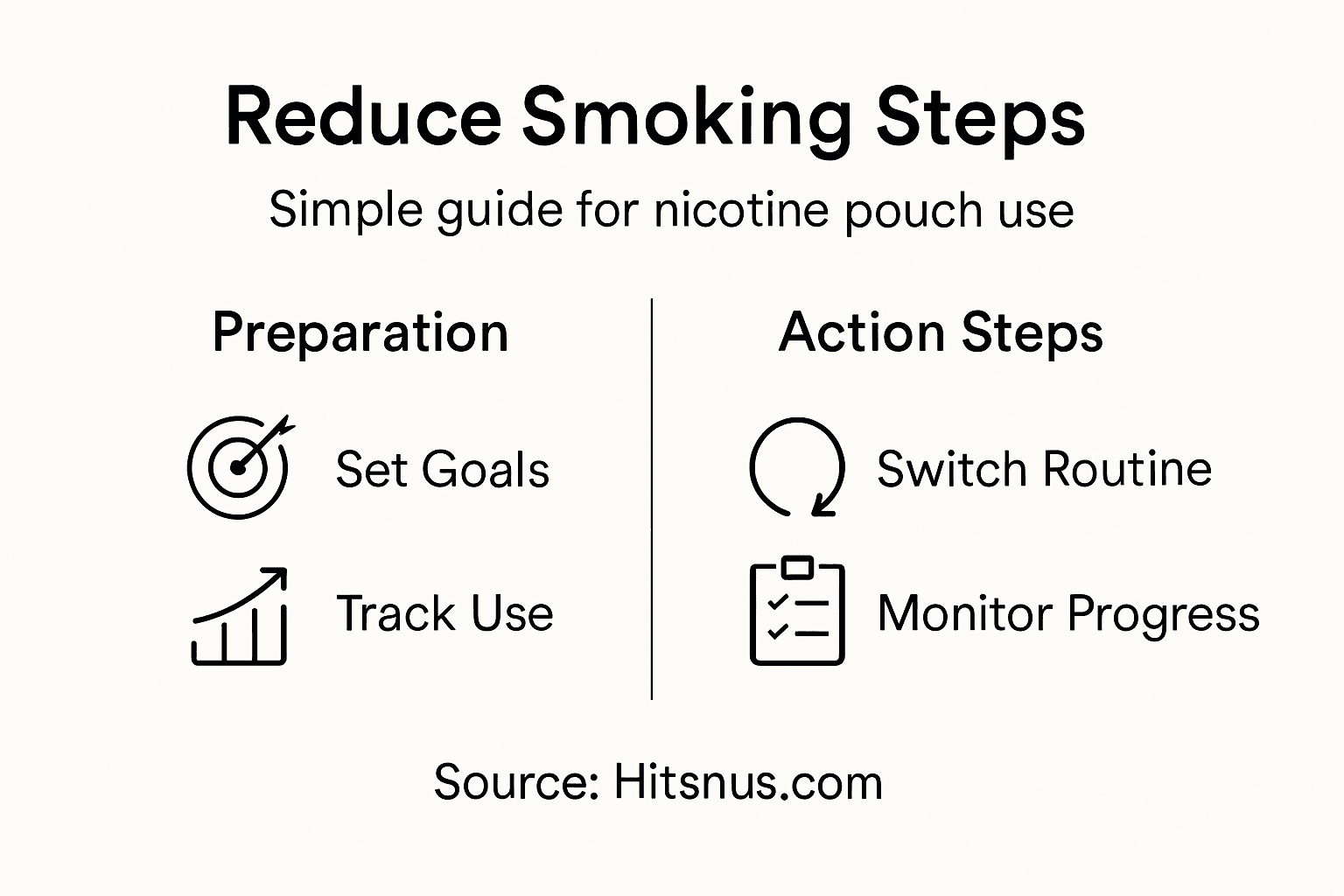
Here is a summary of signals and actions for adjusting your nicotine pouch usage:
| Signal Observed | Recommended Adjustment | Likely Outcome |
|---|---|---|
| Increased cravings | Opt for higher strength pouch | Better craving management |
| Mouth irritation or nausea | Reduce pouch strength or change placement | Enhanced comfort and tolerability |
| Frequent pouch use | Extend duration per pouch | Lower overall consumption |
| Persistent side effects | Try alternative brands or flavours | Minimise adverse effects |
Small, consistent adjustments are more sustainable than drastic changes.
Be patient with yourself during this transition. Some days will be easier than others, and your body needs time to adapt to the new nicotine delivery method. Regular self-assessment allows you to fine-tune your approach and stay committed to reducing smoking.
Expert tip: Set a monthly review date to evaluate your progress and recalibrate your nicotine pouch strategy.
Step 5: Evaluate progress and reward milestones
Tracking your smoking reduction journey requires structured reflection and positive reinforcement. Setting measurable quit milestones helps maintain motivation and provides clear evidence of your progress.
Establish meaningful progress tracking through these key milestones:
- One week completely smoke-free
- Two weeks of reduced cigarette consumption
- One month without traditional cigarettes
- Successful nicotine pouch adaptation
- Reduced daily nicotine dependence
Create a reward system that celebrates each achievement. These rewards should be meaningful and personally motivating, such as purchasing something you’ve wanted, enjoying a special meal, or saving the money you would have spent on cigarettes.
Small victories compound into significant life changes.
Consider using objective verification methods like carbon monoxide testing to confirm your smoke-free status. This provides tangible proof of your progress and can be incredibly motivating. Some healthcare providers offer free testing to support smoking cessation efforts.
Expert tip: Keep a visual progress chart where you can mark each milestone, providing a constant reminder of how far you’ve already come.
Discover Effective Smoking Reduction with Premium Nicotine Pouches
Reducing your cigarette consumption can be challenging, especially when managing cravings and establishing new routines. This article spotlighted key steps like understanding your smoking patterns, selecting the right nicotine strength, and developing a steady daily switching routine. At Hitsnus.com, we provide a thoughtfully curated selection of high-quality nicotine pouches designed to support your journey towards smokeless nicotine use. Our range includes varieties tailored to different strengths and flavour preferences, such as the popular FUMI collection and the uniquely intense Spicy Nicotine Pouches, helping you find the perfect fit for your personal goals.
Start reducing cigarette use today by exploring our diverse offerings at Hitsnus.com. Embrace discreet, satisfying nicotine alternatives that align with your progressive reduction targets. Visit our site now to take the first step in transforming your smoking habits with trusted products crafted for adult users seeking convenient and effective solutions.
Frequently Asked Questions
How can I assess my smoking patterns to reduce consumption?
Understanding your smoking behaviour is the first step in reducing consumption. Track your daily smoking by maintaining a diary that notes the number of cigarettes, times of day you smoke, triggers, and emotional states, then analyse this data to set realistic reduction targets.
What should I consider when choosing a nicotine pouch?
When selecting a nicotine pouch, consider factors such as nicotine strength, pouch size, flavour preferences, and how long the nicotine release lasts. Start with a strength that matches your current smoking levels and try different sizes and flavours to find what works best for you.
How do I create a daily routine for using nicotine pouches?
Establish a daily routine by replacing traditional cigarette moments with nicotine pouches at specific times of the day. For instance, if you typically smoke after meals, use a nicotine pouch instead during those times to help manage cravings.
How can I monitor my nicotine pouch usage?
Monitoring your use involves keeping a log of the number of pouches used, their strength, and the timing of usage along with your cravings and any side effects. Regularly review this log to identify patterns and make necessary adjustments to your pouch usage.
What milestones should I track while reducing smoking?
Track milestones such as one week smoke-free, two weeks of reduced cigarette consumption, and one month without traditional cigarettes. Celebrate these achievements with meaningful rewards to maintain motivation along your journey to smoke reduction.
How should I adjust my approach if I experience cravings or side effects?
If you experience cravings or side effects like nausea, consider adjusting your nicotine pouch strength or frequency of use. For example, if cravings increase, trying a higher-strength pouch may help manage them more effectively while keeping track of your overall consumption.