













Nicotine pouches and oral health: benefits and risks
TL;DR:
- Nicotine pouches can improve oral health by reducing gum inflammation, bleeding, and staining compared to smoking. However, they may cause oral irritation, white lesions, or recession with heavy use, and long-term cancer risk remains uncertain. Behavior and proper oral hygiene are crucial for maximizing their benefits and minimizing risks.
Not all nicotine products harm your mouth in the same way, and understanding the difference could genuinely change your oral health trajectory. Nicotine pouches have surged in popularity across the UK as smoke-free alternatives, yet most switchers make the leap without a clear picture of what they are actually putting inside their mouths. This article cuts through the confusion by drawing on the latest randomised clinical trial evidence, real-world side effect data, and independent research to give you an honest, detailed account of what pouches can and cannot do for your oral health.
Table of Contents
- What are nicotine pouches and how do they work?
- How do pouches impact oral health for smokers switching?
- Risks and side effects: what can pouches do to your mouth?
- Do pouches reduce cancer risk and how reliable is the research?
- The real story behind nicotine pouches and oral care
- Explore safer alternatives and manage your oral health with HitSnus
- Frequently asked questions
Key Takeaways
| Point | Details |
|---|---|
| Slower, smoke-free nicotine | Pouches deliver nicotine without smoke and at a steadier pace than cigarettes. |
| Gum health can improve | Switching from smoking to pouches often leads to better gum and staining outcomes. |
| Watch for local side effects | Pouches can still cause local mouth irritation or sores, especially if overused. |
| Lower harmful compound levels | Pouches contain fewer toxic substances than cigarettes or snus, but long-term risks are not fully known. |
| Use habits shape impact | How often and where you use pouches, plus oral hygiene, greatly affect oral health outcomes. |
What are nicotine pouches and how do they work?
Nicotine pouches are small, white, tobacco-leaf-free sachets designed to sit between your gum and upper lip. You place one in position, leave it for 15 to 60 minutes, and then discard it. There is no spitting, no smoke, and no combustion involved. That simplicity is a big part of why so many adult smokers are giving them a serious look.
The contents are more varied than they appear. Nicotine pouches contain nicotine salts, fillers such as cellulose, pH adjusters, flavourings, and sometimes sweeteners. The nicotine salt form is key because it is gentler on soft tissue at higher concentrations and absorbs efficiently through the lining of your mouth, known as the oral mucosa. This means you never inhale anything, and tobacco-specific combustion products never reach your airways or your teeth.
Compared to cigarettes, the delivery mechanism is notably different. Smoking delivers nicotine in rapid pulses directly to the lungs and then the brain in seconds. Pouches work through passive diffusion across mucous membranes, which is slower. However, research confirms that pouches achieve comparable blood nicotine levels to cigarettes, just with a gentler onset curve. This is actually useful for smokers who want to manage cravings without the sharp spikes and crashes.
| Feature | Cigarettes | Nicotine pouches | Nicotine gum |
|---|---|---|---|
| Delivery route | Lungs | Oral mucosa | Oral mucosa |
| Onset speed | Very fast (seconds) | Moderate (5–10 min) | Slow (15–30 min) |
| Combustion by-products | Yes | No | No |
| Tooth staining risk | High | Low | Moderate |
| Discreet usage | No | Yes | Partially |
For smokers who have tried patches or gum without success, pouches occupy a useful middle ground. If you want to understand more about why some users prefer them, the nicotine pouch benefits breakdown is worth reading alongside a broader comparison of pouches vs patches and gum.
With the basics in mind, let’s explore how using pouches affects your oral health compared to traditional smoking.
How do pouches impact oral health for smokers switching?
The oral health case for switching is building steadily. A randomised controlled trial (RCT) involving adult smokers who switched to nicotine pouches showed measurable improvements across multiple markers after just a few months. The findings are genuinely encouraging, not because pouches are “safe” in an absolute sense, but because they remove a stack of specific harms that smoking introduces to your mouth daily.
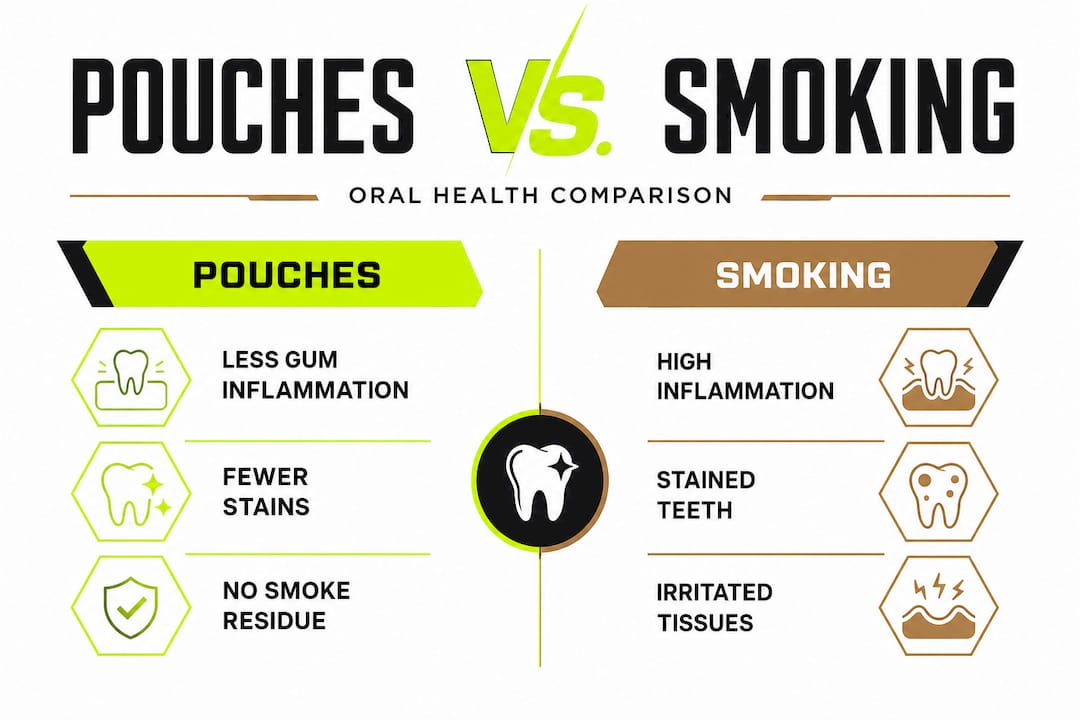
Switching to pouches improves gum inflammation, bleeding on probing, and tooth staining significantly compared to continuing to smoke. Gingival (gum) inflammation scores improved by up to 28% in participants who made the switch, and bleeding scores, which are a standard clinical marker of gum disease progression, followed a similar downward trend. This is clinically meaningful. Chronic gum inflammation is a precursor to periodontitis, the serious gum disease that can lead to tooth loss.
Here are the three key improvements documented when adult smokers switch to pouches:
- Reduced gingival inflammation: Lower scores on standard indices measuring gum redness and swelling.
- Less bleeding on probing: A direct sign that the gum tissue is becoming healthier and more resilient.
- Decreased tooth staining: Because pouches contain no tar, the brownish discolouration from smoking fades over time.
More than 90% of participants in the referenced RCT reduced their cigarette use to near zero within the trial period, which amplifies all three of the improvements listed above. The lesson is that consistency matters enormously. Partial switching gives you partial benefit.
Pro Tip: Combine switching with twice-daily brushing and flossing from day one. The gum tissue responds quickly when inflammation triggers are removed, and good hygiene accelerates that recovery noticeably.
This is good context for anyone considering using pouches to reduce smoking naturally, and the improvement in clinical outcomes reinforces the argument made in depth on pouches vs cigarettes safety. For a broader perspective on smoke-free approaches, smokeless harm reduction is also worth exploring.
| Oral health marker | Continued smoking | Switched to pouches | Non-user |
|---|---|---|---|
| Gum inflammation | High | Reduced significantly | Low |
| Bleeding on probing | Common | Reduced | Rare |
| Tooth staining | Progressive | Stabilised or improved | Minimal |
| Combustion exposure | Ongoing | None | None |
While switching to pouches shows promise for oral health, it is important to understand other effects and possible drawbacks that come with ongoing use.
Risks and side effects: what can pouches do to your mouth?
Pouches are not without their own set of concerns, and glossing over them would do you a disservice. The most commonly reported side effects from regular pouch use are localised to the area where the pouch sits. Your oral mucosa is not designed to have a flavoured sachet pressed against it for hours every day, and some users do experience reactions.
“Frequent pouch use is linked to white mucosal lesions, dry mouth, gum irritation, and in rare cases, leukoplakia.”
White mouth lesions are the most commonly cited concern. These are patches of thickened white tissue that form at the contact site. In most cases they are reversible if you stop or significantly reduce pouch use. However, in rare instances, persistent lesions can progress to leukoplakia, a pre-cancerous condition that warrants prompt dental review. This is not a reason to panic, but it is a reason to stay observant.
Other side effects users report include:
- Gum soreness or recession at the placement site, particularly with high-strength pouches used frequently
- Dry mouth (xerostomia), which can itself increase cavity risk by reducing protective saliva flow
- Gum recession in cases of sustained daily contact with strong pouches
- Hiccups or nausea in users who are new to nicotine or are using strengths that are too high
- Increased plaque acidity following pouch use, which has been noted in research on plaque acidogenicity effects when users switch from snus to pouches
Pro Tip: Rotate the placement of your pouch around your gum line rather than always placing it in exactly the same spot. This distributes tissue exposure and significantly reduces localised irritation and the risk of persistent lesions.
High-strength pouches used in a “chain-use” pattern, where one pouch follows another without a break, carry the highest risk of local irritation. If you find yourself doing this, it is worth reviewing your strength selection. Dropping one or two milligrams in nicotine concentration often resolves irritation without sacrificing satisfaction. For honest information on teeth staining and pouches and essential pouch safety tips, both are useful references as you build a safe usage routine.

Do pouches reduce cancer risk and how reliable is the research?
This is the question that matters most, and the honest answer requires some nuance. Pouches contain none of the combustion by-products that make cigarettes so damaging. No burning tobacco means no carbon monoxide, no tar, and dramatically lower levels of polycyclic aromatic hydrocarbons (PAHs), which are compounds strongly associated with cancer.
Pouches have lower harmful compound levels than either cigarettes or traditional snus, and the cytotoxicity data (the ability of a substance to damage living cells) is more favourable. However, long-term oral cancer risk from pouches specifically is not yet established by independent data, because the products are simply too new for those studies to exist.
| Harmful compound | Cigarettes | Snus | Nicotine pouches |
|---|---|---|---|
| Tobacco-specific nitrosamines (TSNAs) | Very high | Moderate | Very low to none |
| Combustion by-products (tar, PAHs) | High | None | None |
| Tobacco leaf content | Yes | Yes | No |
| Cytotoxicity in lab studies | High | Moderate | Low |
| Long-term cancer data | Extensive | Moderate | Not yet available |
The funding question is also worth raising plainly. Many studies showing positive outcomes for pouches have been funded by the tobacco and nicotine industry. As one Frontiers in Oral Health review notes:
“Industry-funded studies show benefit, but independent sources consistently call for long-term randomised controlled trials before firm conclusions on cancer risk are drawn.”
This is not a reason to dismiss the positive findings entirely. The cytotoxicity advantage of pouches over cigarettes appears consistently across multiple study designs. But it should temper anyone’s certainty about pouches as a completely risk-free product. If you are interested in separating fact from marketing, the nicotine pouch myths article addresses some of the most persistent misconceptions directly.
The real story behind nicotine pouches and oral care
Here is what we believe most articles get badly wrong: they frame the nicotine pouch question as a binary. Either pouches are safe, or they are dangerous. That framing is too simple, and it does not serve you well if you are actually trying to make a sensible decision.
The clinical evidence points clearly in one direction for smokers who switch completely. Your gum health improves, your staining reduces, and your exposure to the worst carcinogens drops dramatically. That is not a small thing. Gum disease affects roughly half of UK adults over 30, and smoking is one of its most powerful drivers. Removing that driver matters.
But pouches are still a nicotine delivery product used inside your mouth, and how you use them shapes what they actually do to your tissue. A person who places a high-strength pouch in the same spot on their lower gum for eight hours a day is going to experience very different outcomes to someone who uses a moderate-strength pouch for 20 minutes, twice daily, in varied positions, whilst maintaining an excellent brushing and flossing routine.
The pouch benefits overview gives you the fuller picture, but the core insight from harm reduction research built over decades is this: behaviour matters as much as product choice. The people who benefit most from switching are those who treat the change with discipline, inform their dentist, maintain their oral hygiene, and actually stop smoking rather than using both products indefinitely.
Pro Tip: Tell your dentist you use nicotine pouches. Many practitioners are not yet familiar with the product category, but they can monitor for early signs of mucosal change and give you personalised advice that no article can provide.
What we consistently see is that users who engage actively with their oral care after switching get the best outcomes. The shift from passive acceptance (“pouches are better so I do not need to worry”) to active management (“I am switching AND improving my habits”) is where the real gains live.
Explore safer alternatives and manage your oral health with HitSnus
If this article has helped clarify your thinking about pouches and oral health, the logical next step is finding products that support a mindful approach to nicotine use. Lower to medium strength pouches are particularly well suited for anyone who is actively switching from smoking, as they reduce the risk of overuse and local tissue irritation while still managing cravings effectively.

At HitSnus, we stock a wide range of nicotine pouches from established brands like ZYN, Velo, and FUMI, covering a spectrum of strengths and flavours. If you are new to pouches or have been using higher-strength products and want to step down, our medium strength options offer a practical starting point that balances satisfaction with a gentler profile for your oral tissue. Browse by brand or strength and find a format that fits your goals.
Frequently asked questions
Can using nicotine pouches improve gum health compared to smoking?
Switching from smoking to pouches has been associated with improvements in gum inflammation and bleeding scores in clinical trials, with some participants seeing up to 28% improvement in gingival scores.
Are nicotine pouches safe for long-term oral health?
Pouches reduce many exposures linked to smoking, but they may still cause lesions, irritation, or recession with heavy use, and long-term cancer risk data remains limited due to the products’ relative novelty.
What symptoms should I watch out for if I use nicotine pouches?
Watch for persistent white patches, gum soreness, or notable recession at placement sites, as these may indicate tissue irritation; white mucosal lesions and soreness are the most commonly reported adverse effects.
Do nicotine pouches stain teeth as much as cigarettes or snus?
Evidence from clinical studies indicates pouches cause significantly less tooth staining than cigarettes, largely because they contain no tar; reduced staining was a consistent finding in the switching RCT reviewed above.