




Nicotine pouch portion size: safe and effective use
TL;DR:
- Pouch portion size refers to nicotine content, but actual absorption depends on various factors.
- Choosing the right size involves considering tolerance, absorption rates, and personal comfort.
- Moderate strengths (6-10mg) generally provide the best, most satisfying experience without side effects.
Most people pick up a nicotine pouch, glance at the number on the tin, and assume bigger means better. It is a natural assumption, but it leads to poor experiences, wasted money, and for newcomers, real discomfort. The figure on the label only tells part of the story. How much nicotine your body actually absorbs depends on far more than a single number, and choosing the wrong portion size can leave you under-satisfied or overwhelmed. This guide breaks down exactly what pouch portion size means, how it affects your experience, and how to find the size that genuinely works for you.
Table of Contents
- What is pouch portion size and why does it matter?
- How different pouch portion sizes impact nicotine intake
- Key factors influencing how a pouch releases nicotine
- Regional differences and practical guidance for choosing your portion size
- A fresh perspective: why finding your right pouch portion size beats chasing the strongest options
- Explore high-quality nicotine pouches with the portion size that suits you
- Frequently asked questions
Key Takeaways
| Point | Details |
|---|---|
| Absorption is partial | Only a quarter to two-fifths of a pouch’s nicotine ends up in your system. |
| Choose by tolerance | Your ideal portion size depends more on personal tolerance than just the product’s label. |
| Not all pouches feel alike | Release rate, moisture, and design make some pouches stronger or milder than others even at the same mg. |
| Safer use means moderation | Most adults are satisfied and safe using 4-10 pouches daily within recommended strengths. |
What is pouch portion size and why does it matter?
Portion size in nicotine pouches refers to the total amount of nicotine contained within a single pouch, usually expressed as mg per pouch or mg per gram (mg/g). These two figures are related but distinct. A pouch weighing 0.5g with a concentration of 12mg/g contains roughly 6mg of nicotine. Many brands lead with the mg/g figure because it sounds more impressive, which is why reading labels carefully matters.
If you are just getting started, the nicotine pouch basics are worth reviewing before you commit to any particular strength. Understanding what you are looking at saves you from choosing something far too strong or far too mild for your needs.
Here is a key point that surprises most users: your body does not absorb all the nicotine in a pouch. Only 25-40% of nicotine per pouch is absorbed by the body. That means a 10mg pouch delivers roughly 2.5mg to 4mg of actual nicotine into your system.
| Pouch strength (mg/pouch) | Estimated absorption (25-40%) |
|---|---|
| 4mg | 1.0 to 1.6mg absorbed |
| 6mg | 1.5 to 2.4mg absorbed |
| 8mg | 2.0 to 3.2mg absorbed |
| 12mg | 3.0 to 4.8mg absorbed |
| 20mg | 5.0 to 8.0mg absorbed |
This absorption gap matters enormously. Two users placing a 6mg pouch under their lip will not have identical experiences because individual factors like saliva production, gum permeability, and pouch placement all influence how much actually reaches the bloodstream.
Common misconceptions also trip people up:
- “Strong” labels do not always mean high mg/pouch. Some brands use “strong” for 6mg and others for 16mg.
- mg/g is not mg/pouch. A product listed at 20mg/g does not contain 20mg per individual pouch unless each pouch weighs exactly 1g.
- Nicotine hits are not instant. Pouches release nicotine gradually over 20 to 60 minutes, unlike cigarettes which spike quickly.
The safe pouch usage guide covers placement and timing in detail, which is just as relevant as strength when it comes to getting the experience right.
Pro Tip: Always check the mg per pouch figure, not just the brand’s own strength rating. Two products from different brands at “medium” strength can vary by as much as 4mg per pouch.
How different pouch portion sizes impact nicotine intake
Choosing between a 3mg and a 12mg pouch is not simply a matter of getting more or less nicotine. The entire experience changes: the speed of onset, the sensation in your gum, and the duration of the effect all shift with portion size.

For context, a standard cigarette delivers approximately 1 to 2mg of absorbed nicotine per smoke. A 6mg pouch, absorbing at 40%, delivers around 2.4mg absorbed, which is comparable. This makes mid-range pouches a natural entry point when comparing strengths and choosing what fits your current tolerance.
| User type | Recommended portion size | Typical absorbed amount |
|---|---|---|
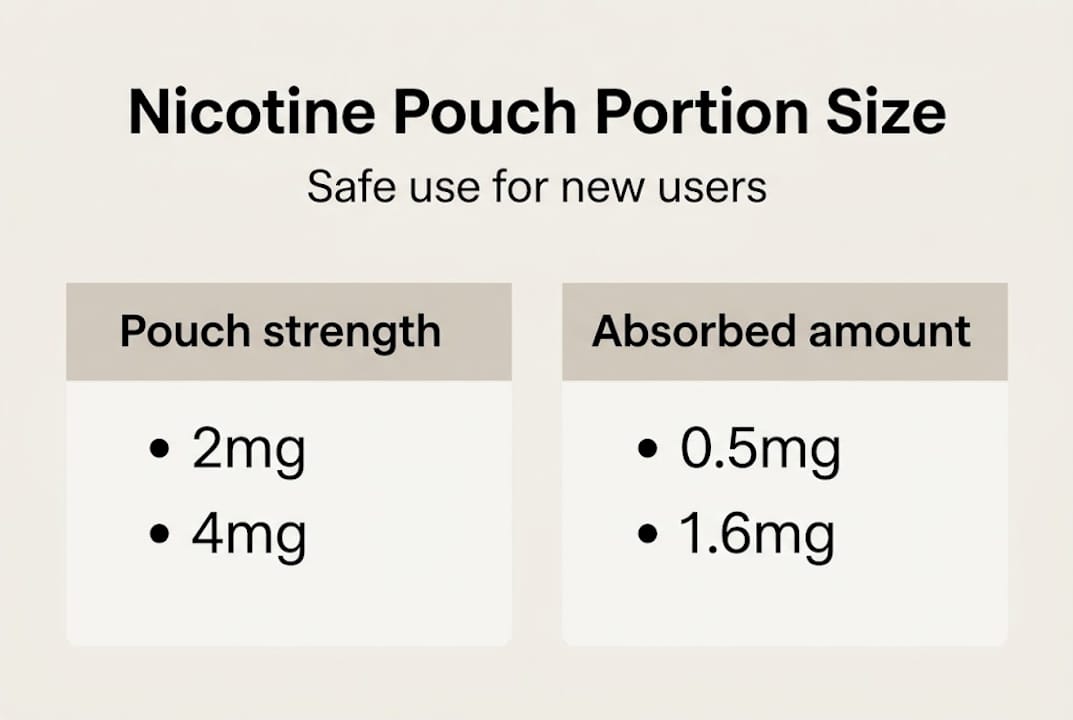
| Beginner | 2 to 4mg | 0.5 to 1.6mg |
| Moderate user | 6 to 8mg | 1.5 to 3.2mg |
| Experienced user | 10 to 20mg | 2.5 to 8.0mg |
Research on dose-dependent effects shows that as pouch strength increases, side effects including nausea, hiccups, and dizziness become progressively more likely, particularly in users who have not built up a tolerance. The strongest pouches are not simply “more efficient” versions of milder ones. They are a different experience entirely.
Daily recommendations are 4-10 pouches depending on strength and tolerance, and straying significantly outside that range is where most problems begin. See how nicotine absorption changes across different product types for a broader picture.
Here is a sensible sequence for adjusting your portion size safely:
- Start with 2mg to 4mg pouches for at least one week.
- Note how you feel after 30 minutes. Mild buzz, no nausea? You may be ready to step up.
- Increase by one strength tier only, not multiple steps at once.
- Give each new strength at least three to five sessions before judging it.
- If any session causes dizziness or discomfort, drop back down immediately.
The biggest mistake experienced users make is assuming that escalating to stronger pouches equals more satisfaction. In reality, absorption plateaus as strength increases, meaning the return on each additional milligram shrinks.
Key factors influencing how a pouch releases nicotine
Two pouches can carry the same mg per pouch and still feel completely different in use. This is not a fluke or a branding trick. It comes down to four variables that determine how nicotine is released and how your body receives it.
As research into release mechanics confirms, release speed is affected by pouch material, moisture, and pH, all of which vary considerably between brands and product lines.
- Moisture content: Wetter pouches release nicotine faster and create a stronger initial sensation. Drier formats release more gradually, which some users find subtler and more comfortable for long sessions.
- pH level: Nicotine is absorbed more readily in alkaline conditions. Manufacturers adjust the pH of their pouches, which affects how much nicotine crosses the gum membrane and how quickly the effect is felt.
- Pouch material: The permeability of the pouch casing controls the rate at which nicotine diffuses outward. Thinner, more permeable materials deliver faster; thicker casings slow things down.
- Fill style: Loose-fill pouches, which shift and pack around the gum, tend to offer greater surface contact and therefore faster absorption compared to hard-pressed formats.
A 6mg pouch from one brand may feel noticeably stronger than a 6mg pouch from another, simply because of differences in moisture, pH, and casing material. The number on the tin is a starting point, not the full story.
This is why reading user reviews and sampling different brands matters, especially when you are deciding between mild and strong pouches. Two products with identical mg ratings can produce markedly different sessions.
Pro Tip: If a pouch feels too strong but has the same mg as one you usually tolerate, check its moisture level and format. Switching to a drier or hard-pressed version of the same strength often solves the issue without changing your portion size.
Regional differences and practical guidance for choosing your portion size
Not every nicotine pouch on the market is available everywhere, and the strengths on offer vary significantly by region. Understanding why helps you make smarter choices, particularly if you order from international sources or travel frequently.
Key regional differences include:
- EU pouches can reach up to 20mg per pouch, while the US market more commonly offers 3 to 9mg per pouch.
- Scandinavian markets, where snus culture is well established, tend to feature a broader range of strengths with well-defined labelling conventions.
- UK-specific regulations in 2026 continue to evolve, and products must comply with current nicotine product standards, which affects what strengths are readily available through domestic retailers.
- Some brands use identical product names across regions but adjust nicotine content to meet local requirements, so always verify the mg/pouch on the specific product page.
Here is a straightforward approach to choosing your portion size:
- Identify your current nicotine habits and what you are trying to achieve.
- Use the user type table above as a starting guide.
- Order a sample or starter pack from a product range with clearly labelled mg/pouch figures.
- Track your daily usage and how you feel throughout the day.
- Adjust only when you have stable, comfortable use across multiple days.
For pouch safety essentials, the principle is straightforward: prioritise comfort and consistency over chasing the highest mg available. A 6mg pouch used correctly and consistently will almost always outperform a 20mg pouch used infrequently out of caution.
| Goal | Recommended portion size | Key consideration |
|---|---|---|
| Quitting cigarettes | 6 to 8mg | Match your current absorbed intake |
| Discreet, low-key use | 2 to 4mg | Minimal sensation, longer sessions |
| High tolerance maintenance | 10 to 16mg | Monitor for side effects daily |
| Occasional social use | 2 to 4mg | Avoid dependence with low frequency |
For UK-based newcomers, the beginner pouch recommendations are a solid foundation before experimenting with anything above 6mg.
A fresh perspective: why finding your right pouch portion size beats chasing the strongest options
There is a persistent idea in nicotine pouch culture that higher strength equals better value. It does not. What it equals is faster tolerance build-up, more pronounced side effects, and a narrowing window of products that actually satisfy you.
The most consistent, enjoyable users we observe are not the ones using 20mg pouches. They are the ones who have found their comfortable range, typically somewhere in the 6mg to 10mg band, and stuck with it. They use their pouches with intention and get a reliable experience every time.
Chasing extreme strengths creates a cycle where your tolerance climbs and your satisfaction stays flat. Gradual self-awareness, honest assessment of your habits, and a willingness to stay in the moderate range will serve you far better in the long run. Making wise strength choices is ultimately about understanding your own tolerance, not proving anything.
Explore high-quality nicotine pouches with the portion size that suits you
Now that you understand how portion size, absorption, and release mechanics all play into your experience, the next step is finding the products that match your needs.
At Hitsnus.com, you will find a wide range of nicotine pouches across every strength tier, from gentle 2mg options perfect for beginners to robust formats for experienced users. Brands like ZYN, Velo, and FUMI are all clearly labelled with mg per pouch so you can shop with confidence. If you want to try something new without committing to full price, the clearance nicotine pouches section regularly features discounted stock across a variety of strengths and flavours. Fast UK delivery and straightforward product descriptions make it easy to put today’s learning straight into practice.
Frequently asked questions
How much nicotine do you actually absorb from a pouch?
On average, only 25-40% of the nicotine in a pouch is absorbed into your system, depending on pouch design and your individual habits.
What portion size should a beginner start with?
Beginners do best with pouches containing 2 to 4mg of nicotine to minimise the risk of side effects like dizziness or nausea.
How many nicotine pouches can you use per day?
Most adults find that 4-10 pouches daily is a typical range, adjusted for pouch strength and personal tolerance.
Why do two pouches with the same mg feel different?
Factors such as moisture, pH, and pouch material alter release speed and absorption, meaning identical mg ratings can produce noticeably different sensations.