












Find your ideal nicotine dosage: a practical guide
Nicotine dosage is not as simple as picking a number off a label. The same milligram strength can feel completely different depending on whether you’re using a pouch, a patch, or a cigarette, because each product delivers nicotine at a different speed and rate. Nicotine pouches are categorised by strength and absorb more slowly than smoking, which means the experience is genuinely different even at equivalent doses. Whether you’re switching from cigarettes, stepping down from vaping, or trying pouches for the first time, this guide will help you match your intake to your body, your habits, and your goals.
Table of Contents
- Why nicotine dosage matters: avoiding pitfalls and maximising benefits
- Nicotine dosage categories: how strengths compare across products
- How to calculate and track your ideal nicotine dose
- Expert advice: choosing strength for your goals (quitting, reducing, switching)
- Adapting your dosage: fine-tuning for daily life and changing needs
- Find the right nicotine products for your journey
- Frequently asked questions
Key Takeaways
| Point | Details |
|---|---|
| Dosage varies widely | Not all products deliver nicotine in the same way or at the same pace. |
| Personalise your intake | Calculate your ideal dose by factoring in previous habits and how you feel throughout the day. |
| Start low, adjust | Begin with the lowest effective dose and fine-tune based on cravings and side effects. |
| Expert guidance | Medical sources recommend using regulated NRT for quitting, while pouches may be suitable for harm reduction. |
| Track and adapt | Log your usage and symptoms to ensure your dosing remains safe and effective over time. |
Why nicotine dosage matters: avoiding pitfalls and maximising benefits
Getting your dose wrong is one of the most common reasons people give up on nicotine alternatives before they’ve had a fair chance. Too little and the cravings come back hard, making you reach for a cigarette out of frustration. Too much and you’re dealing with nausea, a racing heart, or a headache that puts you off the product entirely.
The goal is to find the dose that satisfies your cravings without causing discomfort. That sweet spot is different for everyone, and it shifts over time as your body adjusts. Here’s what proper dosing actually protects you from:
- Underdosing: Persistent cravings, irritability, and failed transitions back to smoking
- Overdosing: Nausea, dizziness, hiccups, and increased heart rate
- Inconsistent dosing: Unpredictable satisfaction that makes it harder to build a reliable routine
- Wrong product type: Choosing a format whose absorption speed doesn’t match your craving pattern
Absorption rates vary significantly between product types. A cigarette delivers nicotine to the bloodstream within seconds. A pouch takes 15 to 30 minutes to reach peak levels. A patch works over 16 to 24 hours. Understanding this changes how you plan your day and how many pouches you actually need.
“Pouches offer discreet delivery but should always be used at the lowest effective dose.” This principle is the foundation of safe, sustainable nicotine use.
Pro Tip: Read up on nicotine safety explained before you start experimenting with strengths. Knowing the basics prevents the most common beginner mistakes. Healthcare providers also have access to nicotine pouch provider guidance that outlines clinical recommendations for dosing.
Nicotine dosage categories: how strengths compare across products
The numbers on a nicotine pouch tin refer to the total milligrams of nicotine per pouch, but that’s not the same as what your body actually absorbs. Pouch absorption is 10 to 30% of stated mg, which means an 8mg pouch delivers roughly 2 to 2.4mg of nicotine into your bloodstream. Cigarettes deliver nicotine faster but the absorbed amount per cigarette is similarly modest.
Here’s how pouch strengths break down and who each level suits:
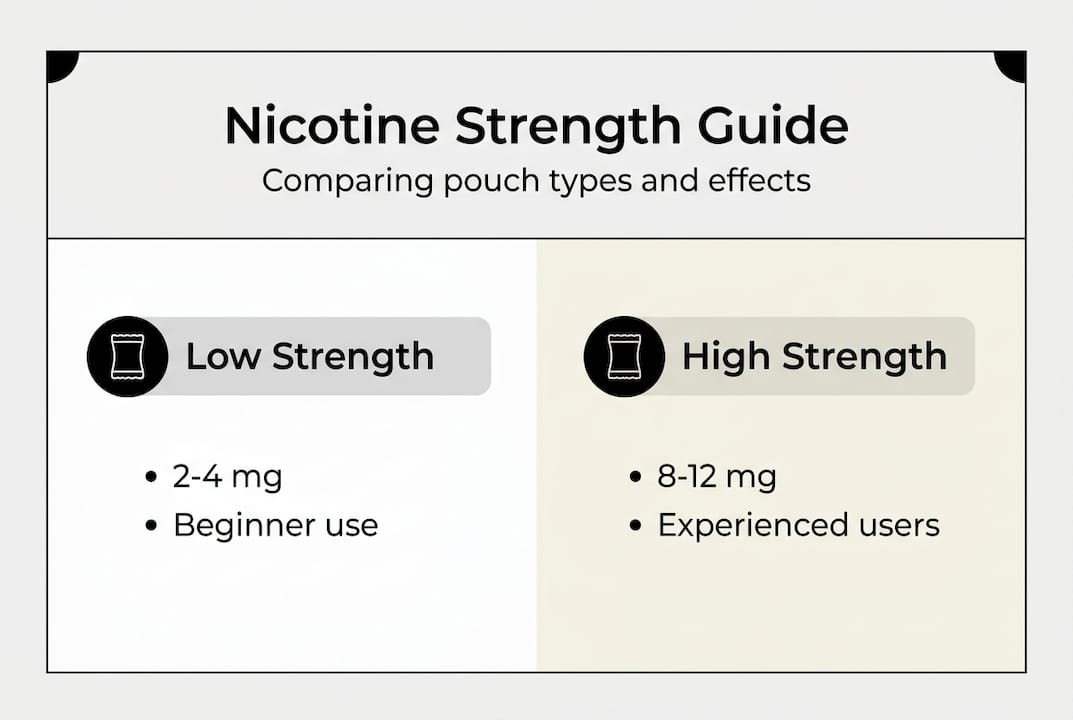
| Strength category | Typical mg per pouch | Best suited for |
|---|---|---|
| Low | 2 to 4mg | Complete beginners, light smokers (under 10 cigs/day) |
| Normal | 4 to 8mg | Moderate smokers (10 to 15 cigs/day), casual vapers |
| Strong | 8 to 12mg | Heavy smokers (15 to 20 cigs/day), experienced pouch users |
| Extra strong | 12mg and above | Very heavy smokers, those with high nicotine tolerance |
Comparing pouches to other nicotine products helps put these numbers in context. Patch protocols for heavy smokers use 21mg per day patches, while nicotine gum comes in 2mg or 4mg per piece. Nicotine gum labelling confirms that the 4mg dose is intended for those who smoke their first cigarette within 30 minutes of waking.
Flavour also plays a role in how strong a pouch feels. A minty, high-moisture pouch often feels more intense than a dry, unflavoured one at the same mg level, even though the nicotine content is identical. This is worth knowing when you’re comparing products. For a deeper look at how the numbers translate to real-world experience, the nicotine strength explained guide and the pouch strength comparison resource are both worth bookmarking.
How to calculate and track your ideal nicotine dose
You don’t need a spreadsheet to work this out, but a bit of honest self-assessment goes a long way. Follow these steps to find your starting point:
- Count your daily cigarettes. If you smoke 15 a day, you’re consuming roughly 15 to 30mg of nicotine in total, though absorbed amounts vary by brand and smoking style.
- Convert to pouch equivalents. A 6mg pouch absorbs about 1.5 to 2mg. To replace 15 cigarettes, you’d likely need 6 to 8 pouches per day at a normal strength.
- Start at the lower end. It’s easier to add a pouch than to deal with overdose symptoms. Begin conservatively and adjust after two to three days.
- Log how you feel. Keep a simple note on your phone: time of pouch, strength used, and how satisfied you felt. Note any side effects.
- Adjust in small steps. Move up or down by one strength category at a time, not two. Give each adjustment three to five days before deciding.
A typical adult uses 4 to 8 pouches per day, and self-tracking is the most reliable way to find your personal routine. Everyone’s metabolism and nicotine sensitivity differ, so what works for a friend may not work for you.

Pro Tip: If you’re completely new to pouches, the nicotine pouches for beginners guide walks you through the basics before you commit to a strength. Once you have a feel for the format, the mild vs strong strengths comparison will help you fine-tune your choice.
Expert advice: choosing strength for your goals (quitting, reducing, switching)
Your goal matters enormously when choosing a nicotine product and strength. Someone trying to quit entirely has different needs from someone who simply wants a discreet alternative to smoking at work.
Here’s how the advice breaks down by goal:
- Quitting smoking entirely: Medical sources recommend regulated NRT products (patches, gum, lozenges) because dosing is standardised and the evidence base is strong. Industry advocates pouches as alternatives, but medical sources urge NRT for proven, regulated dosing when cessation is the primary aim.
- Harm reduction or switching: Pouches are a practical option for those who want to move away from combustible tobacco without quitting nicotine altogether. Start at a strength that matches your current intake and reduce gradually.
- Casual or social use: Low to normal strength pouches (2 to 6mg) are appropriate. There’s no need to use a high-strength product if your nicotine dependency is mild.
- Underlying health conditions: Always seek medical advice before switching products. Nicotine affects cardiovascular function, and some conditions require supervised management.
The pharmacokinetics of pouches are genuinely interesting. A 9mg pouch gives a peak blood nicotine level of 27.9ng/ml, but it takes longer to reach that peak than a cigarette does. This slower rise is actually an advantage for managing cravings without the sharp spike and crash cycle that smoking creates.
Starting with the lowest effective dose isn’t about being cautious for its own sake. It’s about giving your body time to recalibrate without overwhelming it.
For those considering nicotine patch advice alongside pouches, the Mayo Clinic outlines how patches work as a background dose that pouches can complement during acute cravings. The nicotine pouch safety guide on HitSnus covers the current evidence on pouch safety in plain language.
Adapting your dosage: fine-tuning for daily life and changing needs
Your nicotine needs won’t stay the same forever. Stress, routine changes, travel, and social situations all affect how much you crave nicotine and when. The good news is that pouches make it relatively easy to adapt.
Here are the key signals to watch for:
- Too much nicotine: Nausea, hiccups, dizziness, or a feeling of being jittery. Drop to a lower strength immediately.
- Too little nicotine: Persistent cravings within an hour of using a pouch, irritability, or difficulty concentrating. Consider moving up one strength level.
- Just right: Cravings satisfied for two to three hours, no side effects, and a stable mood throughout the day.
Factors like flavour, moisture, and size affect perceived pouch strength, so switching brands at the same mg level can feel noticeably different. Keep this in mind when you’re comparing products.
| Situation | Suggested adjustment |
|---|---|
| High-stress period | Temporarily increase by one strength level |
| Social occasion (no smoking allowed) | Use normal strength for steady satisfaction |
| Tapering off nicotine | Reduce by one level every two to three weeks |
| Travel across time zones | Stick to your usual routine; avoid increasing |
| Side effects appearing | Drop one strength level immediately |
For a structured approach to managing your strength over time, the pouch strengths guide is a practical reference. If you’re working towards lower dependency, the low strength nicotine guide explains how to make the transition comfortably without relapse.
Find the right nicotine products for your journey
Putting all of this into practice starts with having access to quality products you can trust. At HitSnus, you’ll find a wide range of nicotine pouches across every strength category, from low-dose options for beginners to extra-strong formats for experienced users. Brands like ZYN, Velo, and FUMI are all available with clear strength labelling, so you can apply everything you’ve learnt here directly to your product choice.
If you’re just starting out, the pouches beginner guide on the HitSnus blog is a great companion to this article. It covers everything from how to place a pouch correctly to what to expect in your first week. Browse the full range, compare strengths side by side, and make a choice that’s genuinely informed.
Frequently asked questions
How do I know if my nicotine dose is too high?
Common signs include nausea, dizziness, headache, or a noticeably faster heartbeat. Symptoms of excessive nicotine include nausea and dizziness, so drop to a lower strength and monitor how you feel over the next day or two.
How does nicotine absorption from pouches compare to cigarettes?
Pouches absorb more slowly and at a lower rate than cigarettes. An 8mg pouch absorbs roughly 2mg, which is comparable in effect to one or two cigarettes, but without the rapid spike in blood nicotine levels.
What is the safest starting nicotine strength if I’m new to pouches?
Begin with a low or normal strength pouch in the 2 to 6mg range and adjust based on how your body responds. Light users should start at 1 to 4mg, with typical moderate users settling around 4 to 6mg.
Can I use nicotine pouches to quit smoking completely?
Pouches can support a switch away from combustible tobacco, but medical sources emphasise NRT over pouches for full cessation due to standardised dosing and a stronger evidence base. Speak to your GP if quitting entirely is your goal.