




Pouch innovation: exploring what's new in nicotine pouches
TL;DR:
- Genuine innovation in nicotine pouches involves advancements in formulation, delivery, packaging, and regulation that enhance safety and user experience. These improvements allow for more controlled nicotine release, better flavor retention, and discreet usage, benefiting adult users seeking alternatives to smoking. Recognizing authentic innovations helps consumers choose products that are scientifically supported and better tailored to their needs.
Most people assume all nicotine pouches are more or less the same, a small sachet, some nicotine, and a mint flavour. That assumption is increasingly wrong. The past few years have brought genuine, measurable changes to how pouches are formulated, how quickly they release nicotine, how they’re packaged, and which products are approved for sale. These changes affect your experience, your safety, and the choices available to you. This article breaks down exactly what pouch innovation means, why it matters, and how to use that knowledge to choose better products.
Table of Contents
- Understanding pouch innovation: what it means
- How nicotine pouches work: oral mechanics and delivery
- Innovations in pouch packaging and user experience
- Health, regulations, and public perceptions of pouch innovation
- Why real innovation matters in nicotine pouch products
- Explore the latest nicotine pouch innovations with HitSnus
- Frequently asked questions
Key Takeaways
| Point | Details |
|---|---|
| Formulation leads innovation | Modern nicotine pouches use advanced chemistry and delivery to enhance safety and satisfaction. |
| Packaging affects experience | Innovative packaging maintains freshness and enables discreet, convenient usage. |
| Regulations drive quality | Stringent regulatory pathways ensure new pouch products meet safety standards for adults. |
| Evidence over marketing | Scientific trials and pharmacokinetic studies now set the benchmark for innovation in nicotine pouches. |
Understanding pouch innovation: what it means
The word “innovation” gets thrown around a great deal in consumer goods, and nicotine pouches are no exception. But when used precisely, “pouch innovation” refers to product and technology improvements that change how nicotine and flavour are formulated, released, packaged, and delivered. That’s a meaningfully broad definition covering everything from the chemistry inside the pouch to the tin it comes in.
It helps to think of innovation across four distinct layers:
- Formulation: The composition of the filler, the form of nicotine used (free base versus salt), and the pH of the pouch matrix.
- Delivery mechanics: How quickly nicotine is released, whether that release is immediate or staggered, and how effectively the body absorbs it.
- Flavour control: How a pouch maintains flavour consistency across its use window, and how flavour intensity is calibrated.
- Packaging and handling: Whether the container protects freshness, allows one-handed operation, or reduces contamination risk.
Understanding the nicotine pouch benefits that matter most to you personally helps you identify which type of innovation is actually relevant to your lifestyle. A user who wants rapid satisfaction will care most about delivery mechanics. Someone who uses pouches at work will prioritise discreet packaging.
Here’s how major innovation categories compare:
| Innovation area | Traditional approach | Modern innovation |
|---|---|---|
| Nicotine formulation | Basic salt form, single strength | Free base blends, multi-strength, pH-adjusted matrices |
| Release profile | Slow, passive diffusion | Controlled immediate or dual-phase release |
| Flavour delivery | Added flavouring, fades quickly | Encapsulated flavour for sustained intensity |
| Packaging | Hinged tin with no compartments | One-handed dispensing, airtight seals, disposal zones |
| Regulatory status | Minimal review | PMTA pathways, clinical trial evidence required |
“Benchmarks for what counts as genuine innovation are becoming empirical rather than marketing-driven. Regulators and researchers now expect clinical evidence to support product claims, not just branding.”
It’s also worth reading more about debunking pouch myths, because many misconceptions about what pouches do or don’t contain are directly tied to outdated product generations.
How nicotine pouches work: oral mechanics and delivery
With definitions in place, the next question is how these innovative pouches actually function. The mechanics are simpler than they sound, but the science behind them is surprisingly nuanced.
At the basic level, oral nicotine pouches are placed between the lip and gum, and nicotine is absorbed through the mucosal tissues of the mouth. There’s no combustion, no vapour, and no tobacco leaf involved. The pouch matrix, which is the filler material, acts as a reservoir that holds nicotine and releases it gradually as saliva interacts with the pouch.
What innovation changes in this system is the speed, volume, and control of that release. Here’s how that plays out:
- pH manipulation: Raising the pH of the pouch matrix increases the proportion of free-base nicotine, which crosses mucosal membranes more readily. Higher pH equals faster, stronger absorption.
- Nicotine salt forms: Some formulations use nicotine salts for a smoother sensation and slower, more sustained release. This mimics the experience of lower-irritation alternatives.
- Dual-phase release: The most advanced pouches layer an initial burst of nicotine followed by a slower, sustained release over 20 to 40 minutes.
- Filler material texture: Softer, finer-grain fillers create more surface area in contact with mucosal tissue, improving transfer efficiency.
A key goal of modern formulation science is optimising nicotine delivery kinetics, meaning the speed and extent of absorption, without simply increasing the dose. This is a genuinely important distinction. More nicotine is not better for most users. Better-timed nicotine delivery, matched to craving patterns, is what actually improves user satisfaction and reduces the urge to re-dose.
Pro Tip: If you’re transitioning from cigarettes, look for pouches with an initial fast-release component to manage the first few minutes of a craving, followed by sustained release to avoid nicotine dips. A dual-phase formulation can replicate the delivery curve of smoking more closely than a flat slow-release option.
For a direct comparison of how pouches stack up against other nicotine replacement formats, the guide on nicotine pouches vs patches gives a practical breakdown of absorption rates and user experience. If you’re buying in bulk or storing pouches long-term, checking pouch storage tips is essential to preserving the formulation’s performance.
Innovations in pouch packaging and user experience
Delivery mechanics are only part of the story. Packaging is increasingly critical for safety and user satisfaction, and this is an area where innovation has moved quickly.

The traditional nicotine pouch tin was a simple hinged plastic container. Functional, but not optimised. Packaging innovation now includes controlled one-handed dispensing systems, airtight seals that protect freshness over weeks rather than days, and built-in compartments to store used pouches hygienically rather than discarding them in public.
Here’s why each of these matters in practice:
- Airtight sealing: Nicotine oxidises when exposed to air, which degrades both potency and flavour. Better sealing mechanisms preserve the formulation you paid for.
- One-handed dispensing: For users who are driving, working, or in social situations, fumbling with a tin is a genuine inconvenience. Controlled dispensing reduces handling and contamination.
- Disposal compartments: Built-in used-pouch sections, now standard in many premium tins, address both hygiene and environmental concerns.
- Moisture control: Some packaging innovations include moisture-regulating inserts that maintain the pouch’s hydration level, which directly affects how it feels and how quickly it releases nicotine.
| Packaging feature | Problem it solves | User benefit |
|---|---|---|
| Airtight inner seal | Nicotine and flavour degradation | Consistent experience across the tin |
| One-handed dispensing lid | Difficulty in active or social settings | Discreet, quick, no spillage |
| Disposal compartment | Nowhere to put used pouches | Hygienic, socially considerate use |
| Moisture-regulating insert | Pouches drying out or becoming too wet | Reliable texture and release rate |
| Child-resistant mechanism | Accidental access | Safety for households with children |
For a thorough breakdown of how to keep your pouches performing at their best, the freshness guide covers temperature, humidity, and storage duration in practical detail.
Packaging innovation might sound like a minor detail compared to formulation science, but for everyday users, the container is your interface with the product. Poor packaging can negate excellent formulation if the pouches degrade before use or if discreet handling is impractical.
Health, regulations, and public perceptions of pouch innovation
Product innovation must also be considered through the lens of regulations and health, which shape both public opinion and user access. This is where the picture becomes more complex, and where adult users need the clearest possible information.
Here’s how the regulatory and health landscape currently looks:
- PMTA requirements in the USA: The Pre-Market Tobacco Application process requires manufacturers to demonstrate that a product is “appropriate for the protection of public health.” The FDA has approved specific nicotine pouch products through this pathway, which means those products have passed a level of scientific scrutiny that older or unapproved products have not.
- European regulations: EU member states apply varying rules. Some countries restrict flavours or concentrations. The UK has its own framework post-Brexit, which continues to evolve.
- Clinical evidence requirements: Innovation benchmarks are increasingly empirical, with cross-over clinical trials measuring pharmacokinetics and subjective effects now expected to support product claims. This is a step change from the marketing-driven environment of a decade ago.
- Age-related concerns: Regulators in multiple jurisdictions have flagged concerns about pouch appeal to younger people, flavour design, and intoxication cases at higher strengths.
- Comparative harm position: Non-tobacco pouches occupy a notably lower cancer risk profile compared to combustible tobacco and even some other nicotine delivery products, according to several evidence reviews.
“For adult consumers transitioning from smoking, innovation most meaningfully shows up in non-combustible delivery mechanics, tailored nicotine release matched to craving patterns, and regulatory pathways that determine which specific products are legally and safely marketable.”
Pro Tip: When choosing any nicotine pouch, check whether it has been reviewed under a formal regulatory process in your country. Regulatory approval is not a guarantee of personal suitability, but it does mean the product has faced independent scrutiny, which is more than many alternatives can claim.
For British users specifically, the guide on UK pouch safety explains current regulations and what approved products must meet to be sold legally. The broader nicotine safety guide covers strength selection, daily limits, and when to seek advice. Trends shaping this space are also tracked in the article on pouch popularity trends, which places current innovations in their market context.
Why real innovation matters in nicotine pouch products
Here’s a view worth stating plainly: most of what gets labelled “innovation” in the nicotine pouch market is not innovation at all. A new flavour variant, a slightly updated tin design, or a rebranded product at a different strength are commercial decisions, not genuine advances. Real innovation changes what a product does for you, not just how it looks on a shelf.
The meaningful shift happening right now is the move from marketing-driven product development to science-led development. Manufacturers who are investing in clinical pharmacokinetic trials, developing proprietary release matrices, and seeking regulatory authorisation are doing something categorically different from those who are simply flavouring a basic formulation in a new tin. As an adult user, your ability to distinguish between these two categories is your single most powerful purchasing tool.
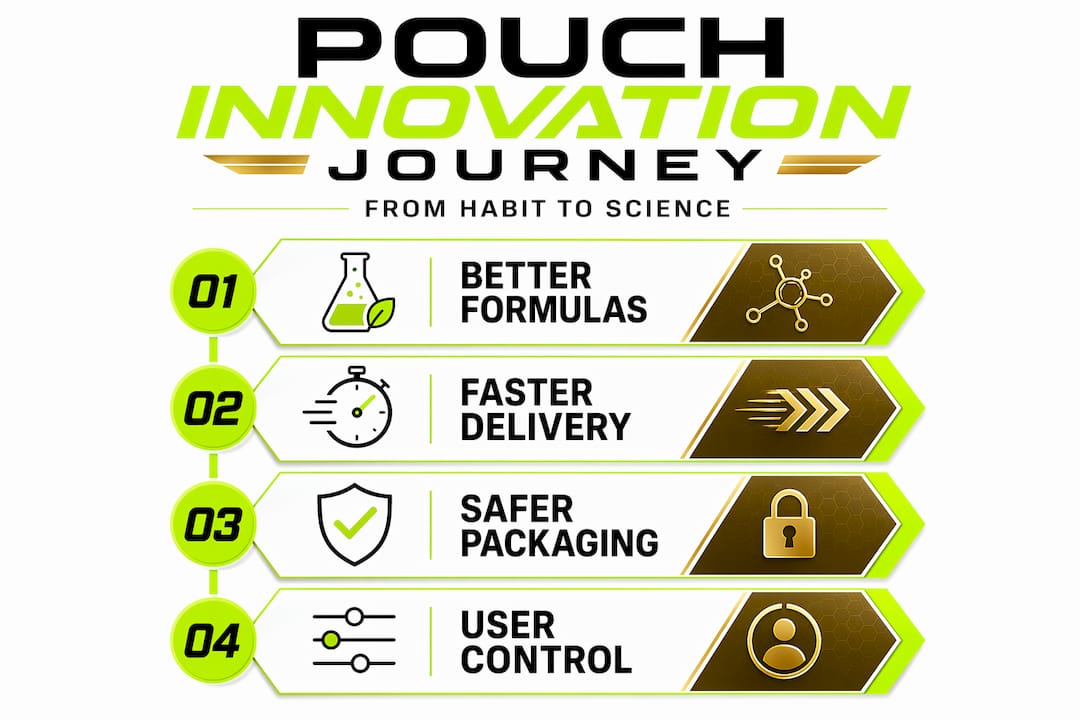
There’s also a longer trend worth acknowledging. For decades, nicotine products were developed primarily around habit and addiction maintenance, not user wellbeing. The current wave of innovation, whatever its commercial motivations, is producing products that give users more control: control over timing, over strength, over how discretely they use, and increasingly over whether they want to step down their nicotine intake gradually over time.
For anyone moving towards new alternatives in nicotine consumption, this control is exactly what makes modern pouches genuinely different from what came before. The best products aren’t just less harmful than cigarettes by default. They’re actively designed to serve your needs better, which is what innovation is supposed to mean.
The uncomfortable truth is that not every product on the market meets that standard. But knowing what real innovation looks like means you can seek out the products that do, and skip the ones that are just dressed-up versions of a decade-old formula.
Explore the latest nicotine pouch innovations with HitSnus
If you’ve reached this point, you now understand what separates genuinely innovative pouches from the marketing noise. Putting that knowledge to use means finding a trusted source with a range that reflects real product advances.
At HitSnus, the nicotine pouch shop stocks a carefully curated selection of modern pouches, from established names like ZYN and Velo to emerging brands with advanced release profiles and updated packaging systems. Every product is aimed at adult users who want discreet, tobacco-free alternatives that actually perform. Alongside the product range, the nicotine safety tips resource helps you use what you buy in a way that suits your needs and keeps you informed. Start exploring and see what genuine innovation actually feels like.
Frequently asked questions
What makes a nicotine pouch ‘innovative’ compared to traditional ones?
Innovative pouches use advanced formulations and delivery systems to release nicotine more effectively and discreetly, often with improved packaging for freshness and user safety. According to the FDA, this refers to product and technology improvements that change how nicotine and flavour are formulated, released, packaged, and delivered.
Are innovative pouches easier to use or safer than older brands?
Many innovative pouches feature improved design and formulation for easier, more consistent use, and a growing number undergo formal regulatory review before reaching market. Packaging innovation that includes controlled dispensing and airtight sealing also reduces contamination and degradation risks.
What health factors should adults consider with new nicotine pouch innovations?
Adults should review nicotine strength, the release profile, packaging quality for freshness, and whether the product complies with local regulations. Evidence reviews note that non-tobacco pouches carry a comparatively lower cancer risk than combustible products, though regulatory context varies by country.
Why are innovative pouches becoming popular among adults seeking smoking alternatives?
Their discreet design, tailored nicotine release, and reduced harm profile make them appealing to adults moving away from cigarettes. For adult consumers, innovation most meaningfully shows up in non-combustible delivery mechanics, tailored nicotine strength matched to craving patterns, and regulatory pathways that confirm which products are legally marketable.