













Nicotine pouches and blood pressure: what you need to know
Yes, nicotine pouches raise blood pressure acutely. Every time you place a pouch, nicotine crosses the oral mucosa into your bloodstream within minutes, triggering a sympathetic nervous system response that pushes heart rate and systolic blood pressure upward. The American Heart Association and the European Society of Cardiology both state that smokeless oral nicotine products are not cardiovascular-neutral, and published pharmacokinetic data show that high-strength pouches can deliver a nicotine peak exceeding that of a cigarette.
- Acute haemodynamic effects: Systolic BP typically rises by roughly 5–10 mmHg and heart rate by 10–27 beats per minute in the minutes following pouch placement, depending on strength and individual sensitivity.
- Who faces heightened risk: People with uncontrolled hypertension, a recent myocardial infarction, stroke, or arrhythmia face the greatest acute danger; even healthy adults show measurable vascular changes.
- Clinical safety flag: If you have cardiovascular disease or hypertension, speak to your clinician before using nicotine pouches. This article is informational and is not a substitute for individual medical advice.
Table of Contents
- How nicotine from pouches affects blood pressure and blood vessels
- What short-term trials show about blood pressure, heart rate and arterial stiffness
- What cohort studies and society positions say about long-term cardiovascular risk
- Why pouch strength, formulation and user behaviour change cardiovascular impact
- Practical clinical guidance for people with hypertension or cardiovascular disease
- How quickly blood pressure recovers after stopping nicotine pouches
- What the evidence cannot yet tell you
- Hitsnus: browse pouches by strength and make an informed choice
- Sources
- FAQ
How nicotine from pouches affects blood pressure and blood vessels
Nicotine activates nicotinic acetylcholine receptors in the adrenal medulla and sympathetic ganglia, triggering a rapid release of catecholamines, principally adrenaline and noradrenaline. Those hormones cause peripheral vasoconstriction, accelerate the heart, and push cardiac output upward. The result is a measurable acute rise in both systolic and diastolic blood pressure within minutes of pouch placement.
The stepwise mechanism runs as follows:
- Nicotinic receptor activation in sympathetic ganglia and adrenal medulla
- Catecholamine (adrenaline, noradrenaline) release into the circulation
- Peripheral vasoconstriction, reducing vessel diameter and raising vascular resistance
- Increased heart rate and cardiac output
- Net acute rise in systolic and diastolic BP
Beyond the immediate haemodynamic hit, nicotine impairs the endothelium, the thin cellular lining of every blood vessel. It reduces nitric oxide bioavailability and increases oxidative stress, two mechanisms that stiffen arteries and impair flow-mediated dilation over time. A mechanistic review published in PMC confirms these pathways operate independently of combustion products, meaning the absence of tobacco smoke does not protect the vasculature from nicotine’s direct effects.
The distinction between transient haemodynamic effects and structural vascular effects matters clinically. A single pouch raises BP for 20–40 minutes. Repeated daily use sustains elevated plasma nicotine, keeps sympathetic tone elevated, and progressively impairs endothelial repair. Arterial stiffness, once established, does not resolve between pouches the way acute BP does.
Statistic callout: A cardiovascular toxicity review found that chronic nicotine exposure is associated with sustained sympathetic activation and may contribute to hypertension in long-term follow-up cohorts, even without combustion byproducts.
What short-term trials show about blood pressure, heart rate and arterial stiffness
The controlled trial evidence is limited in sample size but consistent in direction: nicotine pouches raise heart rate, and at high strengths they raise arterial stiffness acutely.
| Study design | Pouch strength | Key cardiovascular measure | Principal result | Sample size |
|---|---|---|---|---|
| Controlled crossover (randomised) | 30 mg nicotine pouch | Nicotine Cmax, heart rate, arterial stiffness | Cmax above cigarette levels; heart rate increase up to 27 beats per minute; arterial stiffness elevated acutely | Small (healthy volunteers) |
| Crossover pharmacokinetic study | Low-to-moderate strength | Plasma nicotine, HR | Rapid absorption; HR increases within 5–10 minutes of placement | Small (healthy adults) |
| Ambulatory BP monitoring review | Repeated daily use | 24-hour ambulatory BP | Higher average BP during nicotine use periods vs abstinence, even when single clinic readings appeared normal | Multiple small trials |
Sources: Small pouches, but high nicotine doses — PubMed; Ambulatory blood pressure and nicotine studies — PubMed
Key limitations across these trials deserve plain acknowledgement:
- Sample sizes are small, typically fewer than 30 participants, limiting statistical power
- Most participants were healthy volunteers, not people with established cardiovascular disease
- Follow-up periods are short, usually a single session or a few days
- Nicotine extraction rates vary between products, brands and individual users
- Industry-funded studies may differ in endpoint selection from independent research
The practical picture from the trial data: a high-strength pouch can push nicotine Cmax above what a cigarette delivers, and the accompanying heart rate increase can be substantial and clinically meaningful for anyone with a pre-existing cardiac condition. Lower-strength products produce smaller responses, but the direction of effect is the same across the strength range.
What cohort studies and society positions say about long-term cardiovascular risk
Short-term trial data captures the acute hit; cohort evidence is where the longer-term picture emerges. Swedish snus cohorts, the closest analogue to modern tobacco-free pouches, have produced mixed results. Some large Swedish studies found no significant increase in coronary heart disease mortality among snus users compared with never-users, while others identified elevated risks for fatal myocardial infarction and stroke, particularly in people who used snus after a cardiac event. The populations differ from modern pouch users in nicotine dose, product composition, and era of use, so direct extrapolation is imperfect.
A policy synthesis published in PMC warns that non-combusted nicotine products are not cardiovascular-neutral and that public health messaging should not frame them as harmless alternatives. The concern is not hypothetical: nicotine’s endothelial and sympathetic effects operate regardless of delivery route.
The American Heart Association states: “Smokeless oral nicotine products are addictive and can adversely affect some biomarkers of cardiovascular risk. The long-term effects of modern nicotine pouches on cardiovascular health remain inadequately characterised.” (AHA Circulation, 2024)
Research gap: Modern tobacco-free nicotine pouches have been widely available for fewer than ten years. No long-term prospective cohort study has followed pouch users for the decade-plus needed to detect atherosclerotic outcomes. Cohort evidence from snus and other oral products provides a plausible signal, but it cannot substitute for direct evidence in contemporary pouch users. The absence of long-term data is not reassurance; it is an open question.
Why pouch strength, formulation and user behaviour change cardiovascular impact
Not all pouches are equal in their haemodynamic effect. Several factors determine how much nicotine reaches your bloodstream and how fast.
- Nicotine content per pouch: Products range from 3 mg to over 40 mg per pouch. Higher content means higher potential Cmax.
- Release rate and pH: Alkaline formulations release nicotine faster across the oral mucosa, producing a sharper plasma peak and a steeper sympathetic response.
- Pouch duration: Leaving a pouch in for 30–60 minutes versus 10 minutes substantially changes total nicotine absorbed.
- User experience: Nicotine-naive users experience larger cardiovascular responses than tolerant, regular users because tolerance blunts the catecholamine surge.
- Synthetic versus tobacco-derived nicotine: Current evidence does not show a meaningful pharmacokinetic difference between the two at equivalent doses.
- Stacking behaviour: Using multiple pouches in quick succession sustains elevated plasma nicotine and prevents the sympathetic system from returning to baseline.
A risk assessment published in ScienceDirect found that measured nicotine per pouch commonly exceeds proposed acute reference doses by a substantial margin, meaning even a single pouch can produce clinically relevant haemodynamic responses in many users at certain doses. Research on low-strength pouches confirms that even products marketed as mild can acutely exceed those reference thresholds.
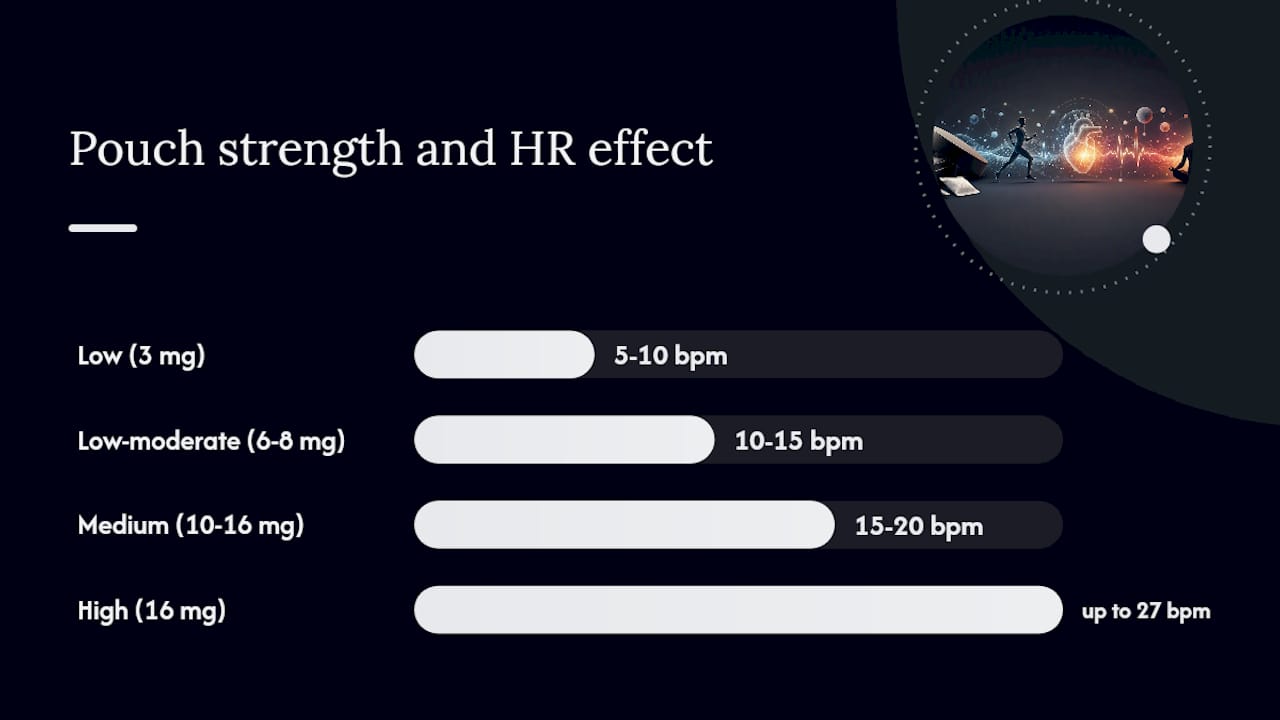
| Strength category | Example products (Hitsnus range) | Approximate nicotine content | Likely acute HR effect |
|---|---|---|---|
| Low | ZYN Cool Mint mini | 3 mg | Modest increase (~5–10 bpm) |
| Low-moderate | ZYN Spearmint mini, XQS Strawberry Kiwi | 6–8 mg | Moderate increase (~10–15 bpm) |
| Medium | Clew Watermelon, Clew Cool Mint, Killa Apple, Killa Pineapple | 10–16 mg | Noticeable increase (~15–20 bpm) |
| High | SYX Forest Fruits | 16 mg | Substantial increase (up to ~27 bpm per trial data) |

HR estimates are indicative, drawn from crossover trial data and scaled by dose; individual responses vary.
Pro Tip: Read the label in milligrams, not just the brand’s “strength” descriptor. A pouch labelled “strong” by one brand may be 10 mg; the same label from another may mean 20 mg. To limit acute BP spikes, choose the lowest strength that manages your craving, keep the pouch in for no longer than 20–30 minutes, avoid using pouches during strenuous exercise, and never use two pouches simultaneously. For a practical guide to reading strength labels, see comparing pouch strengths.
Practical clinical guidance for people with hypertension or cardiovascular disease
Bottom line first: People with a recent myocardial infarction, stroke, uncontrolled hypertension, or significant arrhythmia should avoid nicotine pouches entirely and discuss cessation support with their clinician before considering any nicotine product.
Red flags requiring immediate action
- Chest pain or tightness during or after pouch use
- Palpitations, irregular heartbeat, or a racing pulse that does not settle within 10 minutes
- Dizziness, syncope (fainting), or near-fainting
- Sudden severe headache (a possible hypertensive urgency symptom)
- Shortness of breath at rest
If any of these occur, remove the pouch immediately, sit down, and seek emergency medical attention if symptoms persist beyond a few minutes.
Monitoring your blood pressure
- Measure BP before placing a pouch to establish your resting baseline
- Measure again 10–15 minutes after placement to capture the acute peak
- Use a validated home monitor (look for the British and Irish Hypertension Society validated device list)
- Ambulatory BP monitoring over 24 hours gives a more accurate picture of average BP than single clinic readings, particularly for regular pouch users
- If your systolic BP consistently exceeds 140 mmHg at rest, consult your GP before continuing pouch use
Pouches versus patches and gum
Nicotine patches deliver a slow, steady plasma level over 16–24 hours, producing a much smaller sympathetic surge than a pouch. Nicotine gum sits between the two: faster than a patch, slower than a pouch. Neither is risk-free for people with cardiovascular disease, but the peak-delivery profile of pouches generates a sharper haemodynamic response. A comparison of NRT and pouches covers the practical differences in more detail. Switching from pouches to patches or gum should be discussed with a clinician, not attempted without guidance, because the evidence base for NRT in cardiac patients is distinct from that for pouches.
Proven cessation supports include varenicline (Champix/Cytisine), bupropion, and behavioural counselling combined with NRT. For people with established cardiovascular disease, pharmacotherapy-assisted cessation under specialist supervision is the recommended route.
How quickly blood pressure recovers after stopping nicotine pouches
Recovery is not instantaneous, and the timeline differs between acute haemodynamic effects and structural vascular changes.
- Within 20–40 minutes of removing a pouch: Heart rate and BP begin returning toward baseline as plasma nicotine falls and sympathetic tone reduces.
- Within 24 hours of stopping completely: Resting heart rate typically normalises; acute catecholamine surges cease.
- Within 1–2 weeks: Ambulatory BP readings tend to improve in former users, though the magnitude depends on how long and how heavily pouches were used.
- Within 4–12 weeks: Endothelial function, measured by flow-mediated dilation, shows measurable improvement in studies of people stopping nicotine generally; arterial stiffness indices also begin to improve.
- Beyond 3–6 months: Structural vascular improvements continue, but the degree to which atherosclerotic risk reverses depends on cumulative exposure, age, and co-existing risk factors.
Individual variability is substantial. Someone who used a 3 mg pouch once daily for six months will recover faster than someone using 30 mg pouches multiple times a day for years. Haemodynamic recovery (BP, heart rate) is relatively rapid; atherosclerotic risk reversal is a slower, less certain process. Cessation studies in smokeless nicotine users are limited, and most data come from smoking cessation research, where the cardiovascular benefit of stopping is well established but the timeline for full vascular repair extends over years.
What the evidence cannot yet tell you
The research on nicotine pouches and blood pressure has real gaps, and being clear about them matters.
- No long-term cohort data for modern tobacco-free pouches: The products have not been on the market long enough for decade-long prospective studies. Snus cohort data provides a signal, not a direct answer.
- No controlled trials in people with established CVD: Every published crossover trial used healthy volunteers. The cardiovascular response in someone with coronary artery disease, heart failure, or uncontrolled hypertension is unknown from direct evidence.
- Cumulative effects of repeated daily use: Most trials measure a single session. What happens to ambulatory BP, arterial stiffness, and endothelial function after months of daily use at realistic doses is not yet characterised in pouch-specific studies.
- Synthetic versus tobacco-derived nicotine at high doses: The pharmacokinetic equivalence assumed at moderate doses may not hold at the extreme strengths now available commercially.
- Product formulation influences: Excipients, pH adjusters, and release-rate modifiers vary between brands and affect Cmax. No systematic comparison across commercial products exists in the peer-reviewed literature.
The recommended study designs to resolve these gaps are straightforward in concept: prospective cohorts with validated daily exposure metrics, ambulatory BP monitoring at baseline and follow-up, and inclusion of participants with pre-existing cardiovascular disease. Until that evidence exists, the precautionary position of the AHA and ESC is the most defensible clinical stance. As one policy review puts it, non-combusted nicotine products reversing public health gains is a real risk if uptake grows without adequate safety characterisation.
Hitsnus: browse pouches by strength and make an informed choice
If you have read this far, you already know more about nicotine and blood pressure than most pouch users do. That knowledge is most useful when you can act on it, and that starts with choosing the right strength for your situation.

Hitsnus carries the full spectrum: from ZYN Cool Mint mini at 3 mg for adults who want the lowest available haemodynamic exposure, through mid-range options like XQS Strawberry Kiwi at 8 mg, up to higher-strength products for experienced users who understand the dose-response relationship. Every product page lists the nicotine content in milligrams so you can apply what this article explains. The site also carries usage guides on safe pouch use and prolonged use risks for readers who want to go deeper. Browse the Hitsnus nicotine pouches collection to find the strength that fits your needs, and consult your GP if you have any cardiovascular concerns before starting or changing your nicotine use.
Sources
- Nicotine toxicity and endothelial dysfunction — PMC
- Small pouches, but high nicotine doses — PubMed
- Impact of smokeless oral nicotine products on cardiovascular disease — AHA (Circulation)
Hitsnus stocks a full range of nicotine pouches across strengths from 3 mg to over 40 mg. The product listings include strength, flavour, and format information to help adults make informed choices. Nothing on the site constitutes medical advice.
FAQ
Do nicotine pouches raise blood pressure?
Yes. Nicotine pouches raise systolic blood pressure acutely, typically by around 5–10 mmHg, and increase heart rate by 10–27 beats per minute depending on pouch strength and individual sensitivity.
Can I use nicotine patches if I have high blood pressure?
Nicotine patches carry cardiovascular risk too, but their slow, steady delivery produces a smaller sympathetic surge than pouches. Consult your clinician before using any nicotine product if you have hypertension; patches are not automatically safe for people with cardiovascular disease.
Is using two nicotine pouches a day bad for your blood pressure?
Two pouches daily at low-to-moderate strength produces two acute BP and heart rate spikes per day. For healthy adults this may be manageable, but for people with hypertension or cardiovascular disease even two daily exposures carry meaningful risk, particularly at higher strengths.
How long after stopping nicotine pouches does blood pressure go down?
Resting heart rate and acute BP elevation begin to normalise within 24 hours of stopping. Ambulatory BP readings typically improve within one to two weeks, and endothelial function markers show measurable recovery within four to twelve weeks of complete cessation.