













Nicotine pouches after a tooth extraction: is it safe?
Avoid nicotine pouches immediately after a tooth extraction. The minimum you should wait is 48 to 72 hours, and many dentists recommend 5 to 7 days or longer before resuming any nicotine product. The key point: nicotine itself, not just cigarette smoke, constricts blood vessels and can destabilise the clot that protects your healing socket. Before you use any pouch again, get clearance from your dentist or oral surgeon based on how your recovery is actually progressing.
Immediate do and do not:
- Do bite firmly on the gauze pad your dentist provided for 30 to 45 minutes
- Do rest and keep your head elevated for the first few hours
- Do not place a nicotine pouch near or over the extraction socket
- Do not use a straw, spit forcefully, or rinse vigorously in the first 24 hours
- Do not use any nicotine product until you have passed the critical 48 to 72 hour window at minimum
Browse nicotine pouches at Hitsnus once your dentist has given you the all-clear.
Table of Contents
- What are the real risks of nicotine pouches after extraction?
- How nicotine interferes with oral wound healing
- When might you safely resume nicotine pouches?
- Managing nicotine dependence safely while your mouth heals
- What to do if bleeding, pain or dry socket signs appear
- Post-healing product guidance and how Hitsnus can help responsibly
- Browse Hitsnus once your dentist clears you
- Sources
- FAQ
What are the real risks of nicotine pouches after extraction?
The most serious complication is dry socket, and it is more common than most people expect. Dry socket occurs when the blood clot at the extraction site is dislodged or dissolves before the wound has healed, leaving the underlying bone and nerve exposed. The pain is severe, often radiating to the ear and jaw, and it typically appears 1 to 5 days after extraction.
A systematic review and meta-analysis found dry socket prevalence of around 13.2% in smokers versus 3.8% in non-smokers across pooled studies. That is more than a three-fold increase in risk. While this data covers cigarette smokers, the underlying mechanism, nicotine-driven vasoconstriction and impaired clot stability, applies to any nicotine delivery method, including pouches.
Beyond dry socket, nicotine use in the healing window can cause:
- Delayed wound closure and slower tissue regeneration
- Increased susceptibility to infection at the socket
- Prolonged or renewed bleeding in some cases
- Local irritation from pouch placement near the socket, including from flavouring compounds
The 24 to 72 hour window is when the clot is most vulnerable. Any nicotine exposure during this period carries the highest risk of clot disruption.
The Mayo Clinic advises avoiding tobacco products for at least 48 hours after extraction, noting that tobacco use and suction are among the primary risk factors for dry socket.
Pro Tip: If you had a surgical extraction, such as a wisdom tooth removal, your risk window is longer than for a simple extraction. Treat the first 72 hours as non-negotiable, and plan for up to 14 days of caution.
How nicotine interferes with oral wound healing
Nicotine causes vasoconstriction, narrowing the blood vessels that supply oxygen and nutrients to healing tissue. At an extraction site, this matters because the clot and the new tissue forming beneath it depend on consistent blood flow to survive and develop.
The direct effects on your healing socket include:
- Clot instability: reduced blood flow weakens the structural integrity of the clot
- Slower granulation: the formation of new connective tissue is delayed when oxygen delivery is impaired
- Impaired angiogenesis: nicotine interferes with the growth of new blood vessels, which are central to bone and soft tissue repair
- Reduced immune response: lower perfusion means fewer immune cells reaching the site, raising infection risk
A critical point that practitioners raise is that surface healing can look normal while deeper tissue repair is still incomplete. As Wigmore Smiles notes:
This is why a fixed calendar date is less reliable than a dentist’s assessment. Your socket may look closed on day five while the bone beneath is still actively remodelling.
When might you safely resume nicotine pouches?
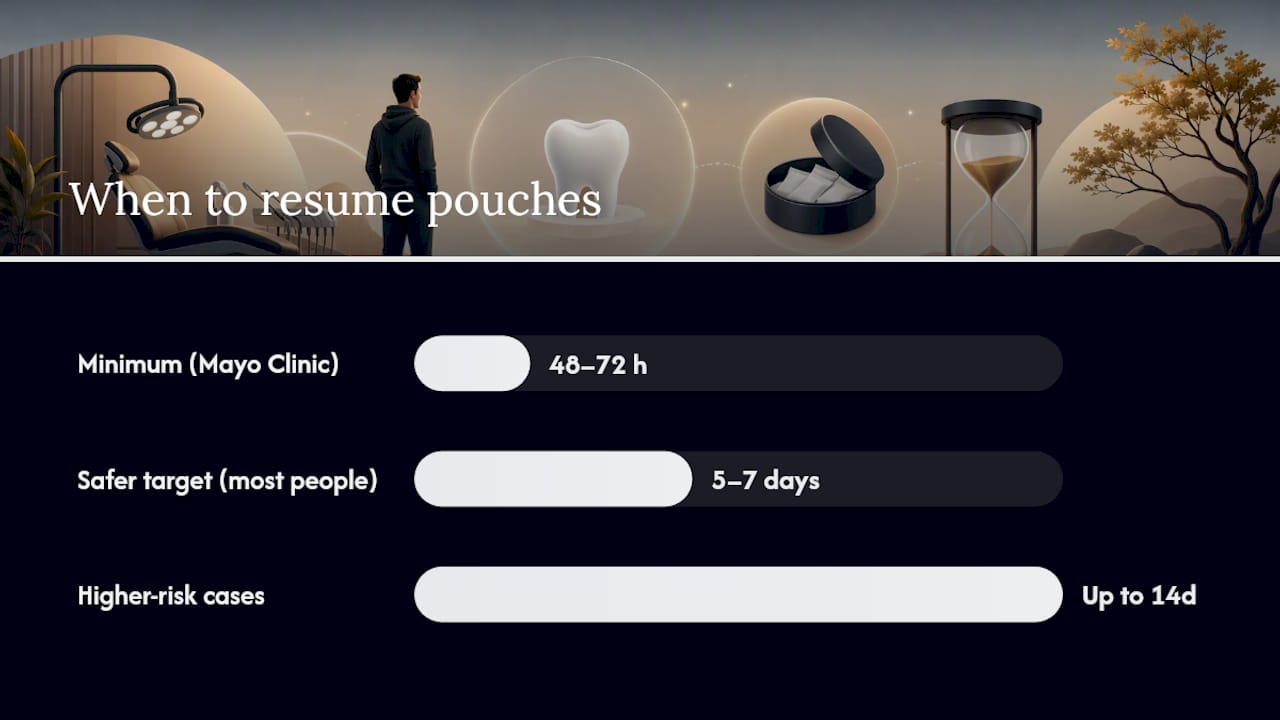
The absolute minimum is 48 to 72 hours, as recommended by the Mayo Clinic and supported by oral surgery guidance. This covers the period when the clot is most fragile and dry socket risk peaks.
For most people, 5 to 7 days is a safer target. Bergen Oral Surgery recommends this window for wisdom tooth cases and notes that up to 14 days is advisable in higher-risk situations. King’s College Hospital advises avoiding smoking for at least two weeks following oral surgery where possible.
Before resuming, you should be able to confirm all of the following:
- No severe or worsening pain at the socket
- The clot appears intact and the socket is not visibly exposed
- Swelling has reduced noticeably
- You can rinse gently with salt water without disturbing the site
- Your dentist or oral surgeon has given explicit clearance
A longer wait is advisable if you smoke cigarettes as well as use pouches, had a complicated surgical extraction, take anticoagulants or immunosuppressants, or have a condition that affects clotting or healing.
Pro Tip: Ring your dental practice and ask one direct question: “My socket looks and feels fine on day X. Is it safe to resume nicotine pouches?” Most practices will answer this in under two minutes without requiring a full appointment.
Managing nicotine dependence safely while your mouth heals
Transdermal nicotine patches are the most practical option during the first few days after extraction. They deliver nicotine through the skin, avoiding all oral contact and the suction risk that comes with pouches, lozenges, and gum. Patient-facing harm-reduction guidance consistently recommends patches as the safer interim choice in the first 3 to 7 days post-op.
Patches are not without limitation. They still deliver nicotine systemically, which means vasoconstriction still occurs to some degree. Discuss the appropriate dose and duration with your GP or dentist, particularly if you are a heavy user.
Practical harm-reduction steps:
- Use a transdermal patch rather than any oral nicotine product for the first critical days
- If you must use an oral product after the initial window, place it on the opposite side of the mouth from the extraction site
- Maintain strict oral hygiene: rinse gently with warm salt water from 24 hours post-op, as advised by NHS guidance
- Avoid highly flavoured or high-strength pouches until healing is confirmed
For structured support, NHS Stop Smoking Services are available free of charge across the UK. Your GP can also prescribe Champix (varenicline) or refer you to a local NRT clinic if you want to use the recovery period to reduce your nicotine dependence more broadly.
Pro Tip: The Hitsnus nicotine safety guide covers responsible pouch use in detail, including strength selection and placement, which is useful reading for when you are cleared to return.
What to do if bleeding, pain or dry socket signs appear
- For bleeding: fold a clean piece of gauze or a damp tea bag into a firm pad, place it directly over the socket, and bite down steadily for 30 to 45 minutes without checking it repeatedly.
- For swelling: apply a cold pack wrapped in a cloth to the outside of your cheek for 10 minutes on, 10 minutes off, during the first 24 hours only.
- If pain worsens after day two: take paracetamol or ibuprofen as directed on the packaging. Do not take aspirin unless your doctor has prescribed it, as it can increase bleeding.
- Contact your dentist if pain is severe, throbbing, or radiating to your ear or jaw, particularly from day two onwards.
- Call NHS 111 if you cannot reach your dentist, if you have a persistent fever, or if bleeding has not slowed after 30 minutes of firm pressure.
- Attend A&E if bleeding is heavy and uncontrolled, you feel faint, or you have signs of a spreading infection such as facial swelling, difficulty swallowing, or a high temperature.
Red-flag symptoms that suggest dry socket or infection:
- Severe throbbing pain that begins 2 to 4 days after extraction and is not controlled by over-the-counter analgesia
- Visibly exposed bone or an empty-looking socket
- Persistent bad taste or odour from the socket
- Fever above 38°C
Post-healing product guidance and how Hitsnus can help responsibly
Checklist for choosing your first pouch after clearance:
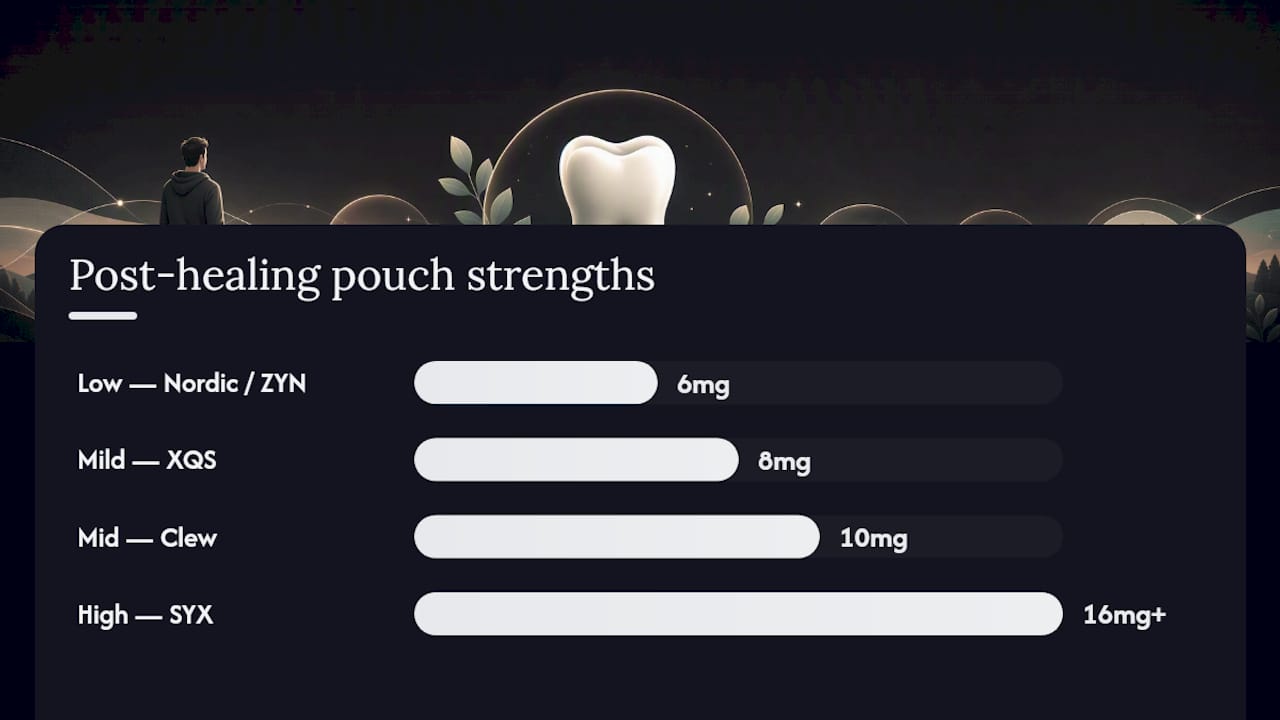
- Start lower strength: Nordic Spirit Sweetmint 6mg and ZYN Spearmint mini 6mg are good starting points. Avoid high-strength products like SYX Forest Fruits 16mg+ until you are confident the site is fully settled.
- Choose milder flavours: XQS Strawberry Kiwi 8mg offers a lighter flavour profile. Intensely flavoured pouches such as Killa Apple or Killa Pineapple can be reintroduced gradually once you are comfortable.
- Placement matters: always place the pouch on the opposite side of the mouth from the extraction site, at least initially.
- Hygiene first: follow the step-by-step usage guide and rinse after each session.
Products such as Clew Watermelon 10mg and Clew Cool Mint 10mg sit in the mid-strength range and are suitable once healing is confirmed. All products sold by Hitsnus are for adults only. UK buyers must meet the legal age requirement of 18 years, and purchases are subject to UK nicotine product regulations.
Pro Tip: Read the Hitsnus oral health guide before returning to regular pouch use. It covers long-term gum and tissue considerations that are worth knowing after any oral procedure.
Browse Hitsnus once your dentist clears you
Dental clearance first, then pouches. That is the only sensible order. Once your dentist confirms your socket has healed, Hitsnus has the UK’s full range of tobacco-free nicotine pouches ready for fast delivery, from gentle low-strength options to bolder formats for experienced users.
Start with something mild. ZYN Spearmint mini 6mg and Nordic Spirit Sweetmint 6mg are popular choices for a cautious return. When you are ready to explore more, the full nicotine pouches range at Hitsnus covers every strength and flavour profile. Follow your post-op instructions, choose a lower strength to begin, and place your order at Hitsnus when you have the green light.
Sources
- Tooth extraction after care
- Dry socket - Symptoms and causes - Mayo Clinic
- Systematic review: smoking as a risk factor for dry socket (Dentistry journal)
- Dry socket prevention
- Smoking & vaping after wisdom teeth removal - Bergen Oral Surgery
- Smoking, vaping and healing: how nicotine affects sockets and what you can do about it
Speak to your dental team for advice tailored to your specific extraction and recovery. General information in this article is not a substitute for personalised clinical guidance.
FAQ
Is it safe to use nicotine pouches right after a tooth extraction?
No. Nicotine causes vasoconstriction that can destabilise the healing clot and significantly raise dry socket risk. Wait a minimum of 48 to 72 hours, and ideally 5 to 7 days, with explicit clearance from your dentist before resuming.
Will nicotine pouches give you a dry socket?
They can. Nicotine impairs blood flow and clot stability regardless of how it is delivered, and placing a pouch near the socket adds local mechanical irritation. A systematic review found dry socket prevalence more than three times higher in nicotine users than non-users.
Can dentists tell if you have been using nicotine pouches after extraction?
Often, yes. Signs such as delayed healing, gum irritation, or a compromised clot can indicate nicotine exposure, and dentists are trained to identify dry socket and its likely causes during a follow-up examination.
Is it okay to use nicotine pouches after oral surgery?
Not immediately. The same risks apply after any oral surgical procedure. Bergen Oral Surgery recommends waiting at least 5 to 7 days after wisdom tooth removal, with longer abstinence for complex cases, and always obtaining clinician clearance before resuming.
Do gums recover fully after using nicotine pouches near an extraction site?
In most cases, yes, provided nicotine use is avoided during the critical healing window and good oral hygiene is maintained. Nicotine’s vasoconstrictive effects are temporary, but repeated exposure during healing can cause lasting delays to tissue repair.