












How to switch from vaping: your quit guide
TL;DR:
- Deciding to quit vaping requires understanding your triggers, choosing a suitable method, and planning relapse prevention strategies.
- Effective quitting involves personalized plans, managing withdrawal symptoms, and considering alternatives like nicotine pouches to ease the transition.
Deciding how to switch from vaping is one of the more honest things you can do for yourself. Vaping was sold as a safer habit, and for many people it became a daily ritual tied to stress, boredom, and routine rather than genuine choice. The health and financial benefits of quitting are well documented, but knowing why you want to stop rarely makes the cravings disappear. What actually works is preparation, the right strategy for your personality, and knowing what to reach for when the urge hits. This guide covers all of it.
Table of Contents
- Key takeaways
- How to switch from vaping starts with knowing why you do it
- Cold turkey vs gradual reduction: which works best?
- Managing withdrawal and cravings
- Alternatives to vaping: nicotine pouches and smokeless options
- Staying vape-free: avoiding relapse long term
- My honest take on quitting vaping
- Ready to make the switch? Hitsnus can help
- FAQ
Key takeaways
| Point | Details |
|---|---|
| Understand your triggers | Identifying why and when you vape is the single most useful thing you can do before quitting. |
| Choose your quit method | Cold turkey and gradual reduction both work; success depends on choosing the right one for you. |
| Manage withdrawal deliberately | Distraction, NRT, and counselling significantly improve your chances of staying vape-free. |
| Consider nicotine pouches | Smokeless, tobacco-free alternatives can ease the transition without the ritual of vaping. |
| Plan for relapse triggers | Building coping routines before you need them is what separates short-term and long-term success. |
How to switch from vaping starts with knowing why you do it
You cannot design a good quit plan without understanding the problem you are actually solving. Most people think they vape because of nicotine. That is partly true, but nicotine is rarely the whole story. A personalised quit plan that names your specific reasons for vaping, identifies your triggers, and sets a firm quit date dramatically improves your chances of success.
Start by spending a week noticing when you vape, not just that you vape. Is it with coffee in the morning? After meals? When you are anxious at work? When you are bored on the sofa? People often underestimate how quickly nicotine use ties to micro-routines, making those small daily moments feel incomplete without a device in hand.
Here are the key questions worth answering before you set a quit date:
- What originally made you start vaping?
- Which emotions or situations most reliably trigger the urge?
- How many times a day do you vape, and at what times?
- Who in your life can support you through the process?
- What has stopped previous quit attempts from succeeding?
Pro Tip: Write your answers down. Seeing your triggers listed plainly on paper makes them feel less automatic and more manageable.
Once you have your answers, set a specific quit date within the next two weeks. Tell at least one person. Not because accountability is magic, but because saying it out loud makes it real. Seeking support from friends, family, or a GP adds a layer of external structure that makes it harder to quietly let the plan slide.
Cold turkey vs gradual reduction: which works best?
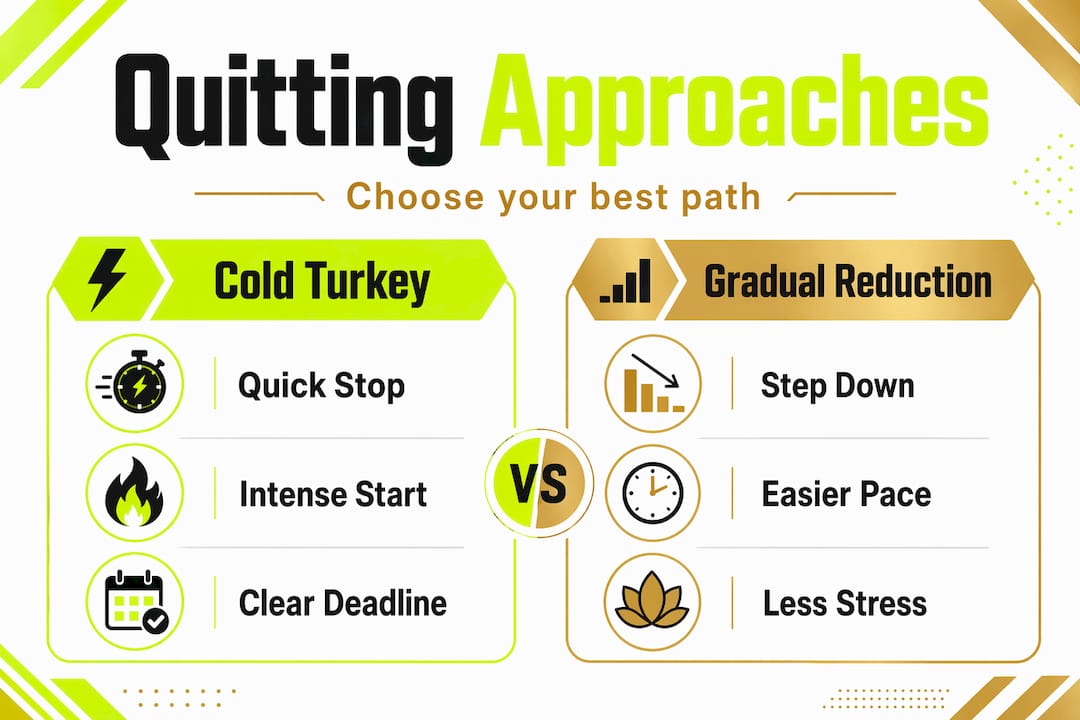
There is no universally correct method for quitting vaping. The two main approaches are stopping all at once (often called cold turkey) or reducing your use gradually until you stop completely. Each suits different people, and understanding the trade-offs helps you choose with your eyes open.
| Method | Pros | Cons |
|---|---|---|
| Cold turkey | Faster, cleaner break; no ambiguity about timelines | Intense withdrawal in first 72 hours; requires high resolve |
| Gradual reduction | Lower initial discomfort; easier to commit to | Risk of stalling; can drag on without a firm quit date |
Cold turkey tends to work well for people who respond badly to half-measures. If you are the type who says “I’ll have just one” and ends up back where you started, a clean break avoids that negotiation entirely. The first few days are rough, but cravings are temporary and each one you ride out builds genuine confidence.
Gradual reduction suits people who find the idea of quitting immediately overwhelming. The critical detail is this: gradual reduction needs a firm quit date attached to it, otherwise it becomes an indefinite delay rather than a plan. Decide in advance to reduce by 25% each week, for example, and set a hard stop date four weeks out.
Pro Tip: Whichever method you choose, remove your vaping device from your usual spaces on your quit date. Out of sight genuinely reduces the pull of habit.
Managing withdrawal and cravings
This is where most quit attempts succeed or fail, so it deserves more than a surface-level list. Nicotine withdrawal produces a predictable cluster of symptoms: irritability, difficulty concentrating, disturbed sleep, increased appetite, and powerful urges to vape. The good news is that the sharpest symptoms usually peak within 72 hours and ease substantially after one to two weeks.
Understanding this timeline matters. Many people give up during peak withdrawal, not realising they are at the hardest point and that relief is days away.
Practical strategies that actually interrupt cravings:
- Go for a brisk walk. Even five minutes of movement changes your body chemistry and shifts attention away from the urge.
- Drink a glass of cold water slowly. It sounds trivial, but the physical act gives your hands and mouth something to do.
- Keep sugar-free gum or healthy snacks nearby. The oral fixation aspect of vaping is real.
- Delay by five minutes. Tell yourself you will vape in five minutes if the urge is still there. It usually passes.
- Remove your device from your home, car, and workspace. Removing vaping devices and planning what you will do during cravings before they arrive significantly reduces relapse.
Nicotine replacement therapy (NRT) is worth serious consideration. Patches, gum, and lozenges help reduce cravings by delivering lower, steadier levels of nicotine without the device ritual. They are not licensed specifically for vaping cessation, but the evidence for their effectiveness in reducing cravings is solid. A pharmacist can advise on the right product and dose for your usage level.
Behavioural counselling combined with NRT produces better outcomes than either approach alone. Counselling is not just about motivation. A good counsellor works through your specific triggers with practical problem-solving, helping you redesign your routines rather than relying purely on willpower. In the UK, the NHS Stop Smoking Service offers free support, and many areas provide phone or online quitline access.

Alternatives to vaping: nicotine pouches and smokeless options
When you are transitioning from vaping, the goal is not always to go from 100% nicotine use to zero overnight. For many adults, moving to a less harmful, non-combustible format is a sensible intermediate step, particularly if vaping was itself a step away from cigarettes. Nicotine pouches are a smokeless, tobacco-free option that can support this transition without the inhalation risks associated with vaping.
A nicotine pouch is a small, discreet pouch placed under the upper lip. No vapour, no smoke, no device. They come in a range of strengths and flavours, which means you can step down your nicotine level gradually while eliminating the habitual hand-to-mouth device ritual that reinforces vaping behaviour. That behavioural decoupling is genuinely useful for many people.
Here is a comparison of common nicotine alternatives:
| Alternative | Tobacco-free | Smokeless | Device needed | Strength control |
|---|---|---|---|---|
| Nicotine pouches | Yes | Yes | No | Yes (multiple strengths) |
| Nicotine patches | Yes | Yes | No | Yes |
| Nicotine gum | Yes | Yes | No | Limited |
| Nicotine lozenges | Yes | Yes | No | Yes |
Brands like ZYN, Velo, and FUMI offer a variety of strengths, making it practical to start at a level that matches your current nicotine intake and reduce over time. If you are new to pouches, reading about smokeless nicotine alternatives side by side will help you pick a format that fits your lifestyle and quit timeline.
Nicotine pouches as an alternative offer one significant practical advantage: they are discreet enough to use in settings where vaping is inappropriate, which removes the social pressure to step outside for a hit. That flexibility matters more than people expect.
Staying vape-free: avoiding relapse long term
Quitting is one challenge. Staying quit is another, and treating them as separate problems leads to better outcomes. The period between week two and month three is statistically when most relapses occur, as the acute discomfort of withdrawal fades but the psychological habits have not fully been replaced.
Here are the steps most likely to protect your progress:
- Identify your highest-risk situations in advance. Social events, stressful workdays, and times when others around you vape are not surprises. Decide what you will do in each scenario before you are in it.
- Build a replacement routine. If you used to vape after dinner, go for a ten-minute walk instead. The routine structure is the point, not the nicotine.
- Avoid dual use. Extended dual use of cigarettes and vaping leads to worse health outcomes than either alone, because it maintains nicotine dependence while adding additional harm. If you are tempted to substitute one for the other, that is a signal to address the underlying trigger rather than swap the delivery method.
- Lean on your support network. A brief message to a friend during a craving is not weakness. It is a strategy that works.
- Treat a slip as data, not failure. If you vape once, note what triggered it and adjust your plan. The research on best ways to quit vaping consistently shows that multiple attempts are normal, and learning from each one improves eventual success rates.
My honest take on quitting vaping
I have spoken to and read the accounts of hundreds of people working through vaping cessation methods, and the pattern that strikes me most is how many people treat quitting as a test of character rather than a design problem. They white-knuckle through cravings and consider themselves weak when it does not hold. That framing sets them up to fail.
What I have found actually works is treating your environment and your routines as the problem, not your willpower. Removing devices. Changing the chair you sit in during a habitual vape moment. Picking a specific thing to do with your hands. These are not tricks. They are the mechanics of behaviour change, and they work in ways that motivation alone does not.
I also think the conversation about alternatives like nicotine pouches is more nuanced than it gets credit for. Some people do better staying on nicotine in a lower-harm format for a while than trying to go cold turkey from everything at once. That is not failure. That is overcoming vaping addiction in a way that respects how your specific brain works.
The one thing I would tell everyone starting this process: write down your quit date and your three biggest triggers. Everything else flows from there.
— Fabio
Ready to make the switch? Hitsnus can help
If you are exploring tobacco-free nicotine alternatives as part of your transition away from vaping, Hitsnus stocks a full range of nicotine pouches in the UK from leading brands including ZYN, Velo, and FUMI. Whether you are stepping down your nicotine strength gradually or simply want a smokeless option that does not involve a device, the selection covers a variety of strengths and flavours to suit your stage in the process. If budget is a consideration, the clearance nicotine pouches section offers discounted stock with fast delivery. Quitting is hard enough without making it expensive.
FAQ
What is the easiest way to quit vaping?
There is no single easiest method, but a personalised quit plan that includes your triggers, a quit date, and NRT support gives you the strongest chance of success.
How long do vaping withdrawal symptoms last?
Symptoms typically peak in the first 72 hours and ease significantly after one to two weeks. Cravings pass more quickly with distraction and physical activity.
Are nicotine pouches a good alternative to vaping?
Nicotine pouches are tobacco-free, smokeless, and available in multiple strengths. They let you manage nicotine intake without a device, making them a practical option for transitioning from vaping.
Is cold turkey or gradual reduction better for quitting vaping?
Cold turkey may be more effective for some people, but gradual reduction works well if paired with a firm quit date. The best method is the one you will actually stick to.
Can counselling help with quitting vaping?
Yes. Behavioural counselling combined with NRT delivers better results than either alone, by addressing the specific triggers and routines driving your vaping behaviour.