




How to compare pouch strengths: a guide for adult users
TL;DR:
- Nicotine pouch labels lack a universal standard, so mg content and formulation both influence strength perceptions.
- Personal tolerance and empirical testing over several sessions are essential for accurately finding the right pouch strength.
- Signs of too high or too low strength include discomfort or ineffective cravings relief, requiring adjustments based on individual response.
Picking up a tin of nicotine pouches only to find the strength label tells you almost nothing useful is one of the most common frustrations among pouch users. One brand’s “strong” is another’s “regular,” and a 6mg pouch from one manufacturer can hit very differently to a 6mg pouch from another. If you have ever switched brands mid-week and felt completely off-balance, you are not imagining it. This guide walks you through exactly how to compare pouch strengths properly, using clear criteria and a practical trial method so that every purchase you make is an informed one.
Table of Contents
- Understanding nicotine pouch strength labels
- Identifying your needs: factors to consider before comparison
- Step-by-step method for comparing pouch strengths
- Verifying and interpreting your results
- Why comparing pouch strengths requires evidence and honesty
- Explore tailored pouch options with HitSnus
- Frequently asked questions
Key Takeaways
| Point | Details |
|---|---|
| Label confusion clarified | There is no universal pouch strength scale; mg and formulation must be checked together. |
| Personal factors matter | Tolerance and prior use affect which pouch strength will suit you best. |
| Empirical testing essential | Trying pouches yourself and tracking response is the only reliable way to compare strengths. |
| Adjust based on feedback | Keep notes and modify choices until you find your ideal pouch strength. |
Understanding nicotine pouch strength labels
Here is the uncomfortable truth about nicotine pouch labels: there is no universal scale. Unlike pharmaceutical products, which are regulated down to the milligram with strict delivery standards, nicotine pouches are marketed across a patchwork of category names. “Normal,” “strong,” “extra strong,” and “ultra” are all used by different brands to describe entirely different mg (milligram, meaning one thousandth of a gram) contents. A brand might label 8mg as “strong” while another reserves that term for 16mg.
The mg content printed on a pouch tin refers to the total amount of nicotine per pouch. More mg does not automatically mean a stronger perceived effect, because formulation matters enormously. Formulation refers to how the nicotine is prepared and delivered within the pouch material. Scientific studies confirm that mg content correlates with uptake but is modulated by formulation, meaning two pouches with identical mg figures can produce meaningfully different absorption (the rate at which nicotine enters your bloodstream) rates.
Here is what to look for when reading a label:
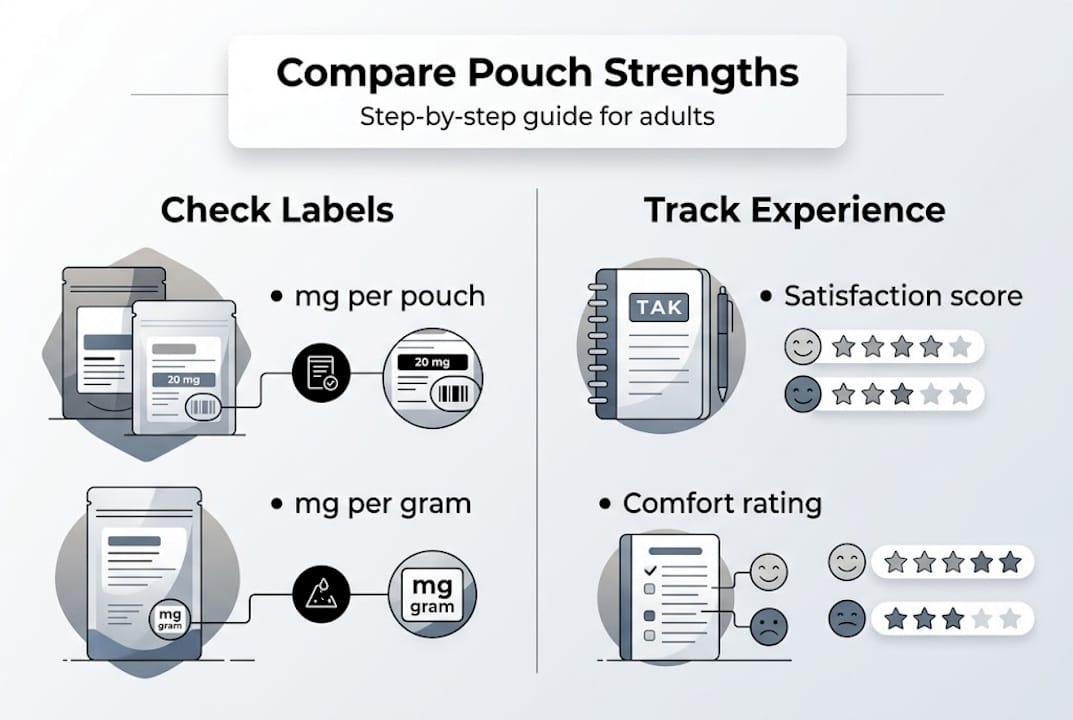
- Nicotine content per pouch (mg): The baseline figure for any comparison
- Nicotine content per gram (mg/g): A more precise indicator of concentration
- Pouch format: Slim, mini, or regular formats release nicotine at different rates
- pH level: Higher pH accelerates absorption through the gum tissue
- Moisture content: Drier pouches often release nicotine more slowly
| Strength label | Typical mg per pouch | Common brands |
|---|---|---|
| Light / mild | 2 to 4 mg | Velo, ZYN |
| Normal | 6 to 8 mg | ZYN, FUMI |
| Strong | 10 to 14 mg | Velo, FUMI |
| Extra strong | 16 to 22 mg | Various |
Pro Tip: Always check mg per gram rather than mg per pouch alone, especially when comparing slim versus regular formats. A slim pouch weighs less, so the same mg figure may actually be a higher concentration.
For a fuller breakdown of how these categories map across products, the nicotine strengths explained guide covers this in detail, and understanding the mechanics behind it is easier once you read up on nicotine absorption facts.
Identifying your needs: factors to consider before comparison
With label clarity in mind, the next step is to honestly assess your own needs and the factors that affect the right pouch strength for you. This part is often skipped, and it is the most common reason people end up with pouches that are too harsh, too mild, or simply inconsistent in their effects.

Your personal tolerance is the single biggest variable. Tolerance refers to how accustomed your body is to nicotine. Seasoned smokers or vapers often find that lower-mg pouches feel underwhelming, while newcomers may find even mid-range strengths intense. Empirical testing and mg content help guide suitability, but they are always modulated by individual factors including metabolism, body weight, and frequency of use. Empirical testing simply means trying something in real conditions and measuring your actual response rather than relying on theory.
Consider the following before you start comparing:
- Prior nicotine history: How much were you smoking or vaping daily before switching to pouches?
- Frequency of use: Are you reaching for a pouch every hour or just a few times a day?
- Sensitivity triggers: Do you experience headaches, nausea, or heart palpitations easily?
- Goals: Are you trying to reduce intake over time, or maintain a consistent level?
- Time of day: Morning use often hits harder due to overnight nicotine clearance
If you are transitioning from cigarettes, your nicotine intake was likely delivered very rapidly via inhalation. Pouches deliver more slowly, so a direct mg-for-mg comparison to your old cigarette consumption is not accurate. Those switching from vaping face a similar adjustment, since device wattage and e-liquid concentration affect delivery in ways that do not translate directly to pouch mg.
The beginners guide to nicotine pouches is worth reading before your first comparison trial if you are newer to pouches. If you already know your general range sits on the lower end, reviewing gentler nicotine pouch options gives you a focused shortlist to work from.
Step-by-step method for comparing pouch strengths
Once you know your needs, here is the practical method for comparing pouch strengths using a structured approach.
- Select two or three products to compare. Choose pouches with similar mg per pouch but from different brands or with different formulations. This isolates the formulation variable.
- Use each product for a minimum of three consecutive sessions. A single trial does not account for daily variation in your baseline or mood.
- Keep conditions consistent. Test pouches at the same time of day, in the same setting, and without mixing caffeine or alcohol, which both alter nicotine sensitivity.
- Track your reactions after each session. Note energy level, cravings within the hour after removal, any dizziness, tingling, or discomfort.
- Compare your notes across products. Look for patterns rather than single-use impressions.
As research confirms, mg content correlates with uptake but is modulated by pouch formulation, so trial is the only reliable method for finding your best fit.
“A single-use impression of a nicotine pouch tells you almost nothing. Three consistent sessions tells you nearly everything.”
| What to compare | Why it matters |
|---|---|
| mg per pouch | Baseline nicotine amount |
| mg per gram | Concentration accounting for size |
| Pouch format | Slim vs regular affects release speed |
| Moisture level | Dry pouches release slower |
| pH indication | Higher pH speeds absorption |
Pro Tip: Keep a simple notes app log with the brand, mg, time of day, and a 1 to 5 score for satisfaction and comfort. After two weeks, you will have data that no label can give you.
For additional comparison frameworks, the tailored pouch strength comparison guide offers structured tools, and if you are deciding between ends of the spectrum, the mild vs strong pouch guide is a useful reference point.
The most common mistake during comparison trials is switching too quickly. Give each product a fair run before drawing conclusions, and avoid comparing a fresh trial of one product to a week-long familiarity with another.
Verifying and interpreting your results
After running comparisons, it is important to verify your results and understand what they mean for your ongoing use. Raw notes are only useful if you know how to read them.
A pouch strength that suits you should produce a clear sense of satisfaction, a reduction in cravings for roughly 30 to 60 minutes after removal, and no uncomfortable physical symptoms. Scientific findings emphasise that real-use feedback and adjusting strength are essential, and that formulation affects perceived impact even when mg figures match.
Signs a strength is working well for you:
- Cravings settle within the first 10 minutes of use
- No dizziness, headache, or nausea during or after the session
- Energy and focus feel stable rather than jittery
- You are not reaching for another pouch immediately after the first
Signs a strength is too high:
- Dizziness, light-headedness, or nausea within minutes of placing the pouch
- Heart rate feels elevated or irregular
- Hiccupping or excess saliva, which sometimes signals the pouch is releasing too rapidly
- Strong urge to remove the pouch early
Signs a strength is too low:
- Cravings return quickly after removal
- No discernible effect during use
- Reaching for multiple pouches back to back
“If your notes show inconsistent results across the same product, check your conditions before changing the product. Lifestyle variables are often the culprit.”
If you are finding results inconsistent, the strong pouch guide for adults covers what to expect at higher strengths, while choosing pouch strength wisely gives a decision framework for iterating based on feedback.
Why comparing pouch strengths requires evidence and honesty
Most guides on this subject stop at reading the label and picking a category. That oversimplification ignores a crucial point: the label is the starting point, not the answer. The reason so many users cycle through products without settling is that they are matching numbers instead of matching responses.
The honest part matters too. It is easy to convince yourself a stronger pouch is fine because you used to smoke heavily, or to under-report discomfort because you want the product to work. Neither approach gives you accurate data. As the science makes clear, mg is only part of the story, and the empirical trial method exists precisely because subjective experience is what ultimately determines fit.
We have seen this repeatedly with users transitioning from vaping: they assume their vaping nicotine level maps directly to pouch mg, buy accordingly, and find the experience either overwhelming or ineffective. Understanding nicotine absorption explained resets those assumptions quickly. The evidence-based approach is slower, but it is the only one that actually works.
Explore tailored pouch options with HitSnus
Ready to put your comparison skills into practice? At HitSnus, you will find a curated range of nicotine pouches spanning every strength level, from gentle introductory options through to high-mg choices for experienced users.
Whether you are mid-trial and want to widen your comparison pool, or you have found your ideal strength and want to stock up, browse pouch options across leading brands including ZYN, Velo, and FUMI. Every listing includes detailed mg information, format descriptions, and flavour profiles to help you match product to preference with confidence. Fast UK delivery means your next comparison trial is never far away.
Frequently asked questions
How do I know which nicotine pouch strength is right for me?
Start by assessing your prior nicotine experience, then trial different strengths while tracking your physical and mental response. Empirical testing and real-use feedback are the most reliable route to finding the best fit.
Can two pouches with the same mg content feel different?
Yes, absolutely. Formulation affects absorption significantly, so pouch material, pH, and moisture content mean effects can vary even when mg figures on the label are identical.
Is it possible to compare strengths without trying the pouches myself?
Not reliably. Empirical self-testing is necessary because label information alone cannot predict how a specific formulation will interact with your individual tolerance and metabolism.
What signs indicate a pouch strength is too high for me?
Dizziness, nausea, elevated heart rate, or strong discomfort during use are the clearest signals. Adjusting to a lower mg option promptly is the right response to any of these symptoms.