










Nicotine Strengths Explained: Choosing the Right Level
Switching from smoking to nicotine pouches brings its own set of questions. Choosing the right nicotine strength is crucial, especially for UK adults seeking a discreet experience without tobacco leaf. With pouch strengths ranging widely and each affecting satisfaction and absorption differently, understanding what those milligram numbers mean can help you find the closest match to your old routine. This guide explains how strengths are measured and what matters most when selecting your ideal pouch.
Table of Contents
- What Nicotine Strength Means In Pouches
- How Strengths Differ Across Popular Brands
- Comparing Pouches With Smoking And Vaping
- UK Labelling, Regulations And Safety Issues
- Selecting The Right Strength For Your Needs
Key Takeaways
| Point | Details |
|---|---|
| Understanding Nicotine Strength | Nicotine strength in pouches is crucial for determining absorption and satisfaction levels; choose based on your smoking history and tolerance. |
| Choosing the Right Strength | Match your nicotine pouch strength to your smoking habits; former smokers may find 6-8mg adequate, while heavy smokers might prefer 10-12mg. |
| Pouch Variations Across Brands | Not all nicotine pouches are identical; strength claims vary by brand, necessitating careful comparison of milligram content rather than relying on labels. |
| Regulatory Compliance Matters | Ensure you buy compliant products with clear labelling, including strength and ingredient transparency, to avoid potential health risks. |
What Nicotine Strength Means In Pouches
Nicotine strength in pouches refers to the amount of nicotine contained per pouch, typically measured in milligrams (mg). This measurement directly determines how much nicotine your body absorbs when using the product.
Nicotine pouches contain nicotine powder and flavourings without any tobacco leaf, which makes them a distinct alternative to traditional snus. The nicotine itself can be plant-derived or synthetic, depending on the manufacturer’s approach.
Why does this matter? Your chosen strength affects how quickly you feel the effects and how long satisfaction lasts. A 3mg pouch delivers a subtle nicotine hit, whilst a 12mg pouch produces a noticeable rush within minutes.
Strength levels aren’t arbitrary—they’re engineered to match different user profiles and consumption habits. As a former smoker transitioning to pouches, understanding these levels helps you replicate your previous cigarette experience without guesswork.
Nicotine strengths vary significantly across the market. Here’s what you’ll typically find:
Below is a quick reference for matching nicotine pouch strength to typical user profiles.
| User Type | Suggested Strength | Experience Level | Intended Outcome |
|---|---|---|---|
| Beginner/Occasional | 2-4mg | New to nicotine pouches | Mild absorption, lower risk |
| Moderate/Former smoker | 6-8mg | Transitioning from cigarettes | Comparable satisfaction, cigarette-like hit |
| Heavy/Long-term smoker | 10-12mg | Experienced with nicotine | Fast, strong effect, higher tolerance |
| Veteran pouch user | 14mg+ | High tolerance, frequent usage | Intense rush, maximised absorption |
- Light pouches (2-4mg): Ideal for occasional users or those reducing intake
- Regular pouches (6-8mg): Matches a standard cigarette for most smokers
- Strong pouches (10-12mg): Suits heavy smokers accustomed to high daily consumption
- Extra-strong pouches (14mg+): For experienced users with substantial nicotine tolerance
The absorption process matters too. When you place a pouch between your gum and lip, nicotine absorbs through the oral mucous membrane. Strength substantially affects absorption and user experience, meaning a stronger pouch delivers faster and more intense effects than a weaker alternative.
Your ideal strength depends on three factors: your previous smoking habits, your current nicotine tolerance, and your desired daily consumption level.
Many UK smokers make the mistake of choosing strength based solely on the pouch’s size or appearance. What actually matters is the milligram count printed on the tin. If you smoked a pack daily, a 6-8mg pouch typically matches your former intake better than guessing from visual cues.
The relationship between strength and satisfaction is personal. Some users find they prefer lower strengths because pouches deliver nicotine more efficiently than cigarettes. Others discover they need stronger pouches to feel satisfied. Testing different strengths across 3-5 days reveals your preference pattern quickly.
Pro tip: Start with the strength you think matches your smoking history, then adjust after one week—moving up or down by 2-3mg based on whether you’re satisfied or feeling excessive stimulation.
How Strengths Differ Across Popular Brands
Not all nicotine pouches are created equal. Even when two pouches claim the same strength, differences in formulation, labelling, and nicotine delivery can create vastly different experiences. Understanding these variations helps you find the right product for your needs.

Popular brands like ZYN, Velo, and On! offer ranges from 1.5mg to 12mg per pouch. However, the naming conventions differ significantly across manufacturers, which can confuse users comparing products side by side.
Take ZYN as an example. Their strength categories follow a straightforward naming system: Dry, Regular, and Strong. Most UK users find their Regular (6mg) pouch delivers nicotine efficiently, whilst their Strong (11mg) option suits heavier smokers transitioning from cigarettes.
VELO takes a different approach with tier names like “Slim” and “Slim Dry.” Their strength range covers similar milligram levels, but the pouch design affects how quickly nicotine releases. Slim pouches sit discreetly and absorb more slowly than standard varieties.
Here’s a comparison of popular nicotine pouch brands and key differences beyond stated strength.
| Brand | Strength Range | Pouch Design | Delivery Features |
|---|---|---|---|
| ZYN | 1.5-11mg | Dry, Regular, Strong | Fast absorption, straightforward labelling |
| VELO | 2-12mg | Slim, Slim Dry | Slower release, discreet fit |
| On! | 2-8mg | Mini square packs | Fast, compact, mild flavour |
Brand differences extend beyond naming:
- Nicotine type: Some brands use plant-derived nicotine; others use synthetic versions
- Pouch design: Smaller pouches deliver slower; larger pouches offer faster absorption
- Flavour intensity: Stronger flavours can mask or enhance the nicotine sensation
- Moisture content: Drier pouches release nicotine differently than moist variants
The labelling problem matters most. One brand’s “Strong” might contain 10mg whilst another’s contains 12mg. What appears identical on the shelf actually delivers different nicotine quantities. This is why reading the milligram count matters more than trusting category names.
Cross-brand comparisons are tricky because identical strength numbers don’t guarantee identical effects—pouch size, moisture, and formulation all influence how your body absorbs nicotine.
Many UK smokers make the mistake of assuming brands offer interchangeable products at matching strengths. Testing a 6mg pouch from Brand A and a 6mg pouch from Brand B might reveal noticeable differences in satisfaction, onset speed, and duration. This variation reflects different manufacturing philosophies and ingredient choices.
Your tolerance builds gradually as you use pouches. If you’ve used one brand for months, switching to another at the same strength might feel weaker or stronger initially. Your body adapts to specific delivery patterns, so transitions typically require a brief adjustment period.
Pro tip: When switching brands, start with a pouch from the new brand during a relaxed moment, not your morning coffee ritual, so you can accurately gauge its strength without daily routine variables clouding the experience.
Comparing Pouches With Smoking And Vaping
Nicotine pouches occupy a unique position between smoking and vaping. They deliver nicotine without smoke, vapour, or combustion, making them fundamentally different from both traditional cigarettes and e-cigarettes. Understanding how they compare helps you make an informed choice based on your priorities.
Smoking delivers nicotine through combustion. You inhale smoke containing thousands of chemicals, including tar and carbon monoxide. This process damages your lungs directly and creates visible smoke that affects those around you. Nicotine absorption is rapid but accompanied by significant health risks.
Vaping heats liquid into vapour instead of burning tobacco. It produces fewer harmful substances than smoking, but still involves inhaling aerosol into your lungs. Vapour dissipates faster than smoke, and there’s no tar or carbon monoxide. However, long-term lung effects remain under investigation.
Nicotine pouches work differently altogether. They deliver nicotine orally through your gums without any inhalation. Pouches are positioned as harm-reduction alternatives due to their lack of tobacco and smoke, making them distinct from both smoking and vaping in how your body absorbs nicotine.
Here’s how they stack up practically:
- Smoking: Fast nicotine hit (10-20 seconds); visible smoke; strong smell; high health risks
- Vaping: Moderate speed (30-60 seconds); no smoke; minimal smell; unclear long-term risks
- Pouches: Slower onset (5-10 minutes); completely discreet; no smell; reduced exposure to harmful substances
The discreetness factor matters significantly for UK users. You can use a pouch at your desk, during a meeting, or on public transport without anyone noticing. Smoking and vaping both produce visible signs that draw attention and trigger smoke-free restrictions.
Nicotine strength comparisons are straightforward. A 6mg pouch delivers comparable nicotine to one cigarette. A standard vape might deliver 10-20mg per puff depending on device and liquid strength. Pouches allow precise dosing without guessing.
Pouches eliminate inhalation entirely, which means your lungs avoid direct exposure to any foreign substances—a significant advantage over both smoking and vaping.
One advantage pouches offer: consistency. Each pouch contains exactly the stated milligrams. Smoking varies based on how deeply you inhale; vaping depends on puff intensity and duration. With pouches, what you see on the tin is what you get.
The transition experience differs too. Smokers often find pouches easier psychologically because the ritual of holding something and using it mirrors smoking behaviour. Vapers may need adjustment since pouches lack the hand-to-mouth action and visible vapour.
Pro tip: If you’re switching from smoking, start with pouch strengths matching your daily cigarette intake (roughly 6mg per cigarette), then use pouches during your habitual smoking moments to ease the behavioural transition.
UK Labelling, Regulations And Safety Issues
The UK regulatory landscape for nicotine pouches remains complex and evolving. Unlike some European countries with established frameworks, British authorities have intensified scrutiny over labelling practices, ingredient transparency, and child-safety measures. Understanding these regulations protects you as a consumer and ensures you’re buying compliant products.
Hazard labelling is the primary concern. UK regulations require clear poison warnings and ingredient transparency under the CLP Regulation. Many pouches sold online lack adequate hazard symbols or ingredient lists, creating legal grey areas for retailers and confusion for buyers.
The CLP Regulation (Classification, Labelling and Packaging) mandates specific warning symbols and text on products containing hazardous substances. Nicotine qualifies as hazardous due to toxicity risks. Non-compliant packaging risks prosecution for sellers.
Nicotine strength disclosure inconsistencies cause real problems. Some manufacturers list strength clearly on the tin; others bury this information or use vague terminology. You deserve transparent labelling showing exactly how many milligrams you’re purchasing.
Key regulatory expectations include:
- Poison symbols: Black skull and crossbones on clear backgrounds
- Ingredient disclosure: Complete list of contents, not just nicotine
- Use-by dates: Expiration information for product safety
- Child-resistant packaging: Tamper-evident, difficult-to-open containers
- Strength labelling: Clear milligram amounts, not just category names
The British Standards Institution recommends a maximum 20mg nicotine per pouch limit for safety. This benchmark protects users from accidental overdose and guides manufacturers toward responsible formulations. Products exceeding this threshold face increased regulatory risk.
Packaging design matters too. Colourful, appealing designs sometimes attract younger users unintentionally. Regulatory bodies emphasise that responsible manufacturers should avoid packaging that appeals to children, even though pouches are exclusively for adults.
Non-compliant products may still circulate online, so verify each tin displays hazard symbols, full ingredient lists, and clear strength information before purchasing.
Accidental ingestion remains a safety concern. Child-resistant packaging prevents accidental access whilst maintaining adult usability. Quality retailers prioritise proper packaging to minimise these risks.
When buying pouches, check for these red flags. Absent hazard warnings suggest regulatory non-compliance. Missing ingredient lists indicate the seller cuts corners. Vague strength labelling means you can’t accurately compare products.
Reputable retailers comply with these standards and stock only compliant products. Buying from established vendors reduces risks substantially compared to grey-market suppliers offering suspiciously cheap or unbranded alternatives.
Pro tip: Before purchasing, inspect product images for black hazard symbols and ingredient lists—these confirm regulatory compliance and indicate you’re buying from responsible sellers.
Selecting The Right Strength For Your Needs
Choosing the correct nicotine strength is personal and depends on three key factors: your smoking history, your current nicotine tolerance, and your lifestyle goals. Getting this right means you’ll actually stay satisfied instead of constantly switching products.
Start by calculating your baseline from smoking. If you smoked a pack daily, that’s roughly 20 cigarettes at 1mg nicotine each, totalling 20mg daily. A 6-8mg pouch delivers comparable strength to one cigarette, making this a useful starting reference point for most former smokers.
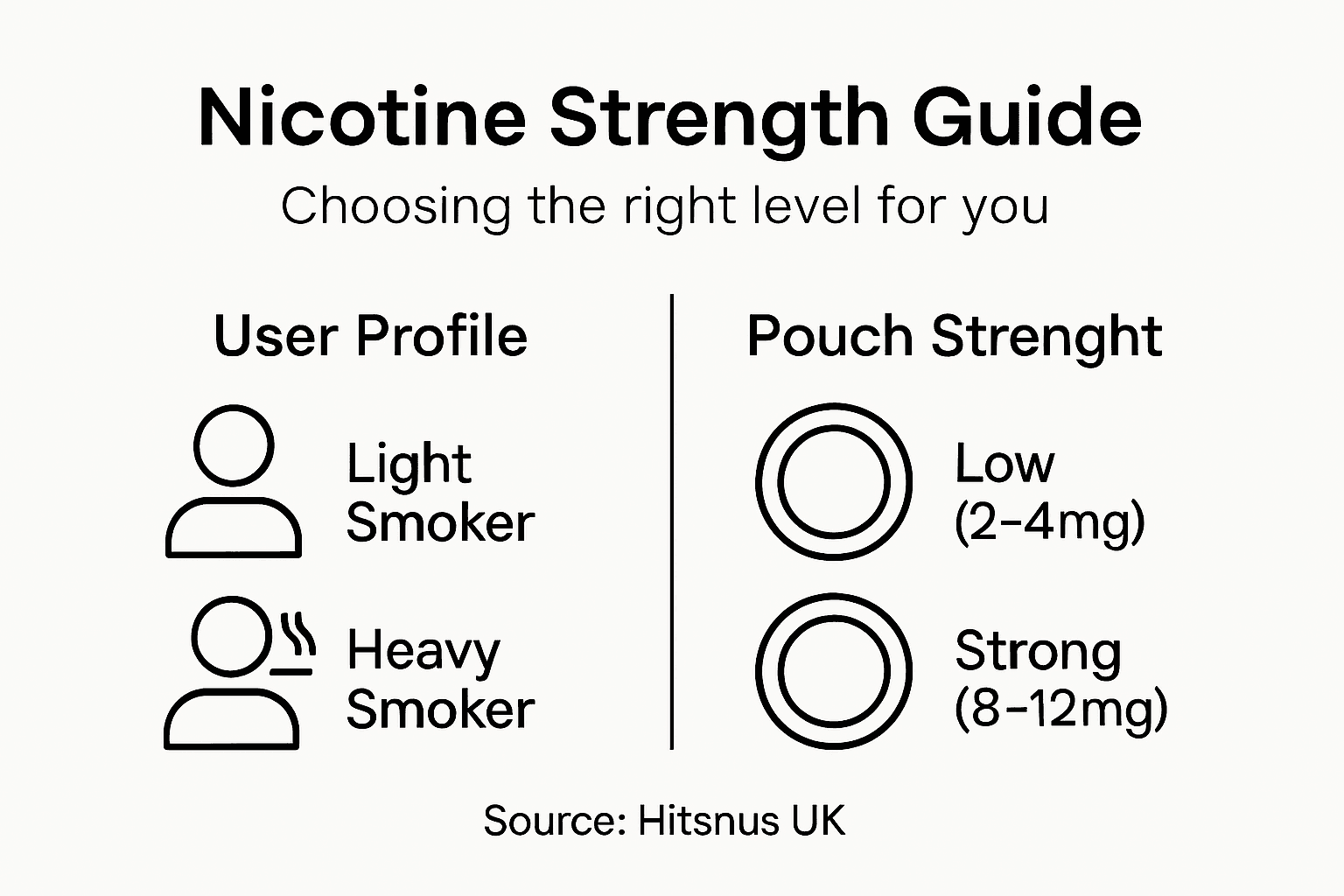
However, pouches deliver nicotine more efficiently than cigarettes. Your body absorbs nicotine faster through oral mucous membranes than through smoke inhalation. This means you might need slightly lower strength than your cigarette consumption suggests. Many smokers transitioning to pouches find 4-6mg delivers sufficient satisfaction.
Consider your actual daily consumption pattern. Did you smoke one cigarette with morning coffee, or chain-smoke throughout the day? Light smokers should explore low-strength options between 2.8 and 4.5mg. Moderate smokers typically find 6-8mg satisfying. Heavy smokers usually need 10-12mg or higher.
Three key factors guide your choice:
- Smoking history: Pack-a-day smokers start higher; occasional smokers start lower
- Tolerance level: Existing pouch users have higher tolerance than new users
- Lifestyle goals: Reducing consumption? Choose lower strength; maintaining satisfaction? Match your habits
Timing matters too. Your morning pouch might need to be stronger than your afternoon one. Some users employ a tiered approach, using stronger pouches early in the day and lighter ones later. This strategy reduces daily nicotine intake whilst maintaining satisfaction.
Don’t rush this decision. Test your chosen strength for 5-7 days before adjusting. Your body needs time to adapt to the new delivery method. After one week, assess honestly: do you feel satisfied? Are you craving more? Feeling too stimulated? Use these observations to guide adjustments.
Your ideal strength exists somewhere between matching your smoking history and respecting how efficiently pouches deliver nicotine—finding this balance takes about two weeks of testing.
When comparing options, understanding the difference between strong and extra-strong pouches helps you make informed jumps when your current strength no longer satisfies. Tolerance builds gradually, so progression is natural.
Avoid the trap of buying multiple strengths simultaneously. Pick one, commit to testing it properly, then adjust methodically. Jumping between strengths constantly prevents your body from establishing baseline tolerance and satisfaction.
Pro tip: Use your strongest craving moments (usually morning or during stressful situations) as your testing benchmark—if a pouch satisfies this moment, it will likely work throughout your day.
Find Your Perfect Nicotine Strength with Hitsnus Today
Choosing the right nicotine strength can feel challenging when transitioning from smoking or exploring discreet options. Whether you are a beginner or an experienced user seeking consistency and satisfaction, understanding your nicotine needs is essential. At Hitsnus, we make this simple by offering a wide selection of carefully categorised products like our Regular Nicotine Strength – HitSnus pouches designed to match your unique consumption habits and tolerance levels.
Experience the difference that clear strength labelling and premium brands can make. Shop now at Hitsnus.com and find your ideal pouch with confidence. Take control of your nicotine journey today by exploring our variety, reading detailed descriptions, and trying strengths tailored to your lifestyle. Visit Hitsnus and step into a world of discreet, smokeless satisfaction today.
Frequently Asked Questions
What is nicotine strength in pouches?
Nicotine strength in pouches refers to the amount of nicotine contained in each pouch, typically measured in milligrams (mg). This measurement determines how much nicotine your body absorbs when using the product.
How do I choose the right nicotine strength for my needs?
Choosing the right nicotine strength depends on your previous smoking habits, current nicotine tolerance, and desired consumption level. Testing different strengths over a week helps you find what satisfies you best.
How does nicotine absorption differ between pouches and other methods like smoking or vaping?
Pouches deliver nicotine through the oral mucous membrane without inhalation, resulting in slower absorption compared to the rapid hit from smoking. Vaping involves inhaling vapour, which may contain fewer harmful substances than smoke but can still pose risks. Pouches avoid respiratory exposure entirely.
What should I consider when switching between different brands of nicotine pouches?
When switching brands, keep in mind that even if the stated strength is the same, differences in formulation, pouch design, and nicotine delivery can lead to varying experiences. It’s advisable to start with a pouch from the new brand during a relaxed moment to accurately gauge its strength.