


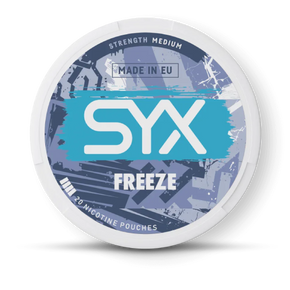


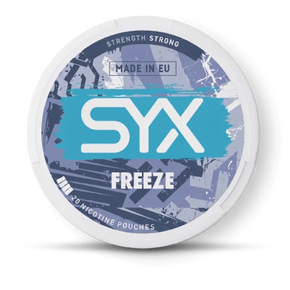


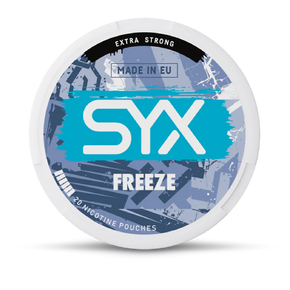




Nicotine salt pouches: what UK adults need to know
Nicotine salt pouches are small, tobacco-free pouches placed between the lip and gum that deliver nicotine through the oral mucosa using nicotine salts rather than freebase nicotine. They are legal to buy and sell in the UK as consumer products, and from 29 October 2026 the Tobacco and Vapes Act 2026 sets a minimum age of sale of 18. On safety: they are likely lower risk than combustible cigarettes because they remove smoke and combustion entirely, but they are not harmless. Nicotine is pharmacologically active and addictive, and long-term effects remain under active study by bodies including the Committee on Toxicity (COT) and Action on Smoking and Health (ASH). Adults considering them can browse the Hitsnus nicotine pouch collection for UK-available options.
Table of Contents
- What nicotine salt pouches are and how they work
- How nicotine pouches differ from snus and other smokeless products
- What the evidence says about health effects and risks
- Understanding nicotine strength and cigarette equivalence
- Who uses nicotine pouches in the UK, and how many?
- UK regulation and product safety standards
- How to use nicotine pouches safely
- How to choose the right nicotine pouch
- Environmental impact and disposal
- Common misconceptions about nicotine salt pouches
- Nicotine pouches for UK adults: browse with confidence
- Sources
- FAQ
What nicotine salt pouches are and how they work
A nicotine pouch is a small, pre-filled sachet, roughly the size of a piece of chewing gum, that sits discreetly between the upper lip and gum. There is no smoke, no vapour and nothing to spit. Saliva activates the pouch, dissolving its contents and releasing nicotine through the buccal mucosa directly into the bloodstream.
Typical ingredients in a nicotine salt pouch:
- Nicotine (tobacco-derived or synthetic), usually in salt form (nicotine benzoate or nicotine bitartrate)
- Plant-based fibres (often cellulose or eucalyptus) as the carrier material
- pH adjusters (such as sodium carbonate or sodium bicarbonate) to optimise absorption
- Sweeteners (e.g. acesulfame potassium)
- Flavourings (mint, citrus, fruit, and more)
- Humectants to control moisture release
The key distinction between nicotine salts and freebase nicotine is chemical stability and pH. Freebase nicotine is alkaline and can feel harsh at higher concentrations. Nicotine salts are formed by combining freebase nicotine with an organic acid, which lowers the pH, reduces harshness and can alter the rate of absorption through mucosal tissue. The practical effect is that salt-based pouches can deliver a smoother sensation at higher nicotine concentrations than freebase formulations would allow.
The absorption pathway runs: pouch placed in mouth → saliva dissolves the pouch matrix → nicotine diffuses across the buccal mucosa → enters the bloodstream. Pharmacokinetic studies indexed on PubMed confirm measurable systemic exposure, though extraction rates vary considerably between products and individual users.
How nicotine pouches differ from snus and other smokeless products
Snus is a moist, loose or portioned tobacco product placed under the upper lip. It contains actual tobacco leaf, which means it carries tobacco-specific nitrosamines and other combustion-adjacent compounds even without burning. Nicotine pouches contain no tobacco whatsoever. That single difference is what determines their legal status in the UK.
Snus has been banned for sale in the UK (and across the EU, with the exception of Sweden) since 1992 under tobacco product regulations. Nicotine pouches, being tobacco-free, fall outside that ban and are sold legally as consumer products. Retailers and public-health groups are clear on this distinction, though many pouch brands are owned by tobacco companies, which raises separate marketing concerns.
Practically, the differences matter for everyday use:
- Moisture and spit: Snus is moist and can generate excess saliva that some users spit. Pouches are drier and designed to be used without spitting, making them more discreet in public.
- Flavour range: Pouches come in a wider variety of flavours (mint, citrus, berry, caramel, violet and beyond) than traditional snus, which tends towards tobacco and mint profiles.
- Regulatory treatment: Pouches are consumer products under the General Product Safety Regulations; snus is banned. Nicotine replacement therapy (NRT) products such as gum, lozenges and patches are licensed medicines regulated by the MHRA.
Compared with vaping, pouches produce no aerosol, require no device and leave no visible trace. For users who need discretion in environments where vaping is restricted, that is a practical advantage.
What the evidence says about health effects and risks
The honest summary: nicotine pouches are probably less harmful than smoking, but that does not make them safe. The COT concluded that pouches deliver a pharmacologically active dose of nicotine, are not harmless, and that significant data gaps remain. ASH echoes this: pouches are likely less harmful than smoking but are not an NHS-recommended cessation aid.
Short-term effects users commonly report include nausea, dizziness (particularly at higher strengths), mouth soreness, and gum irritation at the placement site. Prolonged or frequent use at the same spot can cause localised gingival irritation or ulceration.
Longer-term concerns are less well characterised. Nicotine itself affects cardiovascular function and is harmful during pregnancy. Oral tissue effects from repeated pouch use are under study but not yet fully quantified.
Critical safety points:
- Not suitable for people who do not currently use nicotine
- Not safe during pregnancy or breastfeeding
- Keep all pouches out of reach of children and pets; accidental ingestion of even one high-strength pouch can cause acute nicotine toxicity in a child
- If a child or pet ingests a pouch, call the NHS 111 service or the UK National Poisons Information Service immediately
Pro Tip: Avoid using nicotine pouches alongside cigarettes or other nicotine products at the same time. Combined use stacks your total nicotine exposure and prolongs dependence rather than reducing it. Read more about using pouches safely in 2026 before starting.
Understanding nicotine strength and cigarette equivalence
Pouches are labelled in milligrams of nicotine per pouch, typically ranging from around 2 mg at the low end to 18 mg or above at the high end. The COT noted that commercial pouches most commonly sit in the 4–18 mg range, though information supplied to officials indicated some products may contain up to approximately 120 mg per pouch.
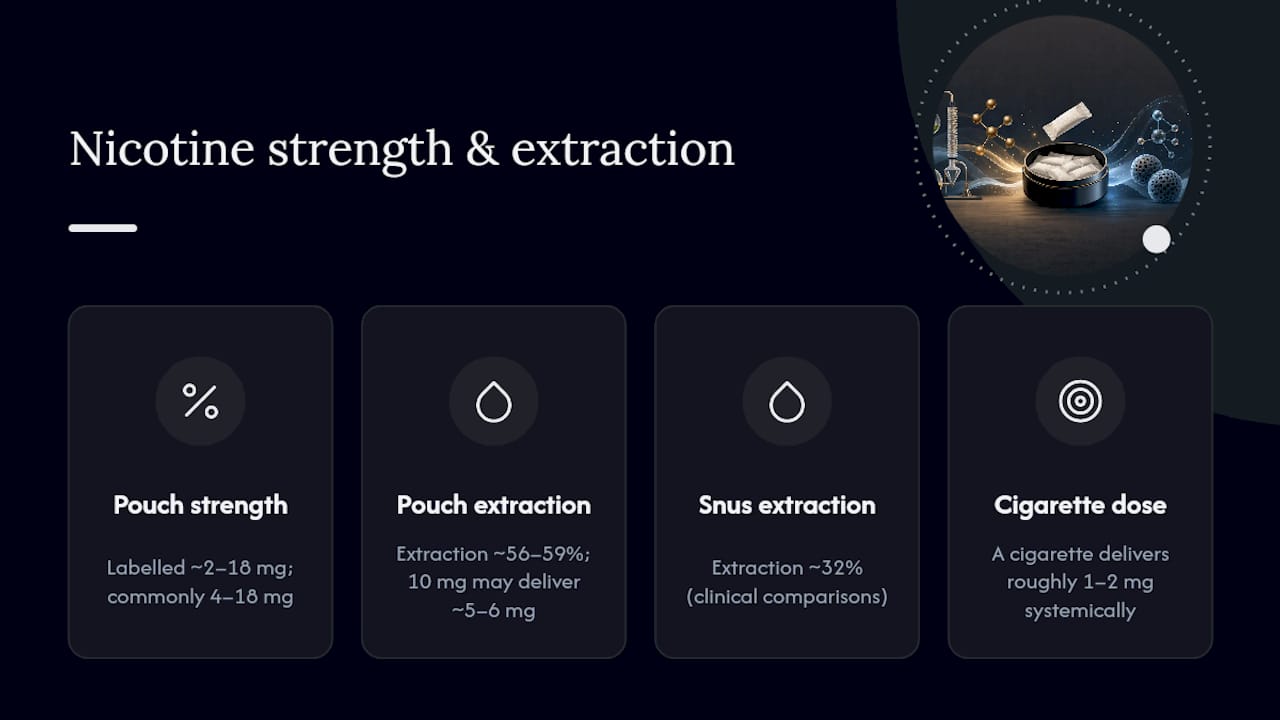
The labelled mg figure is not the same as the dose absorbed. A COT/TOX pharmacokinetic review found that extraction fractions from pouches in clinical studies ranged from roughly 56–59%, compared with around 32% for snus in the same comparisons. That means a 10 mg pouch might deliver somewhere in the region of 5–6 mg of extractable nicotine, though actual systemic absorption depends on individual physiology, placement and duration of use.
A single cigarette delivers roughly 1–2 mg of nicotine to the bloodstream, though this varies with smoking behaviour. Comparing pouches to cigarettes on a per-unit basis is therefore approximate at best. The extraction percentages above come from small clinical trials, some with industry involvement, so treat them as indicative rather than definitive. PubMed-indexed pharmacokinetic studies provide comparative AUC and Cmax data that reinforce why equivalence claims should always be treated with caution.
Who uses nicotine pouches in the UK, and how many?
The typical profile from surveys and public-health reports is adult smokers looking to switch to a less harmful format, some current vapers seeking a device-free alternative, and a smaller group of former smokers maintaining nicotine use. Overall population prevalence remains modest compared with smoking or vaping rates.
The ONS provides the population denominators used to calculate any per-capita prevalence figures, and it is worth noting that systematic monitoring of pouch use is relatively recent. Survey data should be read with that caveat in mind.
Youth uptake is a specific concern for regulators and public-health bodies. Flavoured products in bright packaging have obvious appeal beyond the adult smoker demographic that harm-reduction arguments are built around. The Tobacco and Vapes Act 2026 addresses this directly through age-of-sale restrictions and powers to restrict flavours and packaging, though those provisions are still being implemented.
UK regulation and product safety standards
The Tobacco and Vapes Act 2026 is the primary legislative change UK buyers need to know about:
- From 29 October 2026: selling nicotine products (including pouches) to anyone under 18 is a criminal offence.
- Vending machines and free distribution of nicotine products are banned.
- Advertising and sponsorship restrictions take effect from 1 June 2027.
- The Act also grants powers to restrict flavours, packaging and product standards by secondary legislation.
Currently, nicotine pouches are regulated as consumer products under the General Product Safety Regulations 2005, not as medicinal products. This means they do not require MHRA approval before sale, but they must meet general safety obligations. The British Standards Institution has published PAS 887, a publicly available specification addressing composition, manufacture and testing of oral nicotine pouches. Compliance with PAS 887 is voluntary, but it represents the closest thing to a recognised product standard in the UK market.
Consumer safety checklist — what to look for on a pouch product:
- Full ingredient list on the packaging
- Nicotine content stated per pouch (in mg)
- Manufacturer name and contact details
- Batch code and production date
- Visible safety warnings (keep away from children; not for non-nicotine users; not for use during pregnancy)
How to use nicotine pouches safely
Step-by-step for first-time and routine use:
- Start with one pouch at a low strength (2–6 mg is a sensible starting point for most adults).
- Place the pouch between your upper lip and gum. No chewing required.
- Leave it in place for 20–30 minutes. A mild tingling sensation is normal.
- Remove if you feel nauseous, dizzy or unwell before the session ends.
- Do not use more than one pouch at a time.
- Dispose of the used pouch in the small compartment in the lid of the tin, or in a bin. Never flush pouches.
Child and pet safety:
- Store pouches in their original, closed tin, out of sight and out of reach.
- A single high-strength pouch can cause acute nicotine toxicity in a small child or pet.
- If ingestion occurs, call NHS 111 or the National Poisons Information Service (0344 892 0111) immediately and tell them the product name and nicotine strength.
For smokers considering switching:
- Match your starting strength to your current smoking habit. Heavy smokers (20+ per day) may need 8–12 mg; lighter smokers can often start at 4–6 mg.
- Avoid dual use: using pouches and continuing to smoke simultaneously increases total nicotine exposure.
- NHS Stop Smoking Services offer free structured support and can advise on whether pouches or licensed NRT products are the better fit for your situation.
- Consult a GP or pharmacist before starting if you have cardiovascular disease, are pregnant, or take regular medication.
For a detailed switching plan, Hitsnus has a practical guide on how to switch to nicotine pouches that walks through the process step by step.
How to choose the right nicotine pouch
Strength is the first decision. Start lower than you think you need. Nicotine salt pouches deliver nicotine efficiently, and it is easy to underestimate the dose from a product that produces no visible smoke or vapour. The 2–6 mg range suits most first-time users; experienced users or heavier smokers may move to 8–12 mg once they understand their response.
Format is the second. Slim pouches sit more discreetly under the lip and are less noticeable in conversation. Regular-format pouches are bulkier but some users find they give a fuller sensation. Neither is inherently better; it comes down to personal preference and context.
On ingredients and labelling: choose products that list every ingredient, state the nicotine content per pouch clearly, and carry a batch code. Avoid products with no manufacturer contact details or no visible safety warnings. These are minimum expectations, not premium features.
Retailer considerations for UK buyers:
- The seller must operate age verification from 29 October 2026. Online retailers are legally required to verify age before completing a sale.
- Look for clear returns policies and accessible customer service.
- Be cautious of very cheap products with no English-language labelling; these may not meet UK safety expectations.
On flavours: mint, menthol, citrus and fruit are the most common. Sweeter flavours like caramel and violet are popular but have attracted regulatory attention because of their potential appeal to younger users. Adult buyers who prefer a lower-profile product may find simpler flavour profiles more appropriate for their needs.
Environmental impact and disposal
Used nicotine pouches are small but not trivial from an environmental standpoint. Most pouches consist of a synthetic or plant-fibre pouch filled with cellulose, nicotine, flavourings and other additives. They are not recyclable through standard household recycling streams.

The correct disposal method is the small compartment built into the lid of most pouch tins, followed by disposal in general waste. Flushing pouches down the toilet or drain is not appropriate; nicotine is toxic to aquatic organisms and the pouch material does not break down quickly in water.
The tins themselves are typically made of polypropylene plastic. Some brands have introduced take-back or recycling schemes, though these are not yet widespread in the UK market. If a brand you use offers a returns scheme, it is worth using it. Otherwise, the tin goes in your household plastic recycling where your local authority accepts that material.
Compared with cigarette butts, which are one of the most common forms of litter globally and leach toxic compounds into soil and water, pouches have a smaller footprint per unit. That is a relative point, not a clean bill of environmental health.
Common misconceptions about nicotine salt pouches
“They are completely safe because there is no tobacco.” Tobacco-free does not mean risk-free. Nicotine is pharmacologically active regardless of its source. The COT is explicit that pouches are not harmless.
“They are the same as snus.” They are not. Snus contains tobacco leaf; pouches do not. Snus is banned in the UK; pouches are legal. The nicotine delivery mechanisms are similar but the composition and regulatory status are different.
“They are an NHS-approved stop-smoking aid.” They are not. Licensed NRT products (patches, gum, lozenges, inhalators) have been through MHRA approval and are recommended by NHS Stop Smoking Services. Nicotine pouches have not gone through that process and are not currently classified as cessation aids, though some smokers use them as part of a switching strategy.
“The nicotine content on the label is what you absorb.” The labelled mg figure is the total nicotine in the pouch, not the absorbed dose.
“They are only used by young people.” Survey data points to adult smokers as the primary user group. Youth use is a regulatory concern, but the majority of current users in Great Britain are adults who already use nicotine in some form.
“High-strength pouches are always better for quitting smoking.” Higher strength increases nicotine exposure and the risk of dependence. Starting at the lowest effective strength and stepping down over time is the approach consistent with harm-reduction principles. Read more about the benefits and trade-offs of nicotine pouches before choosing a strength.
Nicotine pouches for UK adults: browse with confidence
Hitsnus stocks a curated range of nicotine pouches for UK adults who want a tobacco-free, smokeless nicotine option, with clear product information and age-verified purchasing. Every order is for adults only, in line with the Tobacco and Vapes Act 2026.
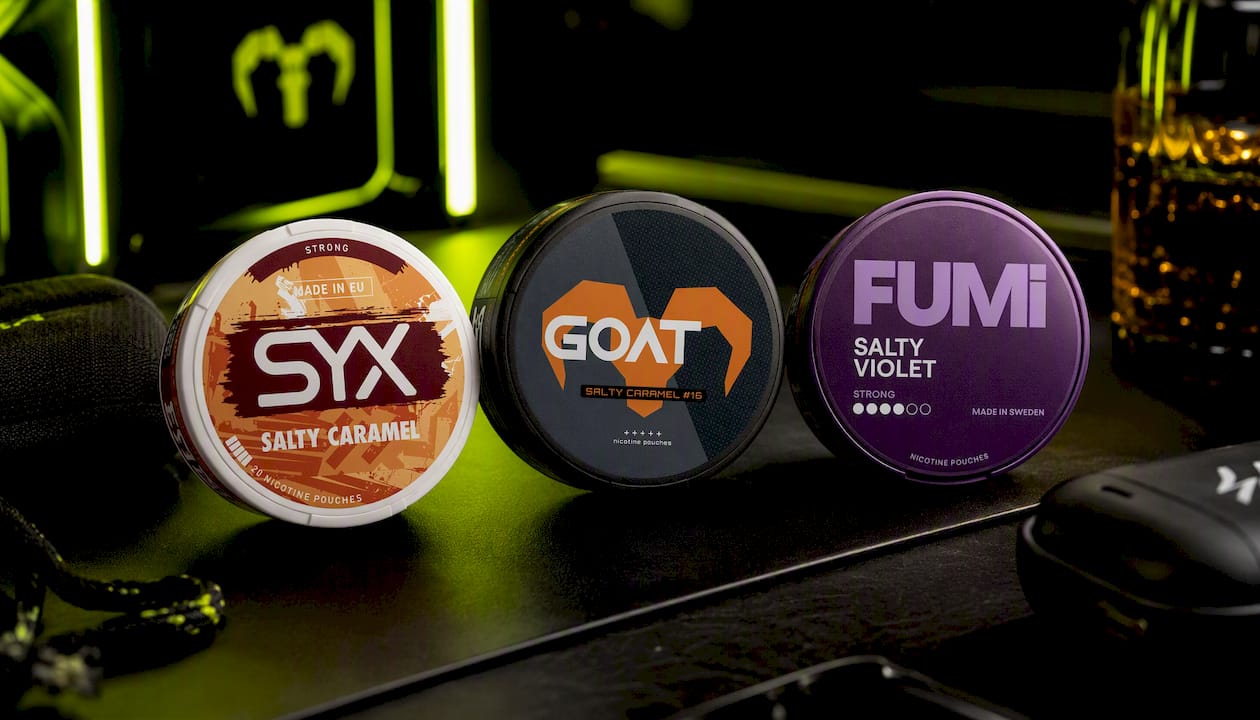
The range includes flavoured options across multiple strengths. SYX Salty Caramel is a high-strength option for experienced users who know their tolerance. GOAT Salty Caramel offers a similar flavour profile at a different format. For adults starting out or preferring a mid-strength option, FUMI Salty Violet at 8 mg is a good place to start. Browse the full nicotine pouches collection to compare strengths, formats and flavours. For adults with medical conditions or who are pregnant, consult a healthcare professional before use.
Sources
- Nicotine pouches - ASH
- Tobacco and Vapes Act 2026
- What are nicotine pouches and are they safer than smoking? — Sky News
- PubMed pharmacokinetic study record
FAQ
Are nicotine salt pouches safe?
They are likely less harmful than combustible cigarettes because they remove smoke and combustion, but they are not safe in an absolute sense. The COT confirms they deliver a pharmacologically active dose of nicotine, carry addiction risk, and their long-term effects are still under study.
How many cigarettes is a 10 mg nicotine pouch equivalent to?
There is no precise equivalence. A single cigarette delivers roughly 1–2 mg to the bloodstream, but individual absorption varies considerably with product formulation and user behaviour.
Why is snus banned in the UK but nicotine pouches are not?
Snus contains tobacco leaf and has been banned for sale across the UK (and EU, except Sweden) since 1992 under tobacco product regulations. Nicotine pouches contain no tobacco, so they fall outside that ban and are sold legally as consumer products under the General Product Safety Regulations.
Are nicotine pouches a recommended NHS stop-smoking aid?
No. Licensed NRT products such as patches, gum and lozenges are the NHS-recommended cessation aids. Nicotine pouches have not gone through MHRA approval as medicinal products and are not currently classified as stop-smoking treatments, though some adults use them as part of a switching strategy away from cigarettes.
What age do you need to be to buy nicotine pouches in the UK?
From 29 October 2026, the Tobacco and Vapes Act 2026 sets the minimum age of sale for nicotine products, including pouches, at 18. Online retailers are legally required to verify age before completing a sale.
This article provides general information only and is not a substitute for professional medical advice. Consult a GP, pharmacist or NHS Stop Smoking Service for guidance specific to your health situation, and verify current regulations with the relevant primary source.