












How pouch material shapes nicotine delivery and comfort
TL;DR:
- The material of nicotine pouch wrappers substantially influences nicotine release speed, comfort, and flavor longevity. Understanding pouch composition helps consumers select products aligned with their preferences, beyond just nicotine strength. Innovations focus on eco-friendly, biodegradable materials that balance performance with environmental impact.
If you’ve ever switched brands and wondered why the same nicotine strength felt completely different, the answer isn’t in your head — it’s in the pouch itself. Most users focus entirely on milligrams per gram, treating nicotine content as the single variable that determines satisfaction. But the fabric, density, and fibre composition of the pouch material silently controls how fast nicotine reaches your bloodstream, how comfortable the pouch sits in your mouth, and whether that mint or berry flavour lingers for five minutes or forty-five. Understanding pouch material gives you a genuine edge in finding your ideal experience.
Table of Contents
- Why pouch material matters: more than just a wrapper
- How pouch material influences nicotine release
- Comfort, flavour, and pouch size: the sensory factors
- Material innovation, environmental impact and the future
- Looking beyond the label: what most users miss about pouch material
- Find your ideal pouch material with HitSnus
- Frequently asked questions
Key Takeaways
| Point | Details |
|---|---|
| Material drives release | Cellulose-based pouch design controls how fast and how much nicotine you absorb. |
| Comfort is material-dependent | Pouch material and construction shape comfort, from mouthfeel to ease of use. |
| Size and material both matter | Slim and regular pouches interact with saliva and fit to alter flavour and delivery. |
| Innovations boost sustainability | Biodegradable and eco-friendly pouch materials are improving the environmental profile of pouches. |
| Experiment for your best fit | Trying different pouch materials and sizes is the most effective way to maximise satisfaction and comfort. |
Why pouch material matters: more than just a wrapper
With common misconceptions out of the way, let’s look inside the pouch — starting with what it’s really made of.
Most people think of the pouch as packaging. In reality, it’s an active part of the delivery system. The outer layer is not passive. It filters, slows, or accelerates the transfer of nicotine and flavour compounds into your saliva and through your gum tissue. Get the material wrong and you can have an uncomfortable, scratchy experience or a flavour that disappears in minutes. Get it right and you barely notice the pouch is there.
The dominant base material is cellulose, derived from plant fibres. This is the same family of materials used in pharmaceutical-grade delivery systems. It offers a soft texture, structural integrity under moisture, and the ability to hold fillers and nicotine salts evenly throughout the pouch. As a 2025 narrative review confirms, “pouch formulations rely on cellulose-based pouch structures, which provide stability and maintain shape.”
The main functions a pouch material must serve are:
- Containing nicotine and filler without leaking or breaking apart under saliva
- Controlling the release rate of nicotine into the oral mucosa
- Affecting mouthfeel and comfort against soft gum and lip tissue
- Supporting flavour additives by holding aromatic compounds and allowing them to release gradually
- Maintaining shape so the pouch stays correctly positioned during use
Understanding these functions helps you make sense of why pouch types differ far more than the label suggests. A pouch with a looser, more permeable weave will release everything faster. A tighter, denser material creates a sustained, measured experience. And as you’ll see, the harshness and flavour impact of a pouch is directly tied to this material question.
“The physical structure of the pouch material is not incidental — it is the primary mechanism by which manufacturers tune user experience, from onset speed to duration and comfort.” — 2025 Frontiers in Public Health narrative review
How pouch material influences nicotine release
Now that we know what the pouch is made from, how does it affect what you actually feel and absorb?

The short answer: dramatically. Research published in a Scientific Reports/PMC study confirms that nicotine dissolution rates vary significantly between products, and this variation links directly to differences in pouch material composition. It’s not simply a matter of strength. Two 6 mg pouches from different brands can deliver entirely different sensations because of how their respective materials filter the nicotine release.
Here’s a simplified breakdown of what researchers have observed across popular brands:
| Brand | Release profile | Onset speed | Duration |
|---|---|---|---|
| ZYN | High dissolution | Fast | Short to moderate |
| on! | High dissolution | Fast | Short |
| Velo | Lower dissolution | Slower | Extended |
| Loop | Lower dissolution | Slower | Extended |
| Dryft | Lower dissolution | Slower | Extended |
| Volt | Lower dissolution | Moderate | Extended |
The practical implication is significant. If you want a sharp, immediate hit similar to what smokers expect from the first drag of a cigarette, a faster-dissolving material works in your favour. If you prefer a consistent background effect during a long commute or a meeting, a slower-releasing material sustains that sensation without the rapid drop-off. Neither is objectively better — they serve different preferences and different times of day.
The brand differences in pouch material are also visible in how the pouch feels against your gum. Denser, slower-releasing materials tend to feel firmer and are often preferred by users who find that thinner pouches cause irritation. This connects directly to why slim pouches have grown in popularity — not just for their discreet profile, but because the compressed format changes how the material interacts with tissue.
Pro Tip: Even with the same nicotine content, switching from a fast-releasing brand to a slow-releasing one can feel like reducing your dose. If you’re transitioning from cigarettes and a pouch feels unsatisfying, the issue may not be the strength — it may be the release profile of the material.
Comfort, flavour, and pouch size: the sensory factors
Beyond just nicotine strength, what makes a pouch actually enjoyable and easy to use day-to-day?
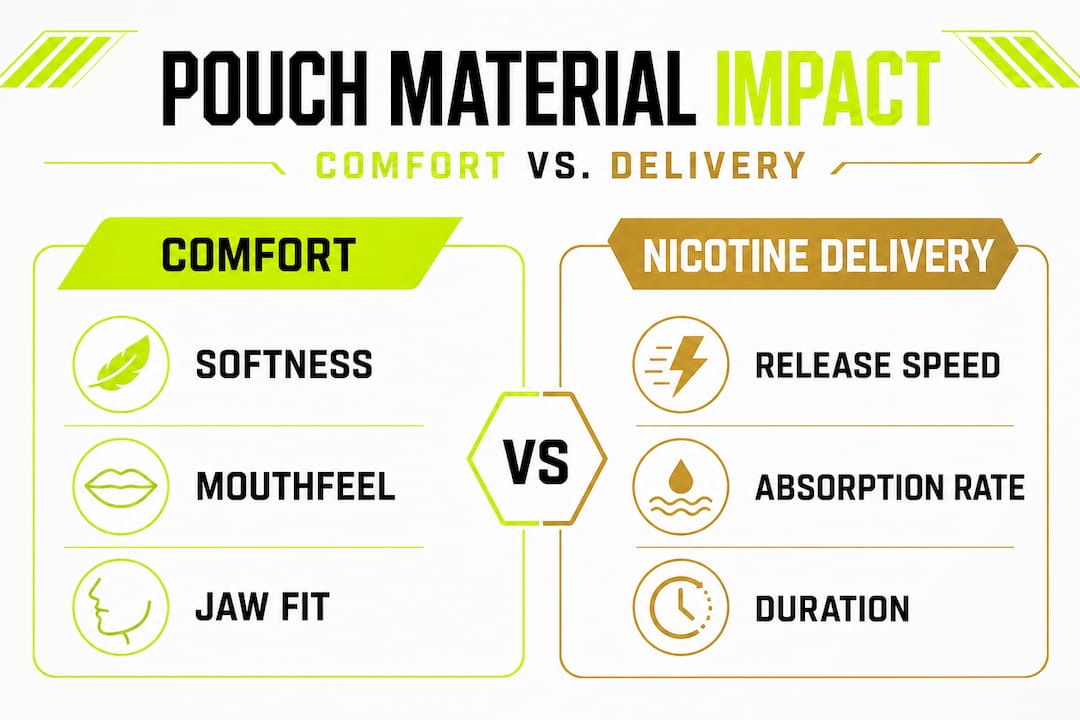
Comfort and flavour delivery are inseparable from how the material sits, bends, and interacts with moisture in your mouth. A 2025 Psychopharmacology study found that comfort and flavour sensations depend partly on pouch material and format, confirming what experienced users have long suspected. The way a pouch is shaped, cut, and finished at its edges directly affects irritation, bite, and flavour longevity.
Slim and non-slim formats interact with oral tissue in very different ways:
| Format | Material thickness | Typical position | Saliva flow interaction | Release profile |
|---|---|---|---|---|
| Slim | Thinner, compressed | Upper lip, discreet | Lower saliva activation | Moderate to slow |
| Regular/non-slim | Thicker, fuller | Upper or lower lip | Higher saliva activation | Faster initial release |
| Mini | Ultra-thin | Any position | Minimal activation | Rapid, short duration |
Saliva flow matters more than most users realise. A thicker, wider regular pouch captures more saliva around it, which speeds up the dissolution of nicotine and flavour additives. A slim pouch tucks tighter against the gum, reducing saliva pooling and slowing everything down. This is why the mini vs slim comparison is about far more than size — it’s a question of delivery chemistry.
To identify the best pouch size and material for your comfort, follow these steps:
- Start with slim formats if you want discretion and a moderate, extended release. They suit most new users and those transitioning from vaping.
- Try a regular format if you find slim pouches unsatisfying. The wider surface area may simply deliver more of what you’re looking for.
- Test at different times of day. Morning use often benefits from faster-releasing materials, while evening use might suit a slower, softer pouch.
- Note irritation. If you feel tingling or soreness, move to a denser, softer material with a smoother edge finish rather than immediately lowering nicotine strength.
- Assess flavour duration. If flavour fades in under ten minutes, the material may be too porous. A denser pouch holds flavour compounds longer.
Understanding safe pouch sizing also contributes to comfort. Overly large pouches can cause jaw fatigue and excessive saliva, undermining any advantage from the material itself.
Pro Tip: Try pouches from the same brand in different formats before assuming you don’t like a particular flavour. The mint in a slim pouch and the mint in a regular pouch from the same range can taste and feel remarkably different because of how the material shapes the release.
Material innovation, environmental impact and the future
While comfort and delivery are essential, today’s users also want a product that is better for the planet. How are materials advancing?
The nicotine pouch industry is still relatively young, but manufacturers are already pushing beyond basic cellulose blends. The pressure to innovate comes from two directions: users demanding a better sensory experience, and growing awareness of plastic waste and manufacturing impacts. As the 2025 Frontiers narrative review notes, the base material is cellulose from plant fibres, with format increasingly important for both performance and user feel — and that format is evolving.
Current innovations in pouch material include:
- Fully biodegradable cellulose blends that break down faster in soil and water without sacrificing structural integrity during use
- Reduced synthetic binder content, moving away from adhesives or coatings that slow natural decomposition
- Improved fibrous textures that are gentler on gum tissue while remaining durable throughout a 30 to 60-minute session
- Moisture-regulating layers that control saliva interaction more precisely, giving manufacturers tighter control over release profiles
- Compostable pouch compartments built into newer can designs, making disposal simpler for conscious consumers
The trade-off remains real. More porous, biodegradable materials can accelerate nicotine release in ways manufacturers don’t always intend. Achieving a slow, controlled release while also ensuring rapid decomposition after disposal is an engineering challenge that hasn’t been fully solved yet. Brands leading this effort are beginning to label products with eco certifications, which is a useful signal for environmentally conscious buyers.
“The evolution of pouch base materials towards greater sustainability represents one of the most significant engineering challenges in the modern nicotine product category — balancing rapid post-use decomposition with reliable in-use performance.” — 2025 Frontiers in Public Health narrative review
For practical guidance on the environmental impact of pouch materials and how to make smarter disposal choices, there’s growing information available that goes beyond simply binning your used pouch. Following eco-friendly disposal tips makes a genuine difference, particularly given that conventional pouch materials can persist for decades in landfill.
When choosing for environmental reasons, look for:
- Products labelled with cellulose content above 90%
- Brands that use compostable inner liners
- Packaging that specifies biodegradable or plant-derived pouch material
- Ranges that avoid synthetic flavour-binding coatings
Looking beyond the label: what most users miss about pouch material
Now that we’ve covered facts and features, here’s a truth that statistics alone can’t reveal.
The nicotine pouch industry markets almost entirely on strength. Every conversation, every product page, every search filter defaults to milligrams per gram. And for new users especially, this creates a fundamentally flawed way of shopping. We’ve watched thousands of people cycle through brands without satisfaction, convinced they simply need more nicotine — when in reality, they need a different material.
Conventional wisdom says: if the pouch isn’t working, go stronger. What the evidence actually shows is that release speed, mouthfeel, and the physical comfort of the pouch against your gum tissue matter far more to everyday satisfaction than whether you’re at 6 mg or 8 mg. A slow-releasing 6 mg pouch will frequently outperform a fast-releasing 8 mg pouch in terms of sustained satisfaction, particularly for users who previously smoked and are used to nicotine arriving over a period rather than in a single sharp peak.
Transitioners from cigarettes and vaping face a specific challenge here. The differences between pouches and vaping go beyond delivery mechanism — they extend to the entire sensory contract you have with your nicotine product. Vapers often find pouches too mild not because the strength is wrong, but because the onset is wrong. Their nervous system expects rapid delivery. A faster-releasing material can bridge that gap better than simply increasing the stated strength.
The little details that manufacturers rarely publicise — the weave density of the pouch fabric, the edge finishing that prevents scratching, the thickness and compression of the filler — determine whether someone sticks with pouches or abandons them. We’ve seen users succeed on their third or fourth brand not because they found a stronger product, but because they accidentally found a pouch material that sat comfortably and delivered at the right pace for their preference.
“The journey to the right nicotine pouch is as much about feel as it is about chemistry. Material shapes the moment of use; numbers only describe the potential.”
Pro Tip: Order a variety of formats and brands rather than committing to bulk quantities based on strength alone. The invisible differences in material construction are the variables that determine whether you find a product genuinely satisfying or persistently disappointing.
Find your ideal pouch material with HitSnus
Ready to experience the difference? Here’s how to match insights with action.
Understanding pouch material is one thing — finding products that live up to that understanding is where HitSnus comes in. At HitSnus, the full range of nicotine pouches spans formats from mini to regular, across fast and slow release profiles, and from brands that prioritise comfort, flavour longevity, and even sustainable materials. Every product listing includes format details, so you’re never left guessing about what you’re actually buying.
If you’re still finding your footing, the medium strength options offer an excellent starting range — gentle enough to experiment with different materials without intensity getting in the way of assessing comfort and release. Browse by format, filter by strength, and use the detailed product descriptions to match what you’ve learned here to what’s in your cart. The right material is out there. Let the experience, not just the label, guide your choice.
Frequently asked questions
What is the most common material in nicotine pouches?
Most nicotine pouches use a cellulose base made from plant fibres, chosen for its stability, comfort, and compatibility with nicotine salts and flavour additives.
Does pouch material affect how quickly you feel nicotine?
Yes, significantly. Differences in outer pouch and filler material directly alter dissolution and release rates, meaning two pouches with identical nicotine content can feel entirely different in onset and duration.
Are slim pouches better for flavour or comfort?
Slim pouches often provide more targeted, comfortable placement and a more controlled release, but format affects comfort differently for each user depending on mouth anatomy, saliva production, and personal preference.
Is pouch material important for environmental impact?
Yes. Biodegradable cellulose options are becoming more widely available, while pouches containing synthetic binders or coatings may persist in the environment considerably longer after disposal.
What is the best way to find the right pouch material for me?
Try sample packs featuring multiple formats and brands, paying attention to comfort, release onset, and flavour duration rather than focusing solely on the stated nicotine strength.