












Double pouching: is it safe for UK nicotine pouch users?
No — using two nicotine pouches at the same time is not recommended. NHS-affiliated guidance is clear: one pouch per session, placed between the lip and gum for 5 to 60 minutes. Stacking two pouches roughly doubles your systemic nicotine exposure, and the COT’s assessment confirms that commercial pouches already deliver a pharmacologically active dose on their own. If you want a stronger hit, a higher-strength single pouch is the safer route. Browse the full range at the Hitsnus nicotine pouch collection to find the right strength without stacking.
Table of Contents
- What double pouching means and why some users try it
- How nicotine pouches release nicotine — and why stacking changes your dose
- Health risks of using two pouches at once
- Safer alternatives to double pouching
- Practical dosing guidance: how to choose the right pouch strength
- What to do if you feel unwell after stacking pouches
- UK legal status and upcoming regulatory changes for nicotine pouches
- Single-pouch strengths, ready to browse at Hitsnus
- Sources
- FAQ
What double pouching means and why some users try it
Double pouching means placing two nicotine pouches under your lip at the same time, stacking them against the gum to increase nicotine delivery. It is distinct from any packaging or sterile-barrier practice of the same name — this guide is entirely about the nicotine-pouch behaviour.
Users typically try it for a handful of reasons:
- Stronger hit: one pouch no longer satisfies a tolerance that has built up over time.
- Longer duration: two pouches seem to extend the session before the nicotine tingle fades.
- Flavour mixing: some users stack two different flavours for a combined taste.
- Habit or convenience: grabbing two pouches becomes automatic, especially during high-stress moments.
Each of these motivations has a safer solution, which the sections below address directly.
How nicotine pouches release nicotine — and why stacking changes your dose
Pouches work through transbuccal absorption. You place the pouch between your lip and gum, saliva dissolves the nicotine from the pouch matrix, and it passes through the oral mucosa into the bloodstream. No smoke, no vapour — just direct mucosal uptake.
The COT reports that commercial pouches typically contain nicotine in regulated amounts, most offering 4–18 mg per pouch, and BSI PAS 8877:2022 recommends a maximum of 20 mg per pouch. ASH Scotland notes typical pouches range in nicotine content, including some that are much stronger.
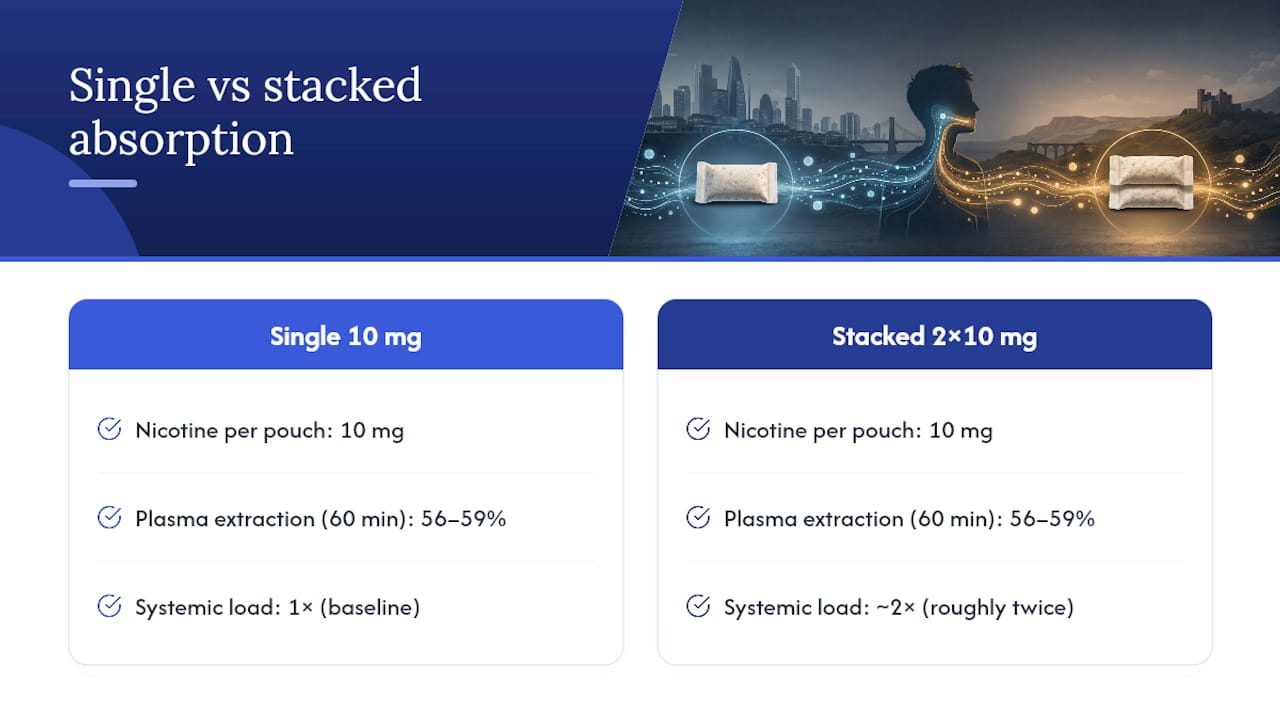
Absorption insight: Small pharmacokinetic studies cited in the COT’s full assessment found that roughly 56–59% of a pouch’s nicotine content may be extracted into plasma over a 60-minute session for certain products.
Three factors affect how quickly nicotine releases: the pH of the pouch formulation, moisture levels in the mouth, and flavour additives. A menthol pouch, for instance, may feel milder than its mg content suggests because of the cooling sensation masking the nicotine tingle.
Stacking two 10 mg pouches does not simply feel twice as strong — it delivers roughly twice the systemic nicotine load, which is where the risk lies.
Health risks of using two pouches at once
The acute effects of excess nicotine are well documented, and double pouching accelerates the path to them.
Acute symptoms to watch for:
- Nausea and stomach discomfort — often the first sign of too much nicotine
- Dizziness or light-headedness
- Headache
- Hiccups — particularly common with stacked pouches due to increased saliva production
- Mouth soreness and gum irritation from double mechanical contact
- Elevated heart rate or palpitations
At higher doses, symptoms can escalate to vomiting, fainting, and chest tightness. HSE guidance stresses that nicotine is addictive and that regular use at elevated doses increases dependence. The NCBI review on nicotine dependence confirms that neurobiological adaptation underlies this process — every nicotine delivery method can drive dependence, and stacking accelerates dose escalation faster than a stable single-pouch routine.
Swedish population data estimate that habitual users consume an average of 8.6 pouches per day. At 10 mg each, that is 86 mg of nicotine daily before accounting for any stacking — already a substantial load.
Special populations who should not stack under any circumstances:
- Pregnant or breastfeeding people — nicotine crosses the placenta and enters breast milk
- Anyone with cardiovascular disease, arrhythmia, or hypertension
- People on medication affected by nicotine metabolism
- Children — accidental ingestion of even one pouch is a medical emergency
Pro Tip: Watch for subtle early signals — a slight headache or mild nausea after placing pouches. These are your body’s first warning that nicotine levels are climbing. Remove the pouch immediately rather than waiting to see if the feeling passes.
Safer alternatives to double pouching
The goal behind stacking is usually more nicotine or a longer session. Both are achievable with a single, better-matched pouch.
- XQS Strawberry Kiwi at 8 mg — a mid-strength fruity option for users stepping up from lighter pouches.
- Clew Watermelon at 10 mg — a solid step up without crossing into high-strength territory.
- Clew Cool Mint (Clearance) at 10 mg — the same 10 mg dose at a lower price point.
- SYX Forest Fruits at 16–42 mg — for experienced users who genuinely need a higher single-pouch dose; read the label carefully and start at the lower end.
- Killa Apple and Killa Pineapple — flavour-forward options with higher nicotine content for users who want intensity without stacking.
- Nordic Spirit Sweetmint at 6 mg — a gentler choice if you are stepping down rather than up.
- ZYN Spearmint mini at 6 mg — compact format, lower dose, good for calibrating sensitivity.
Some users combine a nicotine patch (long-acting background delivery) with a single pouch for acute cravings. Drugs notes that combining a long-acting NRT with a fast-delivery form can support cessation, but it also increases total nicotine exposure — so this approach requires care and ideally a conversation with a pharmacist or GP.
Pro Tip: Before changing your routine, keep a three-day log: pouch strength, how long you used it, and how you felt. Patterns often reveal that a single stronger pouch covers the craving more efficiently than two weaker ones.
Practical dosing guidance: how to choose the right pouch strength
A structured approach prevents the gradual drift towards higher and higher doses that stacking tends to cause.
- Estimate your current nicotine intake. Count how many pouches you use daily and multiply by the mg per pouch. Multiple 6 mg pouches can lead to substantial total nicotine content per day (with roughly 56–59% reaching plasma, per COT data).
- Match strength to need, not habit. If you smoke or vape heavily, a 10–16 mg pouch is a reasonable starting point. Light users or those stepping down should start at 4–6 mg.
- Place correctly. Upper lip, between gum and lip, slightly to one side. The NHS-affiliated user guide recommends 5 to 60 minutes per session — do not exceed 60 minutes.
- Do not swallow pouch contents. If the pouch leaks, remove it and rinse your mouth.
- Track your daily count. More than 8 to 10 pouches per day at standard strengths puts daily intake well above typical reference values, as population estimates suggest habitual users average around 8.6 pouches per day and intakes above this represent high daily exposure. See the nicotine pouch usage frequency guide for practical habit-management advice.
- Step down gradually. Drop one strength tier every two to four weeks rather than cutting abruptly. Abrupt reduction often triggers rebound use.
- Dispose safely. Used pouches contain residual nicotine. Seal them in the lid compartment of the tin and keep out of reach of children and pets. The Hitsnus disposal guide covers this in detail.
What to do if you feel unwell after stacking pouches
Act quickly. The steps below are for adults who have used two or more pouches and feel unwell.
- Remove both pouches immediately.
- Rinse your mouth thoroughly with water.
- Sit or lie down in a comfortable position.
- Sip water steadily — do not drink large amounts rapidly.
- Do not attempt to induce vomiting unless a clinician specifically advises it.
- If symptoms are mild (slight nausea, mild headache), rest and monitor. Most acute nicotine effects resolve within 30–60 minutes once exposure stops.
Call NHS 111 if symptoms persist beyond an hour, worsen, or include vomiting, significant dizziness, or a racing heart.
Call 999 immediately if you or someone else loses consciousness, experiences chest pain, has difficulty breathing, or has a seizure.
This guidance is general information, not a substitute for clinical advice. If you have ongoing concerns, speak to your GP or pharmacist.
UK legal status and upcoming regulatory changes for nicotine pouches
Nicotine pouches currently sit outside tobacco legislation in the UK. They are regulated under general consumer product safety rules rather than the Tobacco and Related Products Regulations 2016, which means there is no mandatory nicotine cap enforced by law at the time of writing.
Key reference points:
- PAS 8877:2022 (BSI standard): recommends a maximum of 20 mg nicotine per pouch — a voluntary benchmark, not yet a legal requirement.
- COT assessment: confirms pouches deliver a pharmacologically active dose and flags the wide variation in nicotine content across products on the UK market.
- Tobacco and Vapes Act: age-of-sale provisions are set to take effect from 29 October 2026; advertising and sponsorship restrictions follow from 1 June 2027. Check the Hitsnus 2026 safety checklist for updates as these dates approach.
- Practical advice: always read the product label, follow the manufacturer’s recommended use time, and prefer products that clearly state nicotine content per pouch.
Single-pouch strengths, ready to browse at Hitsnus

If this guide has convinced you to swap stacking for a better-matched single pouch, Hitsnus has the range to make that switch straightforward. From the 6 mg ZYN Spearmint mini for users calibrating sensitivity, through mid-strength options like Clew Watermelon at 10 mg, up to the higher-dose SYX Forest Fruits for experienced users who genuinely need more — every product lists its nicotine content clearly so you can make an informed choice. Start at the lowest strength that covers your cravings, follow the manufacturer’s recommended session time, and step up only if needed. Browse the full Hitsnus nicotine pouch collection to find your match.
Sources
This article was written by Fabio, a contributor to the Hitsnus blog with a focus on nicotine harm reduction and product education for UK adult users. The content draws on NHS-affiliated user guidance, the COT’s published statement and full assessment on oral nicotine pouches, ASH Scotland’s briefing, HSE nicotine guidance, the Drugs.com professional monograph, and peer-reviewed pharmacokinetic data.
Evidence gaps worth noting: there are no large-scale, long-term studies specifically examining the effects of habitual double pouching. The absorption figures cited here come from small single-dose pharmacokinetic studies. Treat them as indicative, not definitive.
For more on safe pouch use, see the Hitsnus nicotine safety guide and the 6 essential safety tips for UK users.
- Nicotine pouch user guide (NHS-affiliated pack)
- Nicotine pouches briefing (ASH Scotland)
- Nicotine: effects, withdrawal and support to quit (HSE)
- Drugs
- Nicotine: effects, withdrawal and support to quit (NCBI book chapter)
FAQ
Is double pouching dangerous?
It significantly increases your systemic nicotine dose — roughly doubling it — which raises the risk of acute symptoms such as nausea, dizziness, and palpitations. It also accelerates tolerance development and makes reducing use harder over time.
How much nicotine does a single pouch deliver?
Commercial pouches typically contain 4–20 mg of nicotine, with roughly 56–59% extracted into plasma over a 60-minute session according to small pharmacokinetic studies cited by the COT. That means a 10 mg pouch delivers approximately 5.6–5.9 mg systemically.
What should I use instead of stacking two pouches?
Choose a single pouch at a higher strength rather than stacking. The Hitsnus nicotine pouch collection includes options from 3 mg up to higher-strength formats, so you can step up gradually without doubling your mechanical and systemic exposure.
Can I combine a nicotine pouch with a patch?
Some NRT regimens do combine a long-acting form with a faster-delivery form, and this can support cessation. However, combining multiple nicotine sources increases total exposure, so it is worth discussing with a pharmacist or GP before doing so regularly.
When do new UK age-of-sale rules for nicotine pouches come into effect?
Age-of-sale provisions under the Tobacco and Vapes Act are scheduled to take effect from 29 October 2026, with advertising and sponsorship restrictions following from 1 June 2027.