












Nicotine pouches vs lozenges: which one helps you quit?
Licensed nicotine lozenges are the proven choice if you’re making a structured attempt to quit smoking. Nicotine pouches are consumer nicotine products, not licensed stop-smoking treatments, and the evidence behind them for quitting is still thin. That distinction should drive your decision, not flavour or convenience.
- If you’re quitting: follow NHS guidance on licensed NRT, consider combination NRT, and speak to a local stop-smoking service.
- If you’re managing cravings and have already decided pouches suit you: use them knowingly, choose a sensible strength, and keep an eye on your gums and cheeks for irritation.
Table of Contents
- Nicotine pouches vs lozenges: how lozenges fit into quitting
- Nicotine pouches vs lozenges: what pouches actually are
- Nicotine pouches vs lozenges: a side-by-side look
- Choosing between them: a practical decision guide
- What the UK guidance actually says
- Pouches, gum irritation and your mouth’s bacterial balance
- Do people actually stick with lozenges or pouches?
- Mixing pouches, lozenges and other stop-smoking medication
- If you choose a pouch: where to find one that suits you
- Sources
- FAQ
Nicotine pouches vs lozenges: how lozenges fit into quitting
A nicotine lozenge sits in your cheek or under your tongue and releases nicotine as it slowly dissolves, giving you a short, controlled burst rather than a steady drip. You suck it until the taste turns sharp, then park it against your cheek, repeating that cycle for roughly 20 to 30 minutes. Strengths typically run at low to moderate doses, and they’re sold as a licensed medicine, which means they’ve been through the same regulatory scrutiny as any other pharmacy medication.
That licensing matters more than people assume. NICE guidance recommends using a short-acting NRT product like a lozenge to replace each cigarette you’d normally smoke, timed just before your usual craving hits rather than after it starts biting. Used this way, and especially combined with a longer-acting patch, licensed NRT products raise the odds of quitting successfully for six months or more by more than half compared with willpower alone.
- Choose your strength based on how heavily you currently smoke, higher for a pack-a-day habit, lower if you smoke occasionally.
- Use one lozenge roughly every one to two hours during your normal smoking window.
- Suck, don’t chew, and let it dissolve fully rather than swallowing it whole.
- Pair with a patch for background coverage if cravings are frequent.
Common side effects include hiccups, a sore throat, or mild nausea if you chew rather than suck. Most of these ease off within the first week.
Pro Tip: Start your lozenge routine on your quit date at the times you’d normally reach for a cigarette, not just when a craving strikes. It trains the habit loop faster than reactive use.
Nicotine pouches vs lozenges: what pouches actually are
A nicotine pouch is a small white sachet you tuck between your gum and upper or lower lip. It contains no tobacco leaf, and nicotine is absorbed through your saliva into the tissue lining your mouth over 20 to 60 minutes, depending on the strength and how long you keep it in. Strengths on the market span roughly 4mg up to 20mg or more, with flavours ranging from mint and menthol to fruit blends like watermelon, which is partly why they’ve become popular with people who dislike the taste of tobacco or the smell that clings after vaping. Hitsnus stocks a full range in its nicotine pouches collection for anyone comparing options.
The regulatory picture is where pouches diverge sharply from lozenges. ASH is clear that pouches are a new consumer product, not licensed by the MHRA and not recommended by NICE for smoking cessation. They sit outside the medicines framework entirely when no quitting claim is made on the packaging, which is why you won’t find dosing charts or clinical trial data printed on the tin the way you would with a pharmacy NRT product.
- Pros: genuinely discreet, no smoke or vapour, wide flavour choice, no spitting required.
- Cons: oral discomfort or gum irritation is possible with prolonged use, and the evidence for helping people quit smoking is limited.
Nicotine pouches vs lozenges: a side-by-side look
Six factors separate these two products in practice, and none of them point the same direction for every reader.
- Licensing: lozenges are licensed NRT recommended by the NHS and NICE for quit attempts; pouches carry no such licence or clinical recommendation.
- Oral health risk: both can irritate the mouth, but ASH notes pouches specifically have been linked to mouth soreness, ulcers and gum recession in early reports, with long-term data still sparse.
- Convenience: pouches win on discretion and flavour variety; lozenges win on being backed by a full support pathway including free local services.
- Cessation evidence: lozenges sit inside a mature evidence base; pouches don’t, yet.
Cochrane’s 2025 review of oral nicotine pouches found no short-term serious harms in the small trials available, but concluded it remains genuinely uncertain whether pouches help people quit compared with no support at all.
That single line from the Cochrane review is the crux of the whole comparison. Lozenges have decades of trial data behind them. Pouches have a handful of small studies and a lot of consumer enthusiasm, which are not the same thing.
Choosing between them: a practical decision guide
Work through this in order rather than picking based on which product you’ve seen advertised most.
- Ask what you’re actually trying to do. A structured quit attempt calls for licensed NRT with proper support; occasional craving management between cigarettes, or a discreet alternative once you’ve already stopped smoking, is a different problem.
- Match strength to your habit. Heavy smokers typically need higher-strength lozenges or pouches; light or occasional smokers should start lower.
- Time your use before the craving, not during it. NICE’s advice to pre-empt cravings with short-acting NRT applies just as well to pouches if you’re using them to manage triggers.
- Watch your mouth. Rotate placement, don’t leave a pouch in for hours on end, and see a dentist if soreness persists.
- Never mix nicotine products without guidance. Combining a patch with a lozenge is a recognised NRT strategy; combining a pouch with unlicensed sources of nicotine without professional input isn’t.
Pro Tip: Ask your pharmacist or stop-smoking adviser directly: “Which NRT combination suits my smoking pattern, and how do I step down the dose over time?” That single question gets you a tailored plan most people never think to ask for.
What the UK guidance actually says
The clearest signal in UK guidance is that licensing separates a treatment from a consumer product, and that distinction runs through every major source.
- The NHS lists lozenges among its recommended licensed NRTs and states plainly that nicotine pouches are not licensed stop-smoking products.
- Cochrane’s 2025 review found the trial base for pouches too small and imprecise to say whether they help people quit, and uncertain even compared with e-cigarettes.
- ASH and the Committee on Toxicity agree pouches deliver pharmacologically active nicotine and are probably lower risk than smoking, but long-term oral harm data simply doesn’t exist yet.
If you’re genuinely trying to quit, the guidance converges on one point: choose licensed NRT and use the support that comes with it. Pouches may have a place for adults managing cravings, but nobody credible is calling them a treatment.
Pouches, gum irritation and your mouth’s bacterial balance
Your mouth hosts a delicate bacterial ecosystem, and anything sat against the same patch of gum for 20 to 60 minutes at a time has the potential to disturb it. Nicotine pouches work by holding moisture, flavouring and nicotine against one spot in your mouth, which can shift local pH and dry out the tissue underneath if you use the same placement repeatedly.
ASH’s review flags gum recession and localised soreness as reported issues, though it’s careful to note the evidence base is still limited rather than settled. What’s plausible, based on how the products physically sit in the mouth, is that prolonged pressure and repeated moisture exposure at one site could contribute to gum irritation over time in a way that occasional use wouldn’t. This isn’t unique to pouches. Chewing tobacco and long-held sweets cause similar localised effects, which is partly why dentists routinely advise rotating where anything sits in your mouth.
The practical fix is straightforward: alternate which side you place a pouch on, avoid leaving one in for hours beyond the recommended sit time, and don’t use pouches back to back through the day without breaks. Hitsnus covers this in more depth in its guide to nicotine pouches and oral health, including signs worth flagging to a dentist rather than ignoring. Anyone with existing gum disease or sensitive gums should treat that guidance as a floor, not a suggestion.
Do people actually stick with lozenges or pouches?
Adherence tells you almost as much as efficacy, because a product nobody keeps using doesn’t help anyone quit. Lozenges have an adherence challenge for some: the taste and the discipline of sucking rather than chewing can be off-putting initially, and studies of licensed NRT show drop-off can occur without behavioural support from a stop-smoking service.
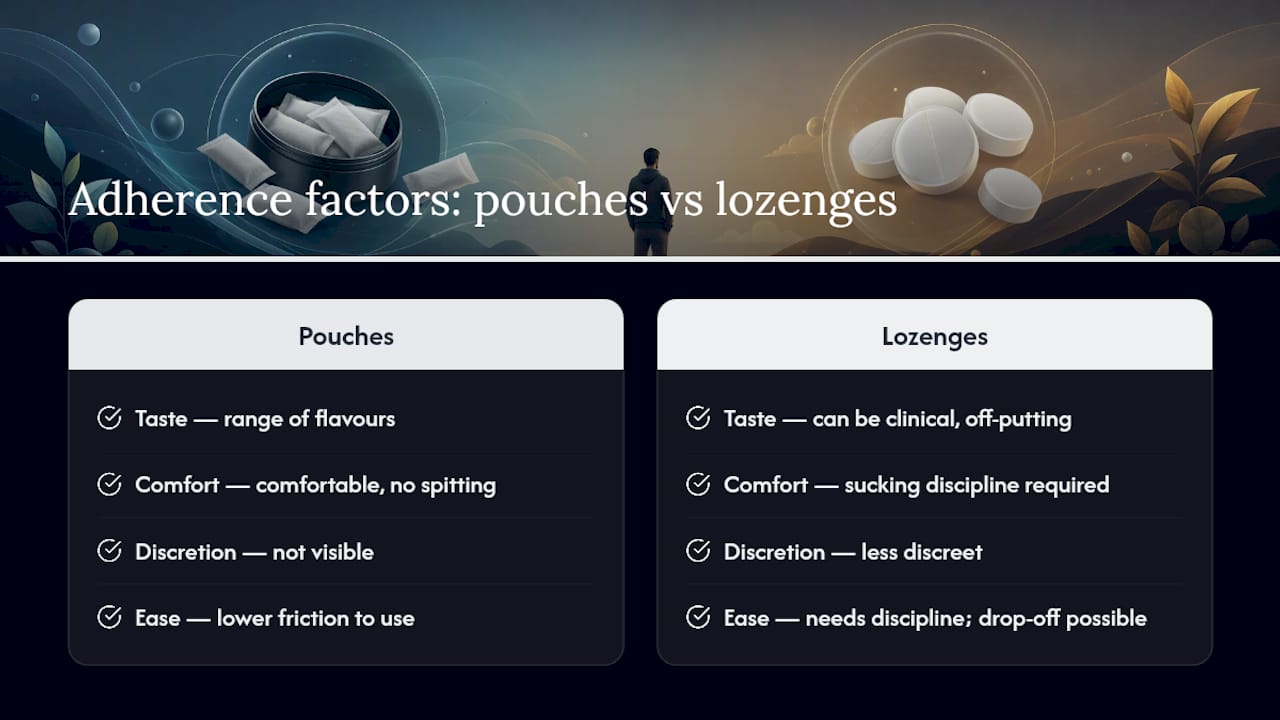
Pouches tend to score well on user satisfaction for comfort and discretion, largely because there’s no spitting, no visible product, and they offer a range of flavours. That’s an important practical difference for anyone who found gum unpleasant to chew for half an hour or lozenges too clinical-tasting to persist with. But satisfaction with the experience of using a product isn’t the same as evidence that the product helps you stop smoking, and Cochrane’s review is explicit that the current data doesn’t establish pouches as a cessation aid, regardless of how comfortable people find them day to day.
The practical takeaway is to treat adherence as one factor among several, not the deciding one. If you find lozenges genuinely intolerable, that’s a legitimate reason to explore a different licensed NRT format, gum, spray or patch, before assuming a pouch is your only alternative. If you’ve already decided you’re not attempting a structured quit and simply want a lower-friction way to manage nicotine intake, adherence and comfort matter far more, and that’s exactly the territory where pouches make sense.
Mixing pouches, lozenges and other stop-smoking medication
Combination therapy is a recognised, evidence-backed approach: pairing a long-acting patch with a fast-acting lozenge covers both baseline nicotine need and sudden cravings, and this combination is specifically endorsed in NICE’s tobacco dependence guidance. What isn’t backed by the same evidence is stacking a nicotine pouch on top of prescribed NRT or on top of varenicline or bupropion without talking to a pharmacist first, simply because nobody has studied that combination’s total nicotine load or interaction profile in a structured way.
If you’re on prescription stop-smoking medication, mention any pouch use to your GP or pharmacist rather than treating it as separate from your quit plan, because your prescriber needs the full picture of your nicotine intake to judge whether your dose is right. The same caution applies in reverse: someone using pouches for craving management who later starts a licensed NRT product for a genuine quit attempt should get professional advice on strength and overlap rather than guessing. Unsupervised mixing of multiple nicotine sources isn’t dangerous in the dramatic sense, but it makes it much harder for you or a clinician to judge whether your current dose is doing what you need it to do.
If you choose a pouch: where to find one that suits you
Not every reader here is mid-quit. Some of you have already stopped smoking and want a discreet way to manage nicotine intake without lighting up or vaping in public, and for that use case, a well-made pouch is a reasonable option. Hitsnus stocks a focused range built for exactly that.
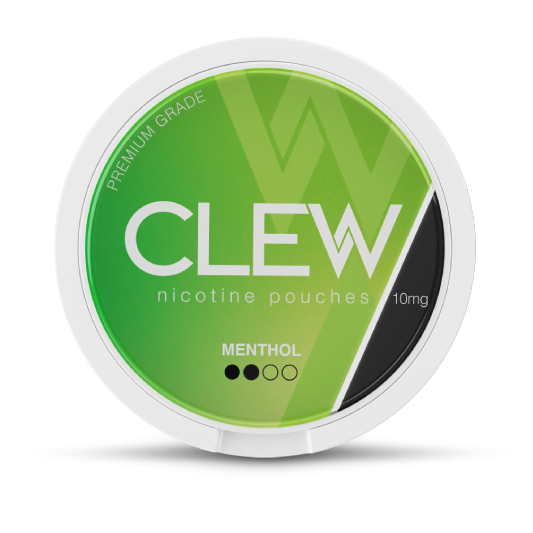
Clew Menthol offers a clean, cooling mint hit at 10mg, a solid middle-strength option for anyone stepping down from cigarettes rather than starting from nothing. Clew Watermelon brings the same 10mg strength with a fruity profile for anyone who finds menthol too sharp for all-day use. If you want the menthol option at a reduced price while stock lasts, Clew Menthol (Clearance) carries the identical formulation.
These products are for adult nicotine users only, and if quitting smoking is your actual goal rather than switching habits, licensed NRT and a stop-smoking service remain the better-evidenced route. For anyone who has decided a pouch fits their situation, browse the full nicotine pouch collection at Hitsnus to compare strengths and flavours before you order.
This article is general information, not a substitute for advice from a qualified doctor. Consult a qualified healthcare professional about your own circumstances before acting on anything here.
Sources
- Quit smoking with nicotine replacement therapies (NRTs) - Better Health - NHS
- Nicotine pouches - ASH
- Cochrane review on oral nicotine pouches (2025)
FAQ
Is one nicotine pouch equal to smoking 50 cigarettes?
No. That comparison usually confuses total nicotine content with equivalent exposure, and pouches deliver pharmacologically active nicotine at levels the Committee on Toxicity notes are lower in toxicant exposure than cigarette smoke, not a multiplied dose.
What is the downside to nicotine pouches?
They’re not licensed as a stop-smoking treatment, evidence on long-term oral health effects is limited, and ASH reports associations with mouth soreness, ulcers and gum recession in some users.
Is using three strong pouches a day a lot?
It depends heavily on strength and your prior nicotine tolerance; someone switching from heavy smoking may find that moderate, while someone new to nicotine would likely find it too much, so starting lower and adjusting is the safer approach.
How unhealthy are nicotine lozenges?
As licensed NRT, lozenges are considered safe when used as directed, with side effects typically limited to hiccups, throat irritation or nausea that usually settle within the first week of use.
Should I use a pouch or a lozenge to quit smoking?
For a genuine quit attempt, choose the licensed lozenge and follow NHS or NICE guidance with support from a stop-smoking service; a pouch is better suited to managing cravings once you’ve already stopped or for discreet nicotine use outside a formal quit plan.