













Do nicotine pouches break an intermittent fast?
No. Nicotine pouches contain no meaningful calories, so they do not break a caloric intermittent fast in the strict sense most people care about, the one built around 16:8, OMAD, or a 24-hour water fast. That is the short version. The longer version matters more if your fasting goal is insulin sensitivity, autophagy, or a religious observance such as Ramadan, because nicotine itself is not metabolically inert.
- Caloric definition: a nicotine pouch has effectively zero calories, so it does not interrupt fat oxidation the way food does.
- Metabolic caveat: nicotine can trigger a short spike in blood glucose and catecholamines, which matters if you are tracking insulin sensitivity, ketone depth, or autophagy markers rather than just calories.
A 2023 clinical study found acute nicotine raised blood glucose by a moderate amount at 60 minutes in a glucose tolerance setting, and older euglycaemic clamp research found the effect was concentrated in people with type 2 diabetes rather than healthy adults. If you want the full range of tobacco-free options to plan around this, Hitsnus stocks a wide selection of nicotine pouches across strengths and flavours.
Pro Tip: If insulin sensitivity is your actual goal rather than just calorie restriction, use your pouch after your eating window opens, not during it. That way you get the nicotine you want without adding a variable to the exact metabolic state you are trying to measure.
Table of Contents
- What “breaking a fast” actually means depends on your goal
- What nicotine pouches are and how the body absorbs them
- What the research actually shows about nicotine and metabolism
- How to use nicotine pouches sensibly during a fast
- Ramadan and religious fasting: a different question entirely
- The verdict, mapped to your actual fasting goal
- Where to find the right pouch for your fasting routine
- Sources
- FAQ
What “breaking a fast” actually means depends on your goal
Ask five people what breaks a fast and you will get five different answers, because “fasting” is not one protocol. It is four loosely related ideas wearing the same word.
Caloric fasting is the simplest: any calorie intake ends the fast, full stop. This is what most people doing 16:8 or OMAD actually mean, whether they realise it or not.
Insulin-focused fasting cares about hormonal response, not just energy. Something with zero calories can still spike insulin or glucose and, by this stricter definition, count as a disruption even though your calorie count stayed at zero.
Autophagy-focused fasting goes further still. Autophagy, your cells’ internal recycling process, is thought to ramp up during extended nutrient deprivation, and anything that meaningfully shifts insulin or amino acid signalling could theoretically blunt it, though human evidence on exactly where that threshold sits is thin.
Religious fasting, covered properly further down, follows jurisdiction-specific rules that have nothing to do with metabolism at all.
Here’s where it gets practical. Time-restricted feeding and 16:8 protocols almost always use the caloric definition, so a nicotine pouch is a non-issue by that standard. A 24 hour or 36 hour fast aimed at deeper ketosis or autophagy leans on the stricter insulin and cellular-signalling definitions, where nicotine’s acute effects deserve a second thought. Researchers assessing whether something “breaks” a fast typically look at:
- Blood glucose response
- Insulin secretion and sensitivity
- Ketone body levels
- Proxy markers of autophagy activation
If your fasting protocol only ever tracks the first item on that list against a scale, you’re covered. If you’re tracking all four, read on.
What nicotine pouches are and how the body absorbs them
A tobacco-free nicotine pouch is a small fibre or cellulose sachet containing nicotine, a filler base, flavouring, sweeteners, and a pH adjuster, usually sodium carbonate or a similar buffering agent that keeps the nicotine in a form your mouth can absorb efficiently. There’s no tobacco leaf involved and no combustion, which is the entire point of the format.
Absorption happens across the buccal mucosa, the lining of your cheek and gum, rather than through the lungs or the stomach. That route is slower than smoking but faster than a lot of people assume.
A randomised crossover pharmacokinetic study found nicotine pouches reach peak blood concentration, Tmax, at roughly 60 to 65 minutes, compared with around 7 minutes for a cigarette. Some pouch products, however, produced a Cmax and total exposure (AUC) similar to or even greater than a single cigarette when held in the mouth for an extended period. Slower does not mean smaller. That is the single most useful pharmacokinetic fact for anyone using pouches during a fasting window: the delivery is gradual, but the total nicotine load your bloodstream sees can rival smoking depending on how long you keep the pouch in.
Most pouches on the market deliver somewhere between 3mg and 20mg or more of nicotine per unit, and manufacturer guidance typically suggests 20 to 60 minutes of use, though study protocols sometimes extend that further to characterise absorption fully. A 2026 modelling study found that saliva pH and pouch dissolution can influence nicotine absorption, leading to variability between users.
Some of the dose gets swallowed rather than absorbed through the cheek. Population pharmacokinetic data indicate oral bioavailability of swallowed nicotine is lower than for transdermal patches, and a variable fraction is swallowed depending on the product. That swallowed portion adds essentially zero calories, so it doesn’t touch the caloric fasting definition, but it still contributes to total systemic nicotine exposure, which is what matters for the insulin question. For a side by side look at how pouches compare with patches and gum on this exact point, it’s worth reading before you settle on a format.
What the research actually shows about nicotine and metabolism
Nicotine is calorie-free, full stop, but it is not metabolically silent. The honest summary: a single acute dose can nudge blood glucose upward, and habitual heavy use is associated with insulin resistance over time, though the certainty and magnitude of both effects vary a lot by study design and who was tested.
On the acute side, the clearest human data comes from a 2023 clinical trial that found nicotine administration raised blood glucose by about 9.3 mg/dL at the 60 minute mark during glucose tolerance testing, alongside a measurable dip in insulin sensitivity. That is not a huge number in absolute terms, but it is a real, measured, non-zero shift, not a rounding error.
Population differences matter here more than most articles admit. A 2001 euglycaemic clamp study infused nicotine intravenously and found it acutely impaired insulin sensitivity in people with type 2 diabetes but had little or no effect in healthy control subjects. If your metabolism is already compromised, nicotine’s acute glucose effect is more likely to show up on a monitor. If you’re metabolically healthy, the same dose may barely register.
Statistic callout: Acute nicotine exposure raised blood glucose by roughly 9.3 mg/dL at 60 minutes in controlled testing, an effect that was present in people with type 2 diabetes but not detectable in healthy adults during comparable clamp testing.
The mechanistic story fills in the gap between “acute” and “chronic.” A 2023 pharmacology review laid out central and peripheral pathways linking nicotine to disrupted glucose homeostasis and rising diabetes risk over time, and animal work from Creighton University shows acute nicotine drives catecholamine-mediated hyperglycaemia, while chronic exposure produces more complex, receptor-level adaptations that don’t always point in the same direction. Duration genuinely changes the answer here, one pouch is a different physiological event to a decade of daily heavy use.
The gaps are worth naming plainly. Almost no study has tested nicotine pouches specifically during an active fasting window, most of the human data comes from cigarettes, gum, or intravenous infusion rather than buccal pouches, and individual baseline metabolic health, as a review of baseline-dependent nicotine effects confirms, swings the outcome considerably. People most likely to notice a measurable effect include:
- Anyone with type 2 diabetes or diagnosed insulin resistance
- Frequent users of high-strength pouches (think 16mg and above) held for long periods
- People already fasting for extended stretches, where baseline glucose is lower and more sensitive to a nudge
How to use nicotine pouches sensibly during a fast
The bottom line for most intermittent fasters doing standard 16:8 or OMAD: pouches won’t break your fast in the sense you care about. Save the extra caution for situations where you’re tracking insulin sensitivity precisely, monitoring ketone depth, or managing diabetes.
If insulin sensitivity or deep ketosis is the actual goal, not just “not eating,” time your pouch for after you break your fast rather than during the fasting window, particularly if you’re about to take a blood glucose or ketone reading. A pouch an hour before a fasting glucose test is going to muddy your own data for no good reason.
For appetite suppression during a fast, which plenty of experienced fasters report genuinely helps them get through hour 14 to 16, a lower-strength, lower-frequency approach works better than reaching for a high-dose pouch every hour. Options like the ZYN Cool Mint mini at 3mg give you the behavioural ritual and the nicotine without pushing your total exposure up unnecessarily.

Dry mouth and mild nausea are the two most common complaints from pouch users during extended fasts, usually made worse by the fact you’re not drinking coffee or eating anything to offset it. Water is calorie-free and permitted under virtually every intermittent fasting protocol, so sip it. If oral irritation is a recurring issue rather than an occasional one, it’s worth reading up on nicotine pouches and oral health before assuming it’s just part of the deal.
Some situations call for skipping pouches during a fast entirely rather than managing around them: pregnancy, cardiovascular instability, uncontrolled type 2 diabetes, or a strict autophagy protocol where you want to eliminate every possible confound. If any of those apply to you, talk to a clinician rather than guessing.
Pro Tip: If you’re the kind of faster who actually owns a glucose or ketone meter, run a genuine self-experiment. Fast one day with your usual pouch routine and one day without, then compare your readings at the same clock time. Individual response to nicotine varies enough that your own data will tell you more than any study average.
Ramadan and religious fasting: a different question entirely
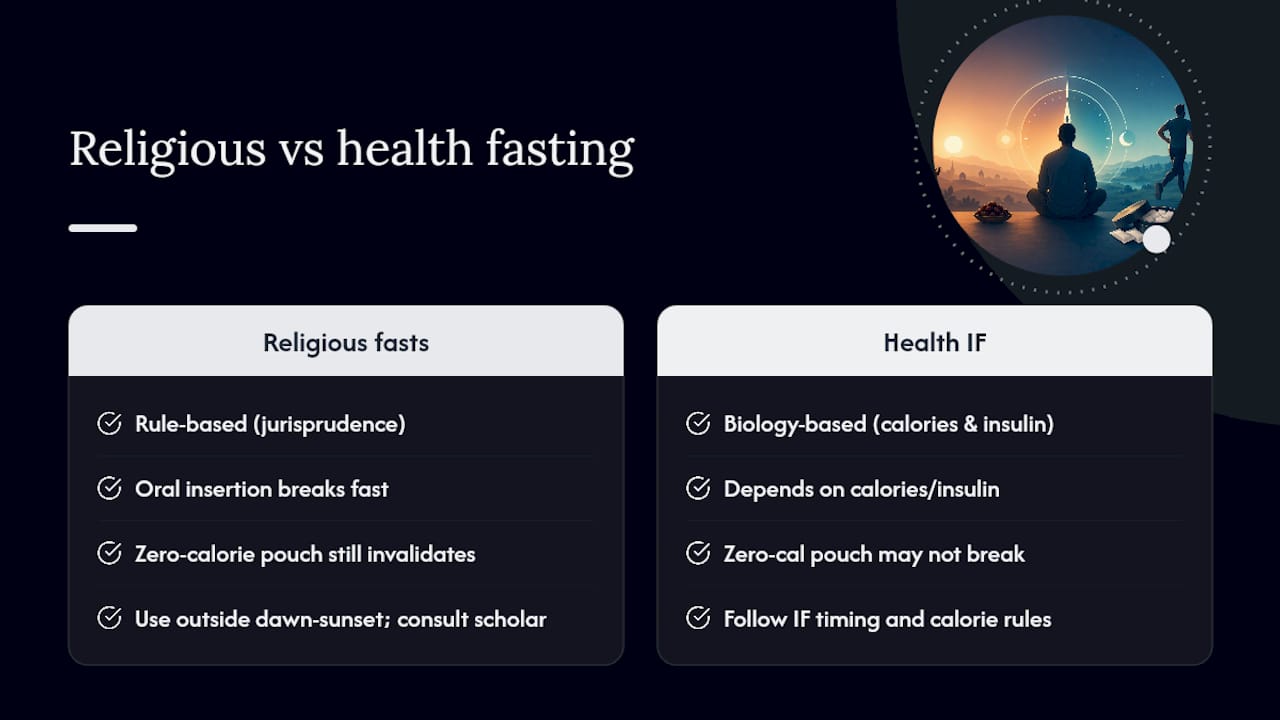
For religious fasts, the scientific metabolic argument is largely beside the point, because most traditional rulings are rule-based rather than biology-based. Many scholars hold that anything deliberately placed in the mouth, particularly something with flavour or the possibility of swallowed residue, breaks a traditional Ramadan fast, regardless of its calorie count or measurable metabolic effect.
This is the key distinction to hold onto: the caloric and insulin arguments made throughout this article apply to health-motivated intermittent fasting, not to fasts governed by religious jurisprudence. A pouch containing zero calories can still be considered to invalidate a religious fast purely on the grounds of oral insertion, independent of any physiological mechanism.
Practically, that means observant users during Ramadan or comparable fasts should plan pouch use strictly outside the dawn-to-sunset window, the same way they’d handle food, drink, or smoking. Because rulings genuinely differ between schools of thought and individual scholars, and because this touches on personal religious practice rather than a settled scientific question, check with your own local religious authority if you’re unsure rather than relying on a general health article to make that call for you.
The verdict, mapped to your actual fasting goal
Match the answer to what you’re actually trying to achieve, because “does it break my fast” has genuinely different answers depending on the goal.
| Fasting goal | Does a nicotine pouch break it? |
|---|---|
| Caloric intermittent fasting (16:8, OMAD) | No, negligible calories |
| Insulin sensitivity / glucose control focus | Possibly, acute effects measured in some studies |
| Autophagy-focused extended fasting | Uncertain, limited direct evidence, err cautious |
| Religious fasting (e.g. Ramadan) | Typically yes, per many traditional rulings |
Three concrete next steps if you take nothing else from this: measure your own personal glucose or ketone response before assuming the research averages apply to you, avoid pouches in the hour before any biomarker test you actually care about, and speak to a clinician before combining pouches with fasting if you have type 2 diabetes or another condition affecting glucose regulation, since the clamp evidence suggests you’re the population most likely to see a real effect.
Pro Tip: If you’re choosing a pouch specifically to minimise your metabolic footprint during a fasting window, lower nicotine strength and shorter mouth-hold time both reduce total exposure. Browse the full range on the Hitsnus nicotine pouch collection and check the milligram strength on the product page before you buy, rather than assuming all pouches deliver a similar dose.
Where to find the right pouch for your fasting routine
If you’ve read this far, you already know a pouch itself isn’t going to sabotage your caloric fast, but the strength, format, and flavour you pick genuinely do matter for comfort and control. Hitsnus stocks the full spread, from ultra-low-dose minis through to stronger formats, so you’re not stuck guessing at strength from a generic supermarket shelf.

If appetite control during a fasting window is your priority, something gentle like the XQS Strawberry Kiwi at 8mg or the ZYN Spearmint mini at 6mg keeps your total nicotine load modest while still giving you the ritual that gets people through hour 15 of a fast. If you’d rather explore stronger or fruitier options once your eating window opens, the Clew Watermelon at 10mg and Killa Pineapple are popular picks, and the clearance collection is worth a look if you’re testing a few strengths before settling on a routine. Browse the full nicotine pouch range and pick a strength that matches your fasting goals rather than the loudest flavour on the shelf.
This article is general information, not a substitute for advice from a qualified doctor. Consult a qualified healthcare professional about your own circumstances before acting on anything here.
Sources
- PubMed: acute nicotine raises blood glucose and impairs insulin sensitivity (2023 study)
- Central and peripheral actions of nicotine that influence blood glucose homeostasis and the development of diabetes (2023 review)
- Nicotine infusion acutely impairs insulin sensitivity in type 2 diabetic patients but not in healthy subjects (2001 clamp study)
- A randomised study comparing nicotine pharmacokinetics of oral nicotine pouches and a combustible cigarette (2021)
- Nicotinic acetylcholine receptors in glucose homeostasis: acute hyperglycaemic and chronic insulin-sensitive effects of nicotine (Creighton University research)
- Development of a model to predict nicotine pharmacokinetics from oral nicotine pouches (Scientific Reports, 2026)
FAQ
Can I use nicotine pouches while fasting?
Yes, for standard caloric intermittent fasting, since pouches contain negligible calories. Take extra care if you’re tracking insulin sensitivity or have type 2 diabetes, where clamp studies show a measurable acute effect.
Does nicotine interfere with intermittent fasting?
It can interfere with the metabolic side rather than the caloric side. Acute nicotine has been shown to raise blood glucose modestly, which matters more if you’re fasting for insulin control or autophagy than if you’re simply avoiding calories.
Does ZYN affect ketosis?
ZYN and other zero-calorie pouches shouldn’t disrupt ketosis through calories, but nicotine’s acute glucose and catecholamine effects mean the picture isn’t fully settled for deep ketosis or autophagy-focused fasts. If ketone depth is your priority, timing pouch use outside your fasting window is the safer approach, and lower-strength options like the ZYN Cool Mint mini reduce that variable further.
Do nicotine pouches count as breaking a fast?
For caloric fasting protocols like 16:8, no, they don’t count. For religious fasts such as Ramadan, many traditional rulings treat placing anything in the mouth as breaking the fast, so check with your own religious authority rather than relying on the metabolic argument.
Are nicotine pouches different from gum or patches for fasting purposes?
Yes, absorption route changes the exposure pattern. Pouches deliver nicotine through the cheek lining over roughly 60 to 65 minutes, compared with faster cigarette absorption and steadier, slower patch delivery, which is worth understanding if you’re choosing a format specifically around your fasting schedule.