












Nicotine pouch tolerance break: a practical plan for pouch users
Yes, you can reset nicotine pouch tolerance. Most users notice a meaningful difference within 2–4 weeks of reducing or stopping use, and a fuller receptor reset typically takes 4–8 weeks. The two main routes are a clean break (cold turkey for 2–4 weeks) or a structured taper by strength or frequency over 4–8 weeks. Both work; the right choice depends on how heavily you currently use and how much disruption you can manage.
Before changing your nicotine intake, a quick safety note: if you are pregnant or breastfeeding, have a heart condition, are under 25 years old, or manage a mental-health condition, speak to your GP or pharmacist first. Nicotine affects cardiovascular and neurological function, and dose changes carry real risks for these groups.
When a craving hits during your break, these immediate options help:
- Drink a full glass of cold water and wait three minutes before deciding anything.
- Use a distraction technique: a short walk, a breathing exercise (4 counts in, 7 hold, 8 out), or a task that occupies your hands.
- Ask a pharmacist about licensed NRT options such as patches or gum to manage withdrawal without high-dose spikes.
Licensed NRT products can more than double your chance of staying nicotine-free at six months when used correctly alongside behavioural support.
Table of Contents
- Why does nicotine tolerance build up in the first place?
- How long does a nicotine pouch tolerance break take?
- Three concrete plans for taking a break from nicotine pouches
- How to handle cravings and withdrawal symptoms
- Safety, daily limits, and when to get professional help
- Alternatives to a full break: lower-strength pouches, NRT, and nicotine-free options
- How Hitsnus products can support your tolerance break
- Sources
- FAQ
Why does nicotine tolerance build up in the first place?
Tolerance is a predictable physiological adaptation, and understanding it makes the break easier to stick to.
Nicotine binds to nicotinic acetylcholine receptors (nAChRs) in the brain. According to Public Health Wales, nicotine reaches the brain within about 10 seconds, triggering a dopamine release that the brain quickly learns to anticipate. With regular exposure, two things happen simultaneously: the receptors become desensitised (they stop responding as strongly to the same dose), and the brain compensates by upregulating — growing more receptors to restore normal signalling. The result is that you need more nicotine to feel the same effect.
A peer-reviewed review in the Journal of Neurobiology confirms that continuous agonist exposure causes functional desensitisation, and that this mechanism sits at the centre of tolerance formation. Separately, research published in The Journal of Neuroscience shows that nicotine-induced receptor upregulation reverses in at least two phases: a fast component and a slower one that can take days to weeks to decay. That two-speed reversal is why a single pouch-free day barely registers, while two or three weeks off produces a noticeably stronger effect when you return.
Animal studies published on PMC add further detail: chronic nicotine produces region-specific and receptor-subtype-specific changes, which explains why some effects (the initial buzz) return relatively quickly after a break, while others (baseline mood stability) take longer to normalise.
The practical takeaway: breaking the ritual matters as much as reducing the dose. The brain links the physical act of placing a pouch with the dopamine hit, so behavioural substitution is not optional — it is half the work.
How long does a nicotine pouch tolerance break take?
The timeline varies by individual, but the biology gives a reliable framework. Here is what to expect week by week.
Week 1: Withdrawal symptoms are at their sharpest. Irritability, difficulty concentrating, and mild headaches are common as nicotine levels fall. Cravings tend to peak in the first 72 hours and then ease slightly by day 5–7.
Week 2: The fast phase of receptor desensitisation reversal is largely complete. Many users report that cravings are shorter and less intense. Sleep may still be disrupted.
Week 4: Receptor sensitivity is meaningfully restored for most users. A pouch at this point will feel noticeably stronger than it did before the break. Mood and concentration typically stabilise around this point.
Week 8: The slower upregulation reversal phase has had time to progress. Users who return to pouches after 8 weeks often find that a lower-strength product delivers the effect they previously needed a higher strength to achieve.
| Biological event | Approximate timescale |
|---|---|
| Nicotine reaches the brain after use | ~10 seconds |
| Fast desensitisation reversal phase | Hours to ~3 days |
| Slow upregulation reversal phase | Days to several weeks |
| Noticeable sensitivity restoration | 2–4 weeks |
| Fuller receptor reset (most users) | 4–8 weeks |
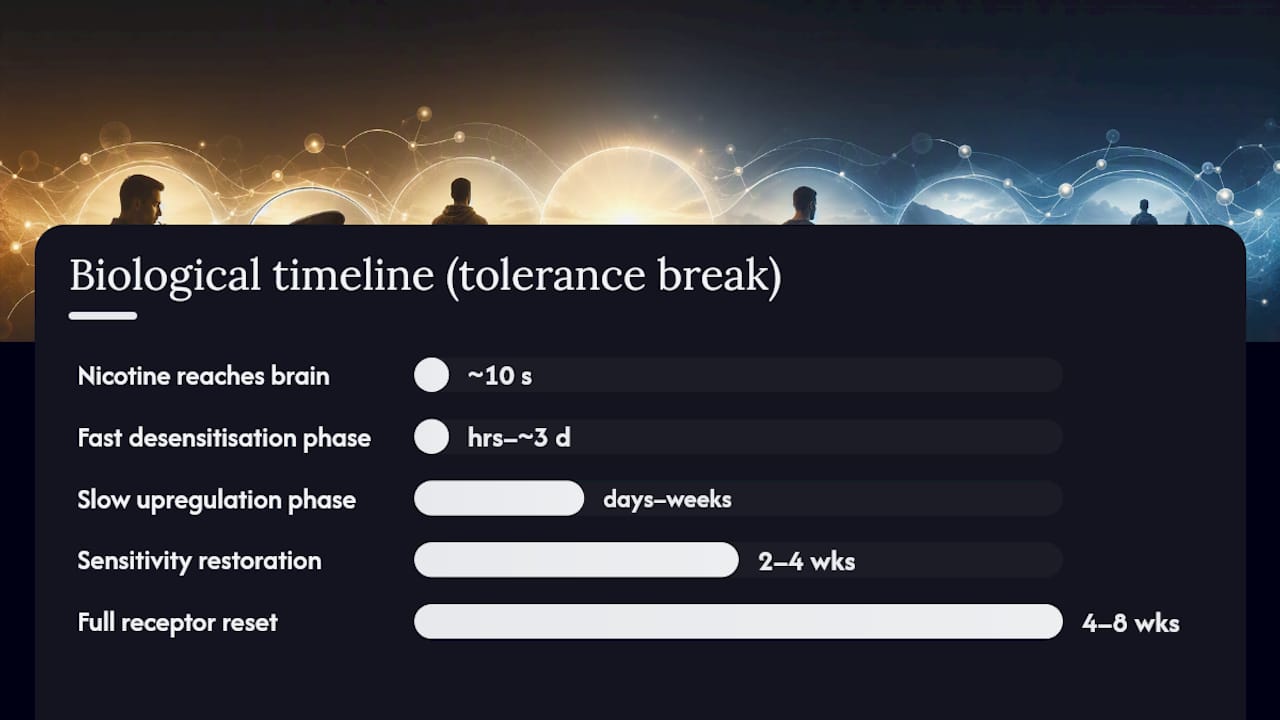
Sources: Public Health Wales; The Journal of Neuroscience
Several individual factors shift this timeline. Heavy users (six or more pouches daily) and those using high-strength products (above 16 mg) typically need the longer end of the range. Age matters too: receptor plasticity tends to be greater in younger adults, which can mean faster symptom onset but also faster recovery. Genetic variation in nicotine metabolism (the CYP2A6 enzyme pathway) affects how quickly nicotine clears your system. Using other nicotine sources — vaping, for instance — during a pouch break will slow or prevent the reset entirely.
Treat these timelines as a guide, not a guarantee. Your experience may differ.
Three concrete plans for taking a break from nicotine pouches
Choose the plan that fits your current use pattern and your schedule. None of these replaces medical advice; if you use more than eight pouches a day or have any of the health conditions listed in the safety section, speak to a pharmacist before starting.
Plan A: 2–4 week cold-turkey break
Best for users who want the fastest reset and can manage a sharp withdrawal period.
- Day 1–3: Stop completely. Use the coping tactics from the opening section (water, breathing, distraction). Keep your hands busy. Tell someone you trust what you are doing.
- Day 4–7: Cravings should shorten. Replace the physical ritual with a substitute: sugar-free gum, a toothpick, or a short walk at the times you would normally use a pouch.
- Week 2: If withdrawal is severe, consult a pharmacist about a short course of licensed NRT (patch or gum) to take the edge off without reintroducing high-dose spikes.
- Week 3–4: Receptor sensitivity is restoring. Avoid any nicotine source during this window to let the process complete.
First-week daily example: Morning — drink water before reaching for a pouch. Midday — take a 10-minute walk at the time you would normally use. Evening — use a breathing exercise before bed instead of a pouch to wind down.
Pro Tip: Write down the three times of day you most want a pouch and plan a specific substitute for each slot before Day 1. Vague intentions collapse under a real craving; a written plan does not.
Plan B: 4–8 week taper by strength
Best for heavy users or anyone who finds cold turkey unmanageable.
- Weeks 1–2: Drop one strength level. If you use 16 mg pouches, switch to 8 mg. Use the same number of pouches per day.
- Weeks 3–4: Drop another level, or reduce to 4 mg if available. Hold frequency steady.
- Weeks 5–6: Reduce frequency by one pouch per day every three days.
- Weeks 7–8: Aim for two or fewer pouches daily, then stop.
First-week daily example: Morning — place a lower-strength pouch at your usual time. Midday — same. Evening — same. The ritual stays; the dose drops. That separation is the point.
For guidance on switching between pouch strengths, Hitsnus has a practical step-by-step resource worth reading alongside this plan.
Plan C: Frequency reduction with pouch-free windows
Best for moderate users who want to reduce tolerance without a formal break.
- Week 1: Introduce one two-hour pouch-free window per day (mid-morning works well for most people).
- Week 2: Extend to two windows, or lengthen the existing one to four hours.
- Week 3–4: Add a full pouch-free morning (no pouch before noon).
- Week 5–8: Alternate pouch-free days with normal-use days.
First-week daily example: Morning — no pouch until 10 AM. Midday — use as normal. Evening — finish by 8 PM, no pouch before bed.
Shift workers should anchor their windows to their sleep cycle rather than the clock: the “morning” window starts when you wake, regardless of the hour. Heavy users may need to combine Plan C with Plan B’s strength reduction for meaningful results.
Safety note: After any break, your tolerance will be lower. Starting again at your previous strength risks nausea, dizziness, and palpitations. Return at a lower strength and step up only if needed.
How to handle cravings and withdrawal symptoms
NHS Lanarkshire’s guidance on nicotine addiction confirms that withdrawal symptoms are temporary and typically include irritability, anxiety, impaired concentration, restlessness, headache, sleep disturbance, and increased appetite. They begin as nicotine levels fall, usually within a few hours of your last pouch, and peak in the first 48–72 hours.
Common withdrawal symptoms and their typical window:
- Irritability and anxiety: onset within hours; usually eases by week 2.
- Impaired concentration: peaks in days 2–5; largely resolves by week 3.
- Headache and malaise: first 3–5 days; hydration helps.
- Sleep disturbance: can persist for 2–3 weeks; avoid pouches in the two hours before bed even during a taper.
- Increased appetite: common throughout; plan healthy snacks to avoid replacing one habit with another.
What actually helps:
- Licensed NRT: patches deliver a steady low dose that prevents the sharp peaks and troughs driving cravings. Gum or lozenges give on-demand relief. Licensed NRT more than doubles your chance of staying nicotine-free at six months when combined with support.
- Behavioural support: your local NHS Stop Smoking Service offers free one-to-one or group support. Find yours at nhs.uk/better-health/quit-smoking.
- E-cigarettes: NHS guidance acknowledges these as a harm-reduction option for some users, though they are not suitable for everyone and still deliver nicotine.
- Physical activity: even a 10-minute walk reduces craving intensity in the short term.
- Hydration: nicotine is a mild diuretic; staying well-hydrated reduces headache severity.
If you slip and use a pouch during your break, do not abandon the plan. Note what triggered it (stress, boredom, a social situation), adjust your substitute strategy for that trigger, and restart the break from that day. One slip is data, not failure.
A pharmacist can recommend the right NRT combination for your use level without an appointment. For nicotine pouch usage frequency guidance and safe daily limits, the Hitsnus blog has a dedicated resource.
Safety, daily limits, and when to get professional help
Nicotine is a pharmacologically active substance. Changing your intake carries real risks if done carelessly, particularly at the extremes.
Daily-intake caution: avoid exceeding the manufacturer’s recommended daily pouch count for your chosen strength. Side effects of too much nicotine include headache, dizziness, nausea, and heart palpitations. Many users mistake these for withdrawal when they are actually signs of overdose at a newly lower tolerance. Starting a break at a lower strength and stepping up only as needed is the safer approach, as the BNF via NICE confirms for licensed NRT products.
Groups who should consult a clinician before changing nicotine intake:
- Pregnant or breastfeeding people (nicotine affects foetal and infant development).
- Anyone with diagnosed heart disease, arrhythmia, or recent cardiac event.
- People managing severe anxiety, depression, or other mental-health conditions (nicotine withdrawal can temporarily worsen mood).
- Under-25s, whose brain development is still ongoing.
When to seek urgent help: if you experience chest pain, severe shortness of breath, or a significant deterioration in mental health during a break, contact your GP or call NHS 111. Severe nicotine withdrawal can, in rare cases, trigger or worsen depressive episodes. Do not manage this alone.
Your local Stop Smoking Service is free, confidential, and available across the UK. A pharmacist can also advise on licensed NRT combinations without a GP referral.
This article provides general information only and is not a substitute for medical advice. Consult your GP or pharmacist for guidance specific to your health situation.
Alternatives to a full break: lower-strength pouches, NRT, and nicotine-free options
A complete abstinence break is not the only route to reducing tolerance. If a full break is impractical, these alternatives offer meaningful harm reduction.
Lower-strength pouches
- Pros: maintains the ritual, reduces nicotine dose, easier to sustain socially.
- Cons: tolerance reduction is slower; requires genuine discipline not to compensate by using more pouches.
- Best for: moderate users who want gradual reduction without disrupting daily routine.
Nicotine-free pouches
- Pros: breaks the chemical dependency while preserving the oral habit; useful as a bridge during a cold-turkey break.
- Cons: does not address the behavioural ritual directly; some users find them unsatisfying and relapse.
- Best for: users in the final stages of a taper who need something for their hands and mouth.
Licensed NRT (patches, gum, lozenges, inhalators)
- Pros: clinically proven, available without prescription, delivers controlled doses that prevent spikes.
- Cons: does not replicate the pouch ritual; some users find patches cause skin irritation.
- Best for: anyone whose withdrawal symptoms are severe enough to threaten the break.
E-cigarettes
- Pros: replicates the hand-to-mouth ritual; NHS acknowledges them as a harm-reduction tool for some.
- Cons: still delivers nicotine; not suitable for non-smokers or those aiming for full nicotine cessation.
- Best for: former smokers who have switched to pouches and find vaping a more manageable step down.
NHS guidance is clear that nicotine pouches are not licensed stop-smoking products in the UK and that evidence on their effectiveness as quitting aids is still emerging. If your primary goal is quitting nicotine entirely, licensed NRT or a combination approach with behavioural support gives you the strongest evidence base. For more on switching between nicotine delivery methods, the Hitsnus blog covers the relative delivery speeds and typical outcomes.
Maintaining a lower tolerance after your break: keep a dose ceiling (never exceed your post-break baseline), build in one or two pouch-free days per week, and schedule a short reset window every 8–12 weeks. These habits prevent tolerance from creeping back to where you started.
How Hitsnus products can support your tolerance break
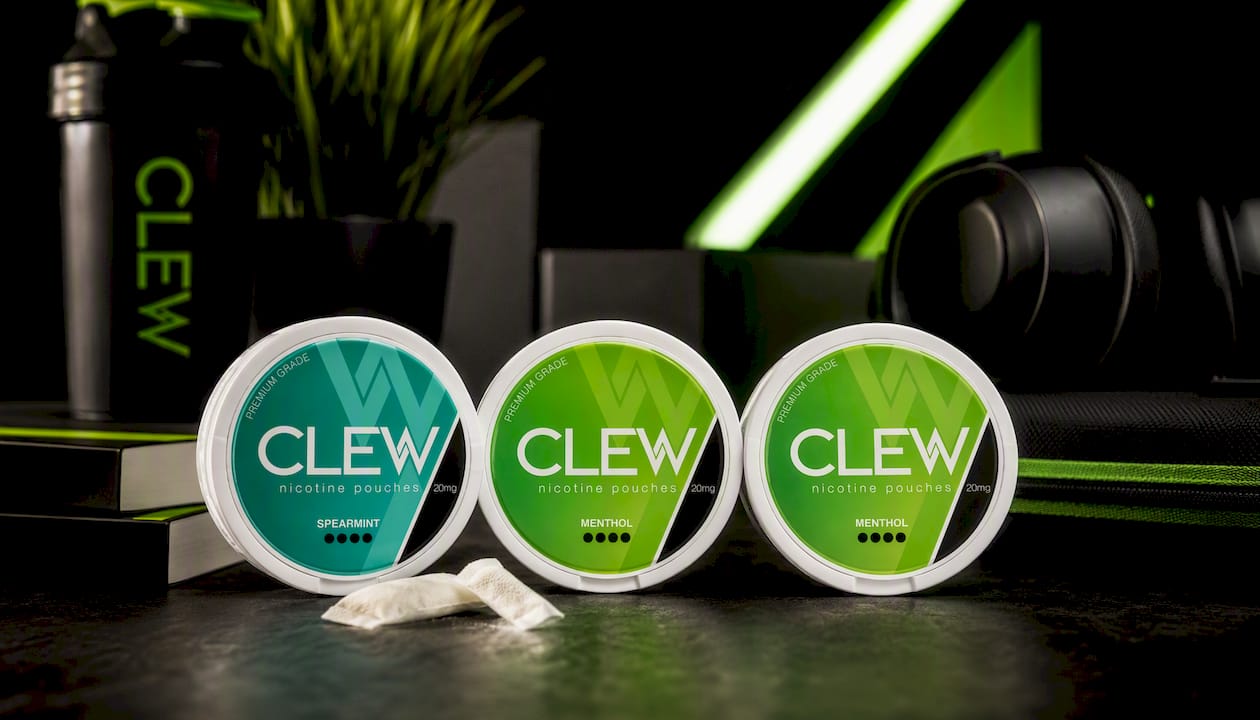
If you are running a taper plan, having the right product at each strength level makes the process considerably more manageable. Hitsnus stocks a range of nicotine pouches across multiple strengths and flavours, which means you can step down without switching brands or disrupting the sensory experience that makes a taper feel sustainable.
Three products worth knowing about for a taper or substitution plan:
Clew Spearmint is a 20 mg spearmint-flavoured pouch. At this strength, it suits users who are at the start of a taper from higher-strength products, or those who want a consistent baseline before stepping down further. The spearmint flavour is clean and distinct, which can also help break the flavour association with your usual product.
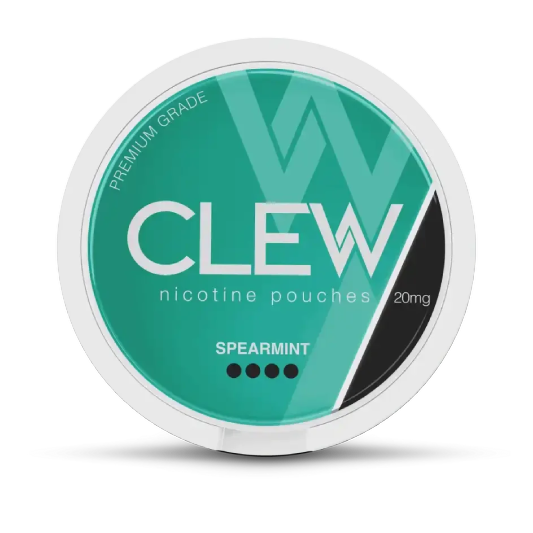
Clew Menthol is a 20 mg menthol option. Switching flavour while holding strength steady is a recognised behavioural tactic: it disrupts the sensory ritual without adding the stress of a dose reduction at the same time. Many users find this a useful first step before tackling the strength itself.
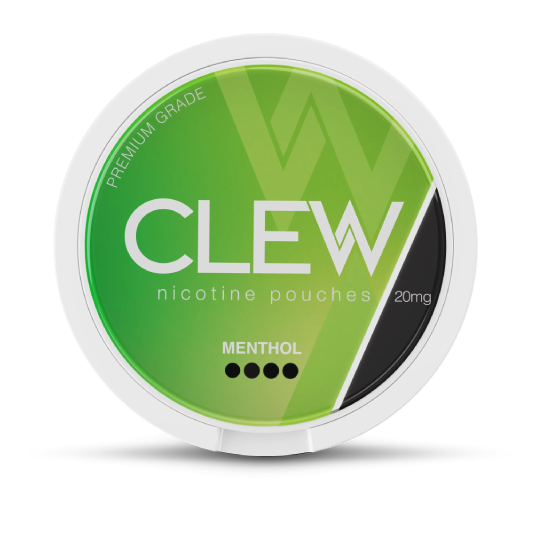
Clew Menthol (Clearance) is the same 20 mg menthol formulation available at a reduced price. Practically useful if you are working through a taper and want to manage costs during a period when you are buying across multiple strength levels.
Browse the full Hitsnus nicotine pouch collection to find the strength that fits your current stage. If you are unsure where to start, a pharmacist can advise on the appropriate strength for your use level.
This section is for product information only and does not constitute medical advice. Consult your GP or pharmacist for guidance on managing nicotine dependence.
Sources
- What is dependency and addiction? — Public Health Wales
- Nicotine addiction explained — NHS Lanarkshire
- Nicotine-induced upregulation kinetics — The Journal of Neuroscience
- Desensitization of neuronal nicotinic receptors — J Neurobiol (Wiley)
- Quit with nicotine replacement therapies (NRT) — NHS
FAQ
How long does a nicotine pouch tolerance break take?
Most users notice meaningful sensitivity restoration within 2–4 weeks of stopping or significantly reducing use. A fuller receptor reset, covering the slower upregulation reversal phase, typically takes 4–8 weeks depending on baseline use frequency and pouch strength.
What withdrawal symptoms should I expect when taking a break from nicotine pouches?
Common symptoms include irritability, anxiety, impaired concentration, headache, sleep disturbance, and increased appetite. These are temporary; most peak in the first 48–72 hours and ease considerably by the end of week two.
How quickly do you build tolerance to nicotine pouches?
Tolerance can begin developing soon after regular use, as the brain adapts by upregulating nicotinic acetylcholine receptors. Dependency may develop rapidly even with occasional use, which is why planned breaks or dose ceilings matter from early on.
Is it bad if a nicotine pouch breaks in your mouth?
A pouch that splits releases its nicotine content more rapidly than intended, which can cause nausea, dizziness, or a sharp throat sensation. Swallow as little of the liquid as possible and remove the pouch. It is not dangerous in a single instance, but it is a sign to check your pouch storage and handling.
How many pouches a day is too many?
There is no universal figure because it depends on pouch strength and individual tolerance. Side effects such as headache, dizziness, and palpitations are reliable signals that your intake is too high for your current tolerance level. During or after a break, these symptoms can appear at doses that previously felt normal, so always restart at a lower count and step up cautiously.