











30–45 Minute Sessions: Long Lasting Nicotine Pouches Explained
Most nicotine pouches deliver usable strength for between 20 and 60 minutes, with the majority of users settling on a 30 to 45 minute session before flavour and nicotine sensation fade. What determines whether a pouch sits at the short or long end of that range comes down to three things: whether it’s a dry or moist format, the pH and formulation behind the nicotine, and the physical size of the pouch. As a safety note, sessions shouldn’t routinely run past 60 minutes regardless of format.
Table of Contents
- How long do long lasting nicotine pouches last from first hit to fade?
- Why do dry and moist pouches release nicotine so differently?
- What can you personally control to extend a pouch session?
- How do you get the most usable time out of every pouch?
- Which Hitsnus pouches suit longer sessions?
- What does the research actually say about why pouches differ?
- Browse Hitsnus for formats built around longer sessions
- Sources
- FAQ
How long do long lasting nicotine pouches last from first hit to fade?
The phrase “long lasting” gets thrown around loosely in this category, so it helps to separate what you feel in your mouth from what’s actually happening in your bloodstream. They’re related, but not identical, and mixing them up leads to disappointment with pouches that are actually performing exactly as designed.
Most users report a usable window of roughly 20 to 60 minutes, with a sweet spot around 30 to 45 minutes for mainstream products. That’s the range where flavour, moisture, and nicotine sensation stay strong enough to justify keeping the pouch in. Beyond that point, the pouch typically feels spent even if trace amounts of nicotine remain.
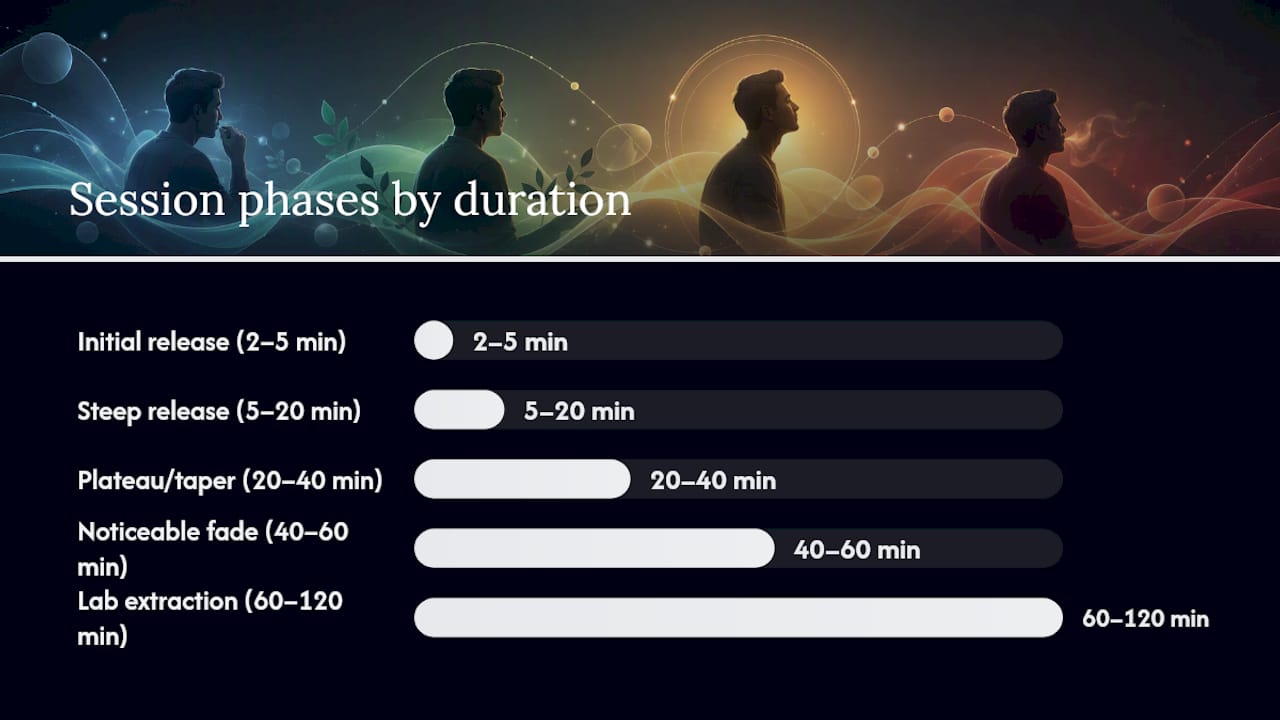
The timeline inside that window follows a fairly predictable shape:
- First 2 to 5 minutes: initial tingling and flavour release as saliva starts breaking down the pouch material.
- 5 to 20 minutes: the steepest phase of nicotine release, when most of the perceptible strength hits.
- 20 to 40 minutes: a plateau or gradual taper, depending on format, where sensation levels off.
- 40 to 60 minutes: noticeable fade in both flavour and nicotine effect for most products.
- Beyond 60 minutes: diminishing returns, with little practical benefit to keeping a spent pouch in.
A dissolution study using USP-4 testing on commercial pouch products found that many types release around 80% of their total nicotine content within the first 20 minutes, and more than 95% by the 40 minute mark. That’s a genuinely useful figure for expectation-setting: the pouch sitting in your mouth at minute 50 is doing very little chemically, even though it might still taste faintly of mint or fruit.
Here’s where it gets more interesting. Systemic nicotine exposure, meaning what’s actually circulating in your bloodstream, doesn’t necessarily stop the moment mouthfeel fades. Pharmacokinetic crossover research on pouch varieties recorded peak blood nicotine concentration (Cmax) at around one hour after insertion in some cases, meaning the body is still processing nicotine well after the pouch itself feels finished. So a pouch can feel “done” at 35 minutes while your body is still working through the dose it delivered.
Separately, extraction studies looking at lab conditions found nicotine continuing to leach out of pouch material for up to 120 minutes under controlled testing with variables like saliva volume and ethanol concentration pushed to extremes. That doesn’t mean you should keep a pouch in for two hours. It means the chemistry of extraction and the practical experience of use are two different things, and real-world sessions should be governed by comfort and sensation, not lab extremes.
Why do dry and moist pouches release nicotine so differently?
Two pouches carrying identical nicotine content in milligrams can feel completely different over the course of a session, and the explanation sits in formulation rather than dosage.
Dry pouches tend to release nicotine more slowly and steadily. Less moisture means the plant fibre or filler material takes longer to fully saturate with saliva, which spreads nicotine delivery across a longer curve. Moist pouches, by contrast, hydrate almost immediately, producing a faster onset and a more pronounced early hit that tapers off sooner. Crossover research comparing the two formats found moist products tend to reduce cravings faster in the early minutes, while dry products maintain a steadier plateau between roughly 45 and 75 minutes.
pH plays a bigger role than most users realise. Nicotine exists in two states inside a pouch: bound (salt form) and free (freebase form). A higher pH shifts more of that nicotine into freebase form, which crosses the buccal membrane in your cheek faster. That’s why two pouches with the same milligram count can feel wildly different in intensity and duration; one might be formulated at a pH that unlocks nicotine quickly, the other more gradually.
A permeation study testing this directly found real variation between brands under identical conditions, with permeability values ranging from roughly 14.84 to 38.24 (×10⁻⁶ cm/s) depending on formulation and saliva composition used in testing.
- Pouch weight and filler mass: larger, denser pouches physically hold more material to extract from, which extends the usable window compared with slim, minimal formats.
- Binder and flavour carrier choices: some flavour systems are designed to release gradually, sustaining both taste and the sensory cue that a pouch still “has something left.”
- Moisture content at manufacture: wetter pouches front-load sensation; drier ones spread it out.
Pro Tip: If you want a longer, steadier session rather than a strong early hit, try a dry-format pouch in a regular or large size rather than a slim moist one. The difference in curve shape is often more noticeable than the difference in milligram strength.
What can you personally control to extend a pouch session?
Formulation sets the ceiling, but your own habits decide how much of that potential you actually use. A handful of behavioural adjustments make a real difference to how long a session feels worthwhile.
- Place it deliberately, not carelessly. Tucking the pouch fully against the upper gum, rather than letting it sit loosely between lip and gum, maximises contact area with the buccal membrane, which is where absorption happens.
- Account for your own saliva flow. Saliva production varies from person to person and situation to situation, drier mouths (common with dehydration, certain medications, or simply talking a lot) slow extraction, while naturally higher saliva flow speeds it up.
- Stay hydrated, but don’t gulp drinks mid-session. Sipping water is fine; downing a large drink washes nicotine and flavour compounds away before they’ve fully released.
- Resist the urge to constantly move or reposition the pouch. Repeated fiddling breaks the saturation process that builds up around the pouch and shortens the effective session rather than extending it.
- Don’t stack pouches to compensate for a weak one. If a pouch feels underwhelming, remove it and start fresh rather than adding a second one alongside it, spacing sessions is safer and more predictable than doubling up.
- Remove the pouch once flavour and sensation clearly fade, generally within the 45 to 60 minute range, rather than leaving it in out of habit.
For more on how frequently pouches should be used across a day rather than within a single session, Hitsnus has a usage frequency guide worth reading alongside these tips.
How do you get the most usable time out of every pouch?
Getting genuine longevity from a pouch starts before it ever reaches your mouth. Selection and storage do as much work as the moment-to-moment technique covered above.
If longer sessions are the goal, lean towards regular or large format pouches over slim ones, and consider dry formulations over moist where flavour intensity isn’t the main priority. The extra filler mass in a larger pouch gives extraction more material to work through, which naturally stretches the usable window compared with a slim pouch built for a quick, discreet hit.
Storage matters more than most users assume. A tin left open on a warm windowsill loses moisture and volatile flavour compounds within days, and a pouch that’s dried out or gone stale releases less effectively regardless of its original formulation. Keep tins sealed when not in use, store them somewhere cool and dry, and avoid leaving opened tins in direct sunlight or a hot car. Hitsnus covers this in more depth in its shelf life and freshness guide, including how long an opened tin typically stays at its best.
A quick daily checklist:
- Do store tins sealed, away from heat and direct light.
- Do rotate stock so older tins get used before newer ones.
- Don’t leave a tin open for extended periods between uses.
- Don’t keep a pouch in past the point where flavour and sensation have clearly faded.
Pro Tip: Buy tins in quantities you’ll realistically use within a few weeks rather than stockpiling months ahead. Freshness has a shelf life, and older stock genuinely delivers a shorter, weaker session.
As a general safe-use guideline, avoid routinely keeping any pouch in for longer than around 60 minutes, and check the safety guidance on prolonged use if you’re unsure what’s appropriate for your own habits.
Which Hitsnus pouches suit longer sessions?
Based on format, strength, and the mechanisms covered above, several products in the Hitsnus range tend to suit users chasing a longer, steadier session rather than a short sharp hit. These are practical examples rather than a ranked list, since the right choice depends on your own tolerance and flavour preference.
- Pablo Blue Raspberry: a strong, dense pouch that suits users wanting an extended, high-intensity session, well suited to a long commute or a stretch of focused work.
- Clew Watermelon: a moderate to firm strength option at 10mg, offering a steadier curve through a working session rather than a fast spike.
- SYX Wintergreen: a classic cooling flavour in a format that holds sensation well past the initial minutes, useful for discreet use in meetings.
- SYX Forest Fruits: available at higher strength bands, better suited to experienced users wanting a longer, more substantial session.
- VELO Bright Spearmint: a lighter 6mg option that still holds flavour reasonably well, a sensible starting point for users new to longer sessions.
- SYX Apple Kiwi: a fruit-forward option in the same higher-strength range, useful where flavour longevity matters as much as nicotine duration.
- Killa Apple (Clearance): a firmer format at clearance pricing, worth trying if you want to test a longer-lasting style without committing to full price.
- Nordic Spirit Sweetmint: a dry-leaning format at 11mg that tends to spread sensation more evenly across a session rather than front-loading it.
What does the research actually say about why pouches differ?
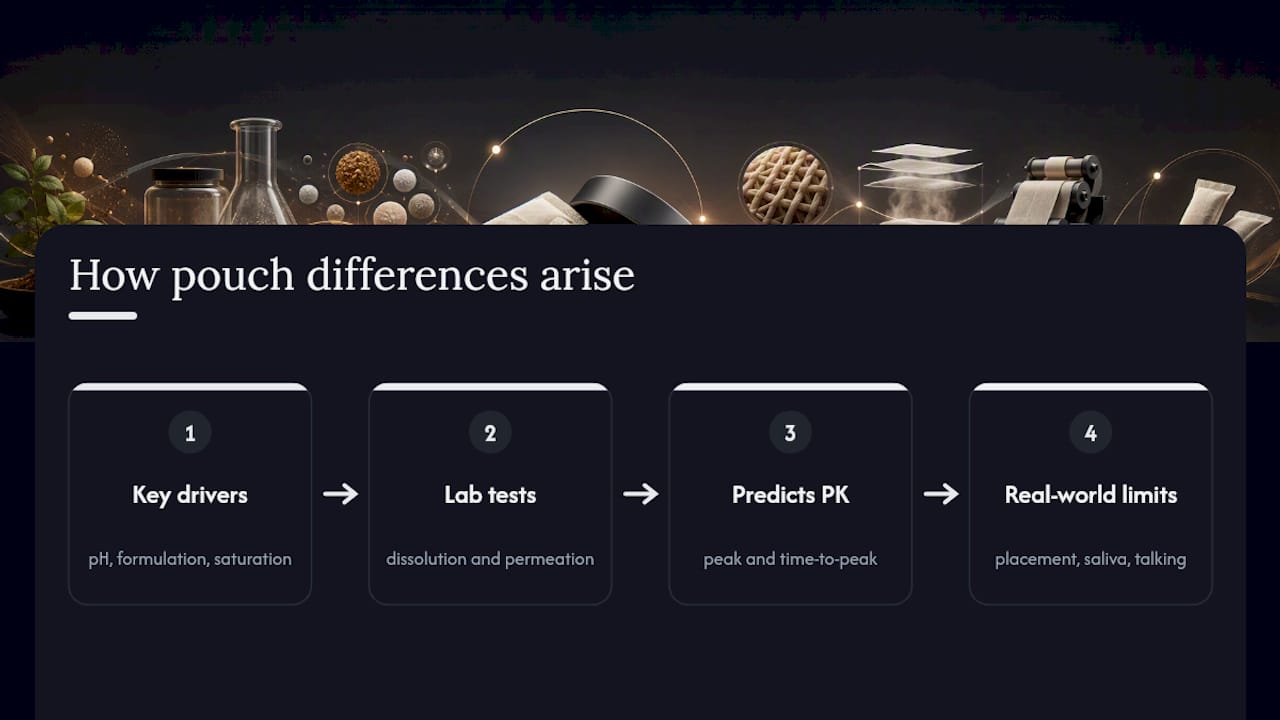
The mechanisms behind pouch longevity aren’t guesswork. Laboratory permeation testing, dissolution studies, and pharmacokinetic modelling all point to the same underlying variables: pH, formulation, and how quickly the pouch material fully saturates.
Testing across several commercial pouch products found that dissolution profiles and pH-driven permeability can reliably predict clinical pharmacokinetic outcomes such as peak concentration and time to peak, with faster early dissolution corresponding to higher early nicotine exposure in the body.
That finding, from predictive PK modelling comparing ZYN, DRYFT, and VELO products, matters because it connects what happens in a lab dish to what a user actually experiences. It’s also worth being honest about the limits: lab dissolution curves predict absorption windows well, but they can’t capture how an individual places a pouch, how much they talk or drink during a session, or how their own saliva chemistry behaves that day. Permeation research backs this up too, showing meaningful permeability differences between brands under identical test conditions, differences driven by formulation choices rather than nicotine strength alone.
Product guides are built around this kind of research, translating lab-level findings into practical advice on format and strength selection that account for real-world variability rather than lab-perfect conditions.
Browse Hitsnus for formats built around longer sessions
Once you know that format, pH, and pouch size drive how long a session actually lasts, choosing the right product becomes a lot less like guesswork. Hitsnus organises its full nicotine pouches collection by format, strength, and flavour, so you can filter towards dry, high-strength, or larger-format options if a longer session is what you’re after, rather than scrolling through everything at once.
If you’re ready to try one of the examples above, the Pablo Blue Raspberry and Clew Watermelon pages both list full strength and format details so you can compare them against your own preferences before ordering. Hitsnus stocks a wide spread of strengths and flavours across recognised brands, with product pages that include usage tips alongside the listings, useful whether you’re switching from smoking or simply looking for a format that suits longer stretches of the day. Browse the collection, check the strength that matches your tolerance, and place an order when you’ve found the format that fits.
Sources
This article draws on peer-reviewed permeation testing, dissolution studies, and pharmacokinetic modelling, alongside Hitsnus’s own internal guides. Key references include the nicotine permeation evaluation, the PK prediction model, and the on!® dissolution study. For broader context on nicotine product safety, ConnectedMedics’ knowledge hub offers additional public health perspective.
- Evaluation of Factors Impacting Nicotine Permeation in Oral Nicotine Pouch Products
- In vitro release profiles of on!® nicotine pouches — MDPI
FAQ
What nicotine pouch lasts the longest?
No single pouch universally lasts longest, since duration depends on format, pH, and size rather than brand alone. Dry, higher-strength, larger-format pouches such as SYX Forest Fruits or Nordic Spirit’s drier formulations tend to hold sensation longer than slim, moist options.
Is two ZYN pouches a day too much?
There’s no universal safe number, since tolerance and individual sensitivity vary widely between users. What matters more than a fixed count is spacing sessions sensibly and not routinely exceeding around 60 minutes per pouch. Hitsnus’s usage frequency guide covers how to pace use safely across a day.
Can dentists see if you use nicotine pouches?
Dentists can sometimes spot signs associated with prolonged pouch use, such as gum irritation or localised discolouration at the placement site, particularly with heavy or extended use. This is one reason session length matters, and Hitsnus’s guidance on prolonged pouch use explains the risks in more detail.
How many cigarettes is one nicotine pouch equivalent to?
There’s no exact one-to-one conversion, since cigarette nicotine delivery and pouch nicotine delivery follow completely different absorption routes and timelines. Rather than comparing to cigarette count, it’s more useful to compare pouch strength in milligrams and choose accordingly, starting lower if you’re new to pouches.