












Why non-tobacco carriers save you money in 2026
TL;DR:
- Non-tobacco carriers offer significantly lower life insurance premiums to nicotine pouch and dip users by recognizing smokeless nicotine separately from combustible tobacco. Understanding carrier-specific guidelines, timing cessation correctly, and working with knowledgeable independent brokers can substantially reduce costs. Many nicotine users unknowingly pay smoker rates because most insurers treat positive cotinine tests as smoking, emphasizing the importance of targeted underwriting strategies.
Non-tobacco carriers are life insurance underwriters that classify nicotine pouch users, dippers, and gum users separately from combustible tobacco smokers, often granting them significantly lower premiums. If you use products like ZYN, VELO, or FUMI and you have never explored specialist underwriting, you are almost certainly overpaying. The difference is not marginal. For a 50-year-old male, tobacco-rated premiums on a £1 million 20-year term policy can exceed non-tobacco rates by over $108,000 in total. That figure alone explains why non-tobacco carriers matter more than most nicotine users realise.
Why non-tobacco carriers treat nicotine users differently
The term “non-tobacco carrier” is an informal phrase used in consumer circles. The recognised industry term is preferred non-smoker underwriting class, and it refers to the rating tier an insurer assigns based on health markers, lifestyle, and nicotine status. Understanding this distinction is the first step to using the system in your favour.
Insurers do not simply ask whether you smoke. They test for cotinine, the primary metabolite your body produces when it processes nicotine. Nicotine pouches like ZYN and VELO trigger positive cotinine results just as cigarettes do, which means a standard carrier will automatically assign you a smoker rate regardless of whether you have ever touched a cigarette. This is the core problem that specialist underwriting solves.
Different carriers draw the line in very different places. Here is what typically separates a lenient carrier from a conservative one:
- Cessation window: Banner Life requires just 12 months of nicotine-free status to qualify for non-smoker rates; conservative carriers demand 36 to 60 months. Choosing the wrong carrier at the wrong time in your cessation journey costs thousands.
- Product type: Some carriers distinguish between inhaled tobacco and smokeless nicotine. Dip, pouches, and nicotine gum are treated differently from cigarettes at carriers like Prudential and Lincoln Financial.
- Synthetic nicotine: Synthetic nicotine is still detected in cotinine tests, so “tobacco-free” pouches do not automatically mean “nicotine-free” in underwriting terms.
- Occasional cigar use: Certain carriers permit up to 24 cigars per year and still award non-tobacco rates, a nuance most applicants and even many agents overlook entirely.
The phrase “tobacco-free” in underwriting almost always means nicotine-free, not simply combustible-tobacco-free. This is the single most common misconception among nicotine pouch users applying for life insurance.
Pro Tip: Before you apply anywhere, ask your broker specifically whether the carrier distinguishes between smokeless nicotine and combustible tobacco. If they cannot answer immediately, find a broker who can.
What are the premium savings for non-tobacco nicotine users?
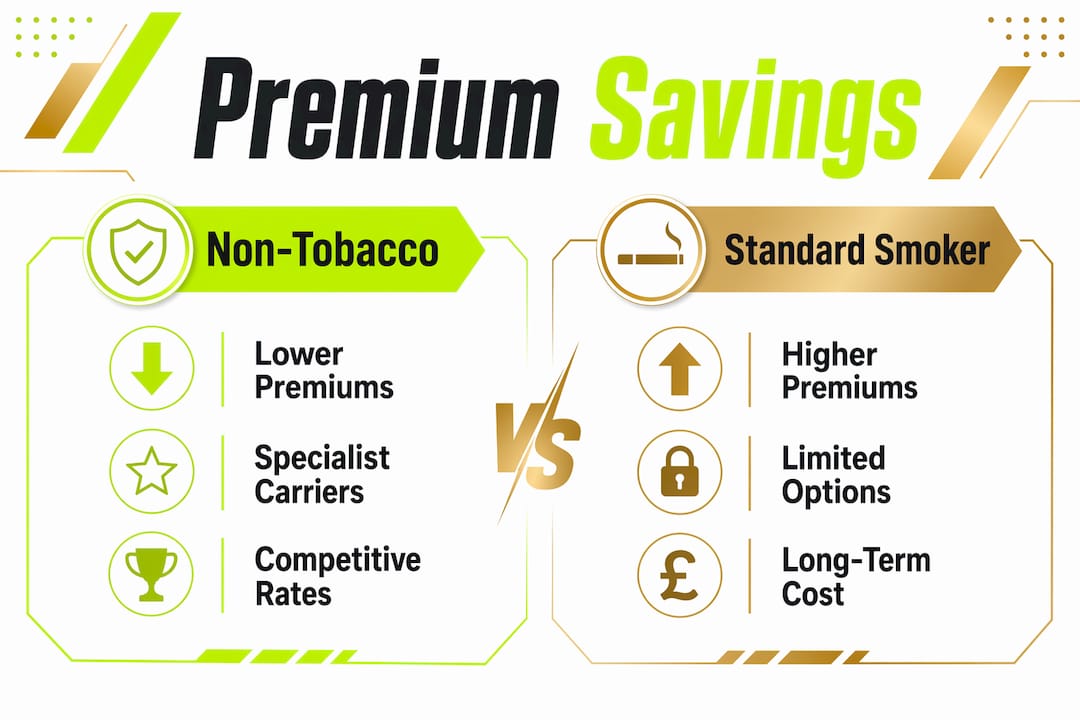
The financial case for understanding non-tobacco carriers is straightforward. Life insurance for tobacco users costs between two and seven times more than equivalent cover for non-tobacco users with identical health profiles. That multiplier applies even when the only difference is a nicotine pouch habit versus no nicotine at all.
The competitive market reinforces this advantage. Over 20 carriers actively compete for non-tobacco profiles, driving rates down through genuine market pressure. Nicotine users who qualify for non-tobacco classification at specialist carriers benefit from that same competition. Those who apply to the wrong carrier simply do not.
The table below illustrates how classification affects annual premiums for a healthy 40-year-old male on a £500,000 20-year term policy:
| Classification | Approximate annual premium | 20-year total cost |
|---|---|---|
| Preferred non-smoker | £480 | £9,600 |
| Standard non-smoker | £720 | £14,400 |
| Standard smoker | £1,850 | £37,000 |
| Tobacco user (rated) | £2,400+ | £48,000+ |
The gap between preferred non-smoker and standard smoker classification represents a saving of roughly £27,400 over the policy term. For a £1 million policy, that gap widens dramatically. Applying to the wrong carrier can result in premiums two to three times higher than necessary, purely because of misclassification rather than genuine health risk.
Users of smokeless nicotine alternatives who qualify for non-tobacco rates at specialist carriers access the full competitive market. Those who do not know to ask simply pay smoker rates indefinitely.

Why do some carriers offer better rates for smokeless nicotine users?
The answer lies in how insurers model risk. Combustible tobacco introduces carbon monoxide, tar, and thousands of combustion byproducts into the body. These compounds drive the elevated mortality risk that justifies higher premiums. Nicotine alone, while addictive, does not carry the same cardiovascular and oncological risk profile as inhaled smoke. Carriers that understand this distinction price accordingly.
Carriers like Prudential, Lincoln Financial, Cincinnati Life, and John Hancock have developed underwriting guidelines that recognise smokeless nicotine use differently from cigarette smoking. At these carriers, a dipper or pouch user who meets other health criteria can qualify for Standard Plus or even Preferred rates rather than automatic smoker classification. This is not a loophole. It is a deliberate risk management decision based on actuarial data.
The underwriting nuances that matter most include:
- Vaping versus dipping: Vaping introduces inhalation risk, so carriers treat it more like smoking. Dipping and pouches are generally viewed more favourably because there is no combustion and no lung exposure.
- Frequency and duration: Occasional use is rated differently from daily heavy use at carriers with nuanced guidelines.
- Overall health class: A pouch user with excellent blood pressure, cholesterol, and BMI will access better rates than one with compounding health risks, even at the same carrier.
- Broker knowledge: Independent brokers with specialist knowledge of carrier-specific policies for nicotine users consistently secure better outcomes than generalist agents who apply to the nearest household name insurer.
Pro Tip: Work with an independent broker who can access at least 10 to 15 carriers simultaneously. A captive agent tied to a single insurer cannot shop the market for you, and that limitation costs nicotine users the most.
The advantages of smokeless nicotine from an underwriting perspective are real, but they are only accessible when you apply to carriers that have built those distinctions into their guidelines. Most have not. The ones that have are worth finding.
What practical steps help you qualify for non-tobacco insurance rates?
Qualifying for non-tobacco rates as a nicotine pouch or dip user is achievable, but it requires a deliberate approach. Follow these steps to give yourself the best possible outcome.
-
Disclose fully and accurately. Never misrepresent your nicotine use on an application. Insurers verify through cotinine testing and medical records. Misrepresentation voids a policy and constitutes fraud. Honesty is both the ethical and the practical choice.
-
Time your application around cessation windows. If you are willing to pause nicotine use, Banner Life’s 12-month cessation window is the most accessible route to non-smoker rates. Plan your application date accordingly and confirm the specific window with your broker before stopping.
-
Identify specialist carriers before applying. Carriers like Cincinnati Life and Lincoln Financial treat smokeless nicotine users more favourably than most. Knowing this before you apply means you target the right underwriter from the start rather than accepting a smoker rate and appealing later.
-
Use an independent broker with nicotine-specific expertise. A generalist broker will submit your application to whoever they know best. An independent broker with market knowledge will match your specific nicotine profile to the carrier most likely to rate you favourably.
-
Reapply with a fresh carrier after meeting cessation requirements. Reapplying with a different carrier after fulfilling a cessation period typically yields better premiums than requesting reconsideration from your original insurer. Fresh underwriting at a lenient carrier exploits carrier-specific rules in your favour.
-
Prepare for cotinine testing. Testing is standard practice. Understand that nicotine patches, gums, and pouches all produce positive cotinine results. If you are still using any nicotine product, apply only to carriers that explicitly accommodate your product type.
The oral health implications of tobacco use also feed into underwriting assessments at some carriers, so maintaining good dental health records strengthens your overall application profile.
Key takeaways
Non-tobacco carriers save nicotine pouch and dip users thousands of pounds by matching them to underwriters who distinguish smokeless nicotine from combustible tobacco risk.
| Point | Details |
|---|---|
| Cotinine testing is universal | All nicotine products trigger positive results; carrier choice determines how that result is rated. |
| Premium gap is substantial | Tobacco-rated policies cost two to seven times more than non-tobacco equivalents on identical profiles. |
| Carrier selection is decisive | Prudential, Lincoln Financial, and Cincinnati Life offer favourable rates for smokeless nicotine users. |
| Cessation windows vary widely | Banner Life requires 12 months; conservative carriers require up to five years of nicotine-free status. |
| Independent brokers are essential | Specialist brokers who know carrier-specific rules consistently secure better outcomes for nicotine users. |
The underwriting gap most nicotine users never close
I have spoken with dozens of people who use nicotine pouches daily and have no idea they are paying smoker rates on their life insurance. They switched from cigarettes to ZYN or VELO specifically to improve their health, and they assumed their insurer would notice. Most insurers do not notice. They see a positive cotinine test and assign the highest risk class automatically.
The uncomfortable truth is that the life insurance industry has not kept pace with the shift towards smokeless nicotine. Most underwriting guidelines were written when “nicotine user” meant “cigarette smoker,” and many carriers have never updated them. The carriers that have updated their guidelines, Prudential, Lincoln Financial, Cincinnati Life, John Hancock, represent a minority of the market. But they are the minority that matters for anyone using pouches or dip.
What I find most frustrating is that this information is not hidden. It is simply not communicated. A good independent broker knows exactly which carriers will treat a ZYN user fairly. The problem is that most people never ask, and most generalist agents never think to raise it. The result is that nicotine pouch users routinely overpay by thousands of pounds per year for cover they could access at a fraction of the cost.
My advice is direct: if you use any nicotine product and you have not specifically asked your broker about carrier-specific smokeless nicotine underwriting, ask today. The savings are real, the process is straightforward, and the only thing standing between you and a better rate is knowing the right question to ask.
— Fabio
Explore tobacco-free nicotine options with Hitsnus
If you are moving away from traditional tobacco and exploring smokeless alternatives, Hitsnus stocks a wide range of tobacco-free nicotine pouches from brands including ZYN, VELO, and FUMI. Every product is tobacco-leaf free, discreet, and available with fast UK delivery. Whether you are in the early stages of switching or already committed to a smokeless lifestyle, browse the full range at Hitsnus to find the right strength and flavour for your needs. Making the switch is the first practical step towards the health profile that specialist carriers reward.
FAQ
What does “non-tobacco carrier” mean in life insurance?
A non-tobacco carrier is an insurer that offers a separate, lower rate class for individuals who do not use combustible tobacco. Some carriers extend this classification to smokeless nicotine users like pouch or dip users who meet specific criteria.
Do nicotine pouches like ZYN count as tobacco for insurance purposes?
At most standard carriers, yes. ZYN and similar pouches trigger positive cotinine tests, which typically result in smoker classification. Specialist carriers like Prudential and Lincoln Financial assess smokeless nicotine differently and may offer non-smoker rates.
How long do I need to be nicotine-free to qualify for non-tobacco rates?
Cessation windows vary by carrier. Banner Life requires 12 months of nicotine-free status, while more conservative carriers require between three and five years. Confirming the specific window with your broker before applying is essential.
Can an independent broker really make a difference to my premium?
Yes, significantly. Independent brokers who specialise in nicotine-user underwriting can direct your application to carriers with favourable guidelines for smokeless products, potentially halving your annual premium compared to a standard carrier submission.
Does reapplying to a new carrier after quitting nicotine improve my rates?
Reapplying with a fresh carrier after meeting cessation requirements typically yields better premiums than requesting reconsideration from your original insurer, because new underwriting applies carrier-specific lenience rules from the start.